
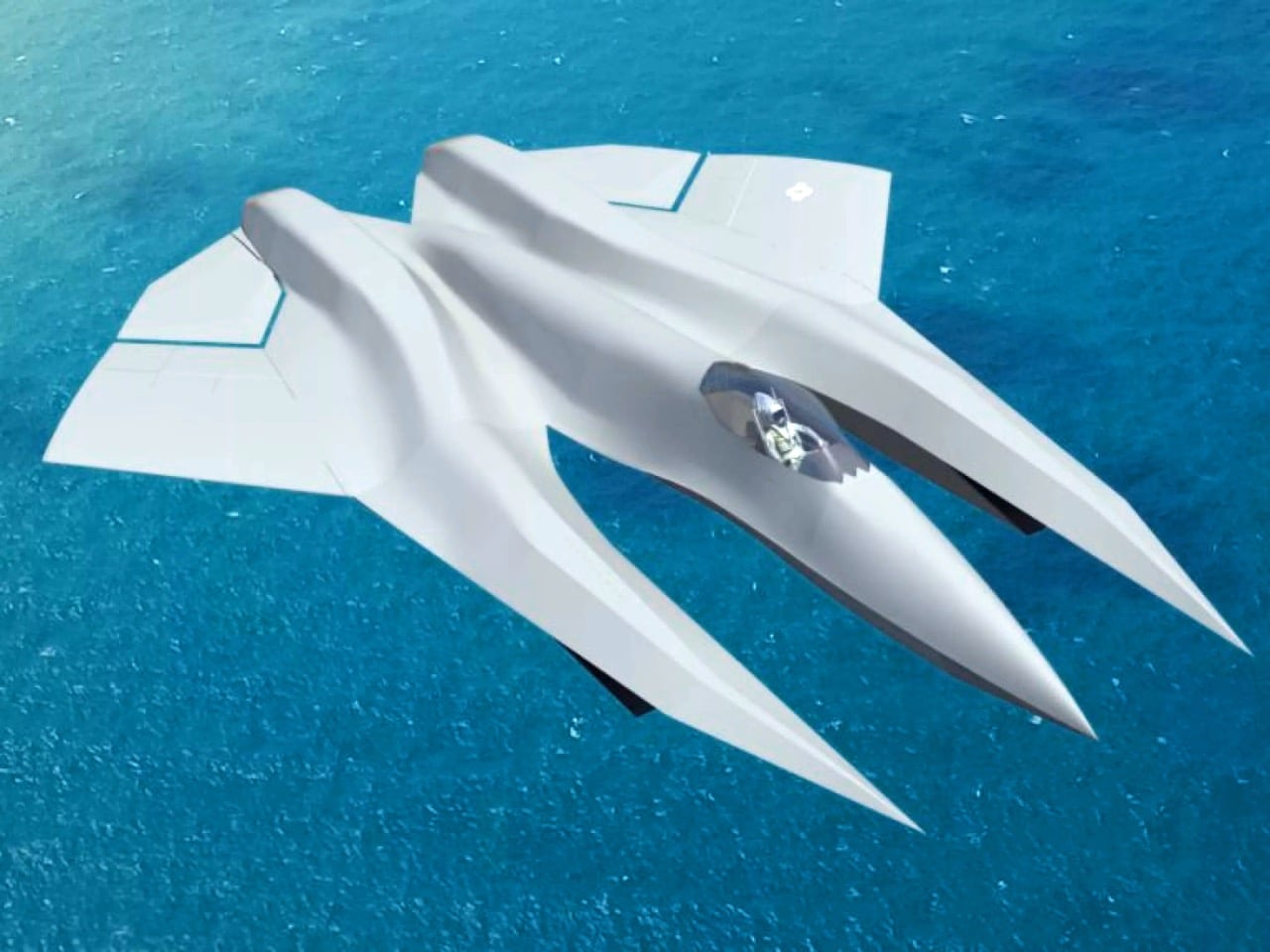
David versus Goliath stories captivate us, especially when David brings a slingshot that looks like alien technology. Enter Stavatti Aerospace, a 25-person firm from Niagara Falls taking on Boeing and Northrop Grumman for one of the most lucrative defense contracts in naval aviation. Their weapon of choice? The SM-39 Razor, a fighter design so visually striking it demands a double-take. The triple-fuselage “Batwing” configuration breaks from a century of conventional aircraft architecture, presenting a form that’s more science fiction than traditional aerospace engineering.
The radical design supposedly delivers Mach 4 speed, Mach 2.5 supercruise, and performance metrics that eclipse what defense industry titans are proposing. Stavatti built these ambitions on titanium foam construction and aerodynamic principles that challenge orthodox thinking about fighter design. The catch? Stavatti has never manufactured an actual aircraft. Since opening in 1994, the company has produced concepts, proposals, and computer-generated imagery. Nothing has left the ground. The SM-39 represents either visionary thinking waiting for its moment or the latest chapter in a long catalog of paper airplanes.
Designer: Stavatti Aerospace
Three distinct fuselages merge into a blended wing body that genuinely resembles the vehicle Bruce Wayne keeps in his cave. The central section houses the cockpit while two outer nacelles sweep back at aggressive angles, each tapering to needle-sharp points. From above, the silhouette reads as pure menace. From the side, you see how the bodies integrate into the wing structure rather than sitting on top of it like conventional designs. Variable-camber technology supposedly lets the wing morph its shape for different flight regimes. Stavatti claims this delivers efficiency from carrier deck launches all the way through to near-hypersonic speeds.
Speaking of speeds, let’s talk about that Mach 4 claim. Current fifth-generation fighters top out around Mach 1.8 to 2.0. The SR-71 Blackbird, built with exotic materials and specialized engines for one specific purpose, hit Mach 3.3. Stavatti wants us to believe their turbofan-powered fighter will casually exceed that by nearly a full Mach number while also handling carrier operations, dogfighting, ground attack, and electronic warfare missions. The physics gets dicey here. At Mach 4, ram air temperature at the intake approaches 400 degrees Celsius. The skin heats up enough to glow on infrared sensors from a hundred miles away. Stealth becomes a joke when you’re essentially a flying torch broadcasting your position to every heat-seeking sensor in the battlespace.
Those elongated outer nacelles look sleek in CGI but imagine the torsional loads during a 9G turn. You’re talking about tremendous stress on the attachment points where they meet the central wing structure. Conventional aircraft concentrate mass along a single fuselage spine for good reason. Spreading things out multiplies the engineering challenges exponentially. Stavatti’s answer involves titanium foam, a material with impressive strength-to-weight ratios in theory. In practice, nobody has built a supersonic fighter from it because manufacturing consistent, reliable structural components at scale remains a massive hurdle.
The elephant in the room is just the money. Stavatti pulls in about $3 million annually, reportedly from venture capital, government incentives, and IP sales. That budget wouldn’t cover the coffee bill at Boeing’s fighter division. The company has zero prototypes, zero test flights, zero production experience. The Navy hasn’t even confirmed receiving their F/A-XX submission. Meanwhile, Boeing and Northrop Grumman have actual sixth-generation fighter programs with actual hardware being tested at actual classified facilities.
That being said, the SM-39 Razor does look absolutely fantastic. That counts for something in an industry where form follows function to an extreme degree. Wild unconventional designs sometimes break through. The Northrop flying wing became the B-2 Spirit. Skunk Works turned crazy ideas into the U-2 and SR-71. But those programs had serious funding, experienced teams, and institutional backing. Stavatti has renderings and ambition. Beautiful concepts deserve appreciation as thought experiments. Treating them as legitimate competitors requires suspending disbelief past the breaking point.
The post The Navy’s Batwing Fighter Jet Promises Mach 4 Speed… But It’s Still Just A Concept first appeared on Yanko Design.