
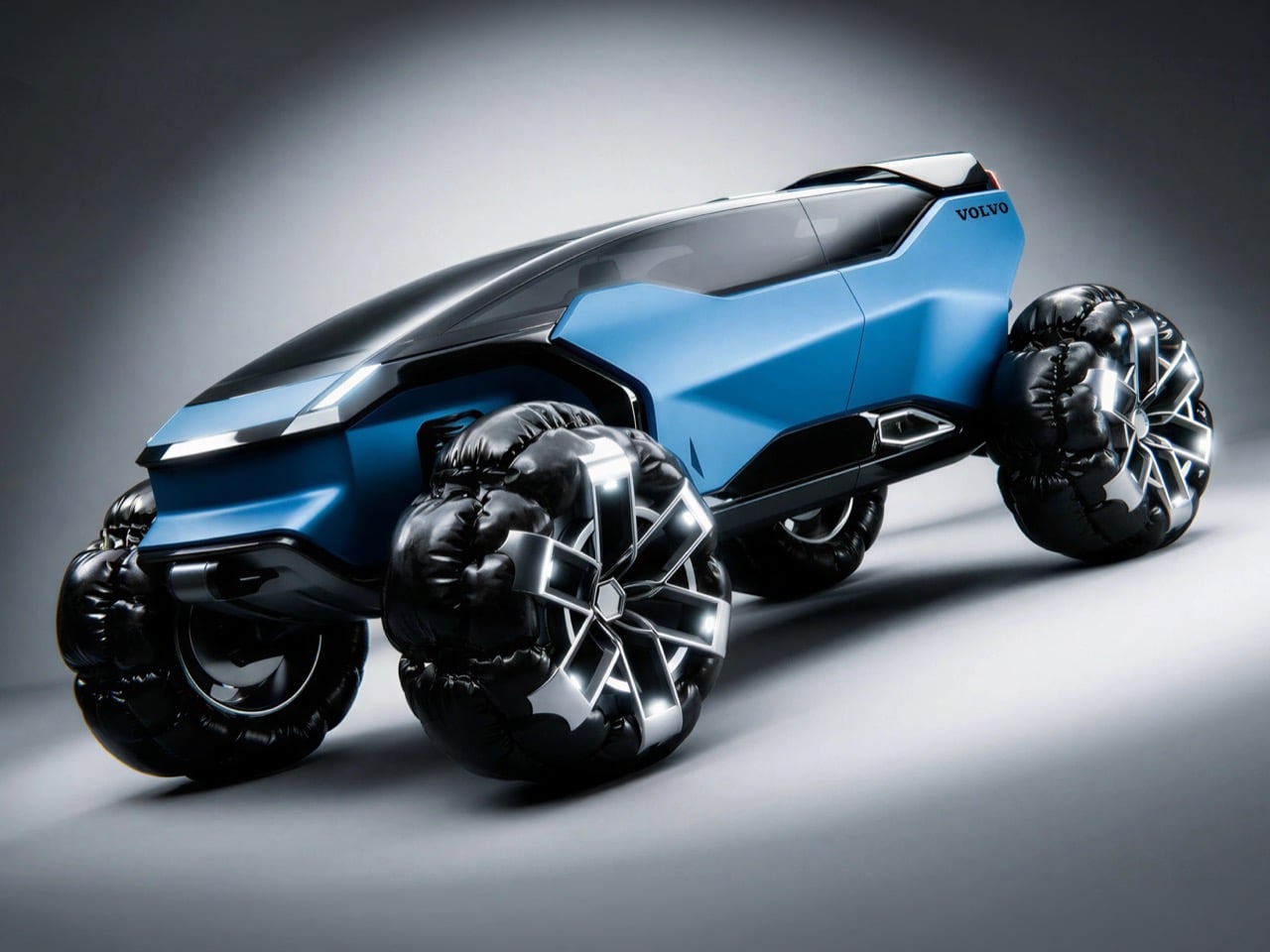
Volvo has spent the better part of a century building its reputation on one foundational promise: keep the people inside the car alive, no matter what the road throws at them. That philosophy produced crumple zones, three-point seatbelts, and side-impact protection systems that the rest of the industry eventually copied wholesale. The logical endpoint of that thinking, taken to its most extreme conclusion, produces a vehicle engineered for terrain that would destroy any conventional automobile outright. Designer Sampad Chaulia arrived at exactly that conclusion with the Volvo Cosmic Surfer, a concept submitted for the Volvo Design Competition 2026 that imagines the Swedish brand’s DNA transplanted onto a lunar-grade off-road platform co-badged with The North Face.
The Cosmic Surfer’s central design provocation is its wheel system, a gravity-adaptive, inflatable assembly that swells and compresses in response to surface conditions, conforming around boulders and craters the way a hand closes around a stone. The body sits low and wide over those massive multi-lobe wheels, draped in Volvo’s signature steel blue with The North Face branding stenciled across the flanks in expedition-ready block lettering. Chaulia frames the vehicle’s intended era as 2040, an interplanetary expedition machine for galactic explorers, built from Scandinavian minimalist principles and wrapped in the visual language of gorpcore punk. The result lands somewhere between a NASA lunar rover and a concept car that wandered off the Geneva Motor Show floor and kept going until it hit the Moon.
Designer: Sampad Chaulia
The wheel remains perhaps the most interesting element on the vehicle, evoking the same jaw-drop that I had when I first saw NASA’s chainmail wheel back in 2017. Chaulia modeled and rendered it entirely in Blender 3D, and the result looks less like a tire and more like a living organism that happens to roll. Each assembly pairs a geometric star-shaped alloy core, all sharp angles and polished facets, with a ring of inflatable outer lobes that bulge around the rim like an over-pressured deep-sea creature. The engineering logic is genuinely elegant: rather than relying solely on suspension travel to absorb terrain irregularities, the inflatable lobes compress and deform on contact with rocks and surface obstacles, conforming to the ground rather than demanding the ground conform to them. At low gravity, where surface textures are extreme and suspension dynamics behave very differently than on Earth, that compliance-first approach to traction makes far more sense than anything pneumatic rubber could offer.
The body language above those wheels is angular and deliberate, a form study in what Chaulia calls “Scandinavian soul” filtered through techwear aesthetics. The flanks are wide and planted, with faceted surfacing that catches studio light in sharp, graphic planes rather than soft automotive highlights. A dark greenhouse tapers rearward and sits flush with the bodywork, keeping the silhouette monolithic and uninterrupted from nose to tail. At the rear, a broad red light bar stretches the full width of the vehicle, reading less like a regulatory tail lamp and more like a distress beacon, which, given the concept’s intended operating environment, seems entirely appropriate. The Volvo wordmark sits cleanly on the upper body, and The North Face logo claims the flanks, a co-branding pairing that frames the vehicle as high-performance technical apparel on wheels.
The gorpcore punk framing Chaulia wraps around the Cosmic Surfer is more than an aesthetic mood board. It locates the vehicle within a specific cultural conversation about what extreme outdoor equipment looks like when the outdoors in question has no atmosphere, no roads, and gravity running at roughly one sixth of what your suspension was tuned for. The North Face partnership makes genuine design sense here because both brands share the same foundational brief: build something that keeps the person inside it functioning when the environment outside it is actively trying to kill them. That shared DNA produces a concept where the co-branding reads as a logical merger of two survival philosophies rather than a marketing exercise.
Volvo’s production lineup in 2026 is focused squarely on Scandinavian refinement and urban electric mobility, the EX30, EX40, and EX90 forming a coherent family of composed, safety-first EVs for city intersections and motorway cruising. The Cosmic Surfer asks what happens when that same foundational commitment to occupant protection gets aimed not at pedestrian detection systems and crumple zones but at the lunar highlands, where the obstacles are the size of houses and the nearest service center is 238,000 miles away. Chaulia produced this entire concept in a single day, which makes its conceptual coherence remarkable. The central idea, a vehicle whose wheel technology borrows the compliance logic of outdoor gear rather than automotive convention, arrived fully formed and persuasive on the first pass, which is more than most studio teams manage in a month.
The post The Volvo Cosmic Surfer Has Gravity-Adaptive Wheels Designed For Smooth Driving On The Moon first appeared on Yanko Design.