
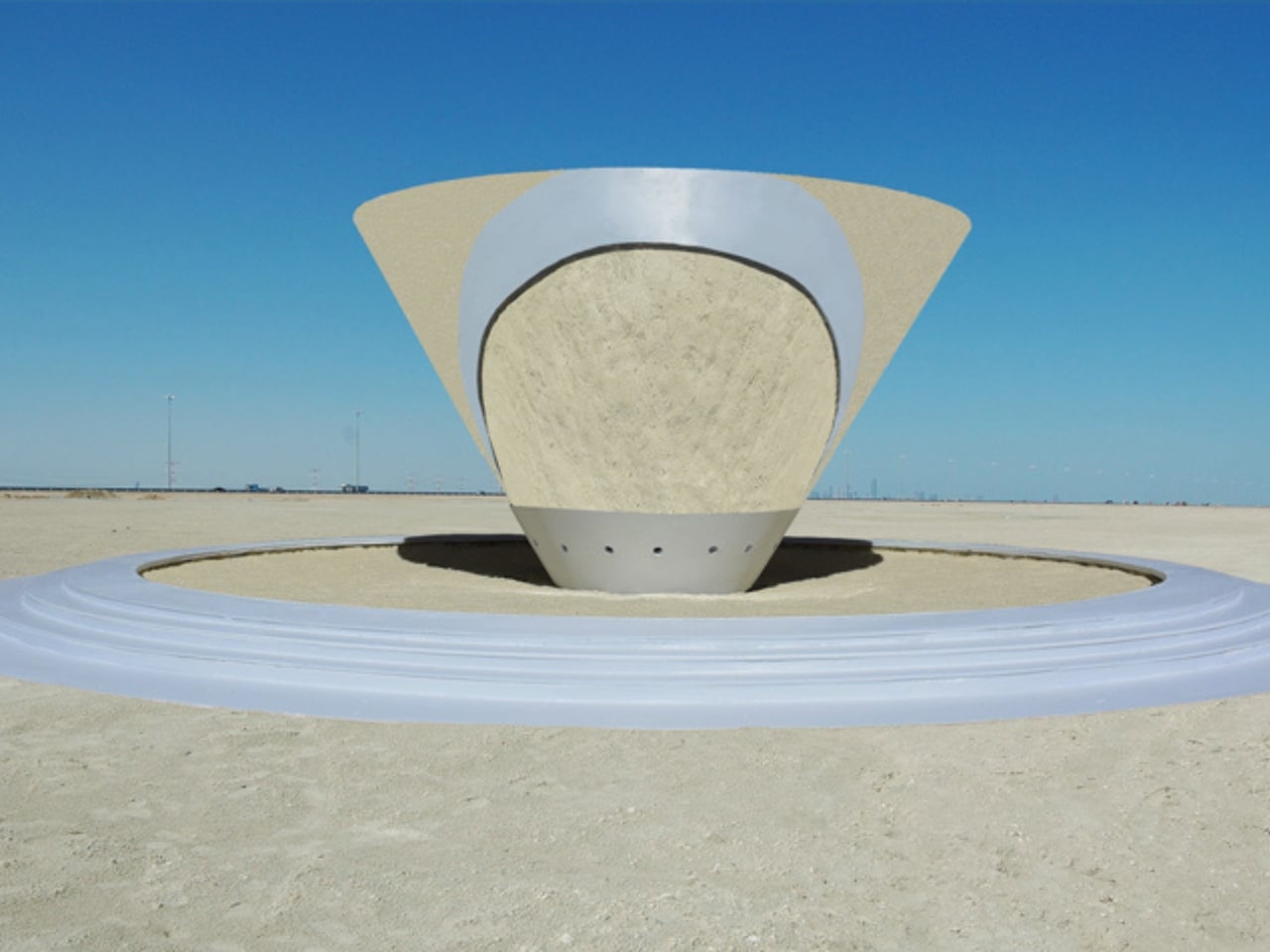
Picture a tall mirrored cone rising from a circle of sand in the middle of the desert. You step in, drag your feet, draw patterns, and the cone reflects all of it back to you, warped and strange and weirdly beautiful. That’s the Interactive Sand Reflecting Cone, a concept by designer Michael Jantzen, and it sits at the intersection of public art, land art, and the simple joy of messing around in sand. No screens, no apps. Just you and your reflection. I think it’s kind of brilliant.
The setup is deceptively simple. A circular concrete ring, complete with a landing pad and three descending steps, defines the play area. Inside that ring is a field of refined sand. Rising from the center is a tall cone wrapped entirely in polished mirrored steel. Solar panels sit on top, charging batteries during the day so the whole thing lights up at night. No Wi-Fi. No app. No QR code. Just you, the sand, and your own warped reflection staring back at you from a cone.
Designer: Michael Jantzen
What I find most compelling about this project is that it treats sand as an interactive medium. Not a screen, not a touchpad, not something that requires a software update. Sand. The stuff kids play with at the beach. You walk through it, drag your feet, draw patterns, build little mounds, and all of that activity gets captured in the mirrored surface. The cone becomes what Jantzen calls a short-term event recorder, documenting the collective traces of everyone who steps into the ring. It’s analog memory, and it only lasts until the next visitor reshapes the surface or the wind smooths it over.
The mirrored cone itself adds a layer that I think elevates the whole thing beyond a glorified sandbox. Because the surface is curved, not flat, the reflections come back distorted. Your footprint patterns stretch and warp in ways you can’t quite predict. You’re collaborating with geometry. You make a mark in the sand, look up, and the cone shows you something slightly different from what you expected. That unpredictability is what turns a passive viewing experience into an active, playful one. You start experimenting. You try new shapes just to see what they’ll look like reflected. You become both the artist and the audience.
I also appreciate that this is designed specifically for desert landscapes, not dropped into them as an afterthought. The sand inside the ring is refined, but the material itself belongs to the environment. The installation doesn’t fight its surroundings. It borrows from them. The concrete base anchors the piece physically, but the sand connects it to everything beyond the circle’s edge. It feels like a conversation between the built and the natural, which is something Jantzen has been exploring for years across his various pavilion and shelter concepts.
The solar-powered lighting is a nice touch, too. During the day, the polished steel catches sunlight and throws it around in dramatic ways. At night, the embedded lights in the concrete base take over, illuminating the sand and the cone from below. The piece transforms depending on when you visit. A daytime experience full of glare and sharp reflections becomes something softer and more atmospheric after dark. That duality gives the installation a longer life cycle than most public art pieces, which tend to lose their impact once the sun goes down.
If I have one reservation, it’s the same one I always have with Jantzen’s concepts: they’re concepts. The Interactive Sand Reflecting Cone exists as renders and descriptions, not yet as a physical structure you can actually walk into. Jantzen is prolific with ideas, and many of them are genuinely inventive, but the gap between a compelling render and a realized installation is vast. Engineering challenges, material costs, site logistics, and the simple question of who funds this kind of thing all stand between the concept and the experience. I’d love to see this one make the leap.
The post This 12-Foot Mirrored Cone Turns Desert Sand Into Living Art first appeared on Yanko Design.