
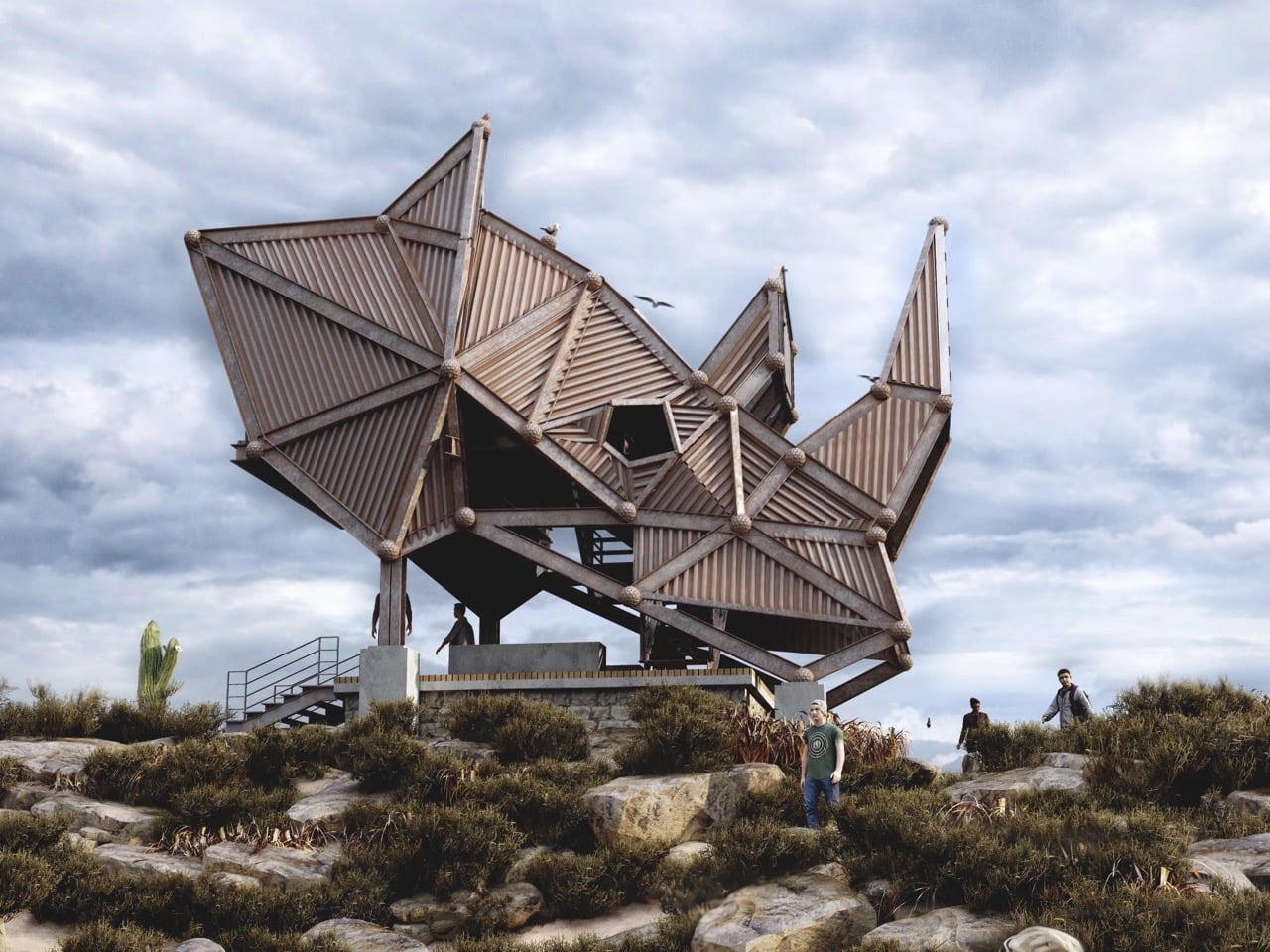
Sri Lankan designer Thilina Liyanage has built a recognizable portfolio around one core idea: that architecture in wild spaces should speak the language of those spaces. His previous concepts have drawn from bird forms, insect geometries, and the angular logic of animal skeletons, earning him a following among readers who track biomimetic architecture with the same enthusiasm others reserve for gadgets. His latest, the Rhino Safari Deck, takes that approach to one of its most literal and structurally ambitious expressions yet. Rendered under overcast skies above a scrubby, semi-arid landscape scattered with cacti and boulders, the structure earns its name in full. From a distance, you are looking at a rhino. The silhouette is unmistakable: a squat, armored mass with a pronounced horn erupting from the roofline, flanked by secondary angular spires that read as ears, the whole thing hunched forward on its platform like the animal mid-charge.
Liyanage named the project “Kifaru Point,” using the Swahili word for rhino, which sets the geographic and tonal intention clearly. The structure is conceived as a wildlife observation deck, elevated above the terrain on a concrete plinth with a timber-decked lower platform that wraps around the base. A set of steel-railed stairs leads visitors up from the rocky ground level, and the shaded gathering area beneath the main structure provides a transition space before the ascent continues to the upper observation level. The interior views glimpsed in the renders show open, framed apertures that funnel sightlines out across the flat scrubland below, the kind of panoramic sweep that makes the elevated position feel earned rather than arbitrary. As a piece of safari infrastructure, Kifaru Point is doing something most viewing platforms do not bother attempting: it turns the act of looking at animals into an architectural experience that is itself worth looking at.
Designer: Thilina Liyanage
The entire form is built from triangulated steel frames, with each panel clad in ribbed, corrugated steel slats that create a warm, striated texture across the facets. Spherical steel nodes connect the struts at every junction, giving the whole skeleton a Meccano-meets-brutalism quality that suits the rugged setting perfectly. There is no smooth surface anywhere on this building. Every plane is either angled, folded, or interrupted, and the aggregate effect genuinely reads as armored hide from the outside while remaining open and structurally legible from within. The corrugated steel and timber combination ages well in outdoor conditions, which matters for a structure intended to sit in a landscape indefinitely rather than perform at an exhibition and disappear.
What Liyanage is clearly working through in this series is the question of how a building earns its place in a landscape. The typical eco-lodge answer involves receding into the environment through natural materials and muted palettes, becoming invisible by design. Kifaru Point goes the opposite direction: it announces itself as a landmark, a destination, something you orient toward from across the plain. The rhino reference gives it a totemic presence that goes beyond novelty. Rhinos are ancient, armored, and critically endangered, and a safari deck that reads visually as one of those animals is making an argument about the relationship between the people who come to observe wildlife and the wildlife itself. Biomimetic architecture has a long tradition of borrowing animal logic for structural efficiency, but borrowing it for symbolic weight, for the purpose of rhino conservation awareness built into a building’s silhouette, is a less common move and a more interesting one.
The rendered setting positions Kifaru Point among desert shrubs and saguaro-like cacti, suggesting a location somewhere in southern or eastern Africa, though the landscape has a looseness that keeps the concept legible across multiple possible sites. The palette of weathered steel and warm timber sits comfortably against the muted greens and grays of the terrain, and the overcast sky in most of Thilina Liyanage’s renders gives the structure a moody weight that a blue-sky backdrop would have undercut entirely. He knows how to light his visualizations for atmosphere, and that skill is doing real work here, making a conceptual project feel like a building that already exists and is already waiting for visitors to climb its stairs and look out across the plain at whatever is moving in the distance.
The post This Bio-mimicking Safari Deck Is Designed to Look Exactly Like a Rhino first appeared on Yanko Design.