
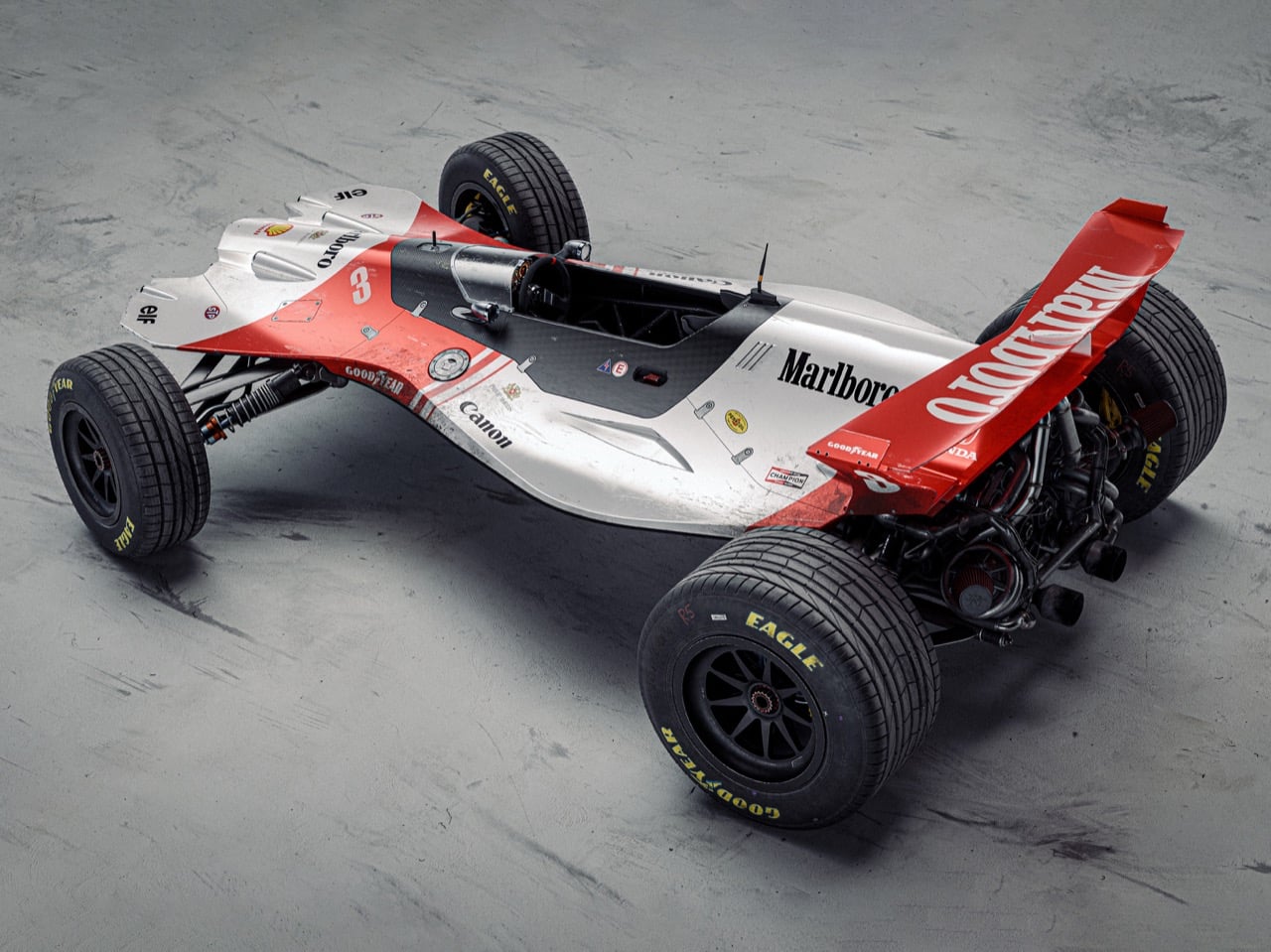
What happens when you yank one of the most dominant Formula 1 cars in history off the smooth tarmac of Suzuka and hand it the suspension travel of a Baja 1000 trophy truck? Pascal Eggert decided to find out, and the result is equal parts sacrilege and beautiful.
Eggert, a Presentation Director at EA DICE in Stockholm (the studio behind the Battlefield franchise) and former Art Director at Crytek, clearly spends his off-hours channeling a very specific brand of automotive madness. His latest personal project, titled “Offroad Racer,” takes the unmistakable silhouette of a late-1980s Formula 1 car and reimagines it as a lifted, wide-track off-road machine that looks like it escaped from a fever dream involving Ayrton Senna, the Dakar Rally, and a really ambitious RC car collection.
Designer: Pascal Eggert
The primary variant wears the iconic Marlboro McLaren livery in all its red-and-white glory, complete with the number 3 on the nose cone, Honda badging on the rear wing endplates, Shell logos, Canon branding, and Goodyear Eagle tires. For anyone with even a passing knowledge of F1 history, that combination screams McLaren MP4/4, the 1988 car that won 15 out of 16 races with Senna and Alain Prost behind the wheel. It remains one of the most successful single-seater race cars ever built, designed by the legendary Gordon Murray and Steve Nichols, powered by a Honda RA168E turbocharged V6. Eggert has taken that iconic bodywork and done something beautifully absurd with it.
The track width has been stretched dramatically. Long-travel double wishbone suspension arms sit fully exposed at both the front and rear, made from what appears to be tubular steel framework that would look right at home on a desert pre-runner. The ride height is jacked up considerably, giving the car enough ground clearance to tackle terrain that would shred a real F1 car’s floor in milliseconds. Up front, a pair of compact headlights sit recessed into the nose, giving the machine a menacing, almost insectoid face when viewed head-on. And at the back? The entire rear end is stripped bare, exposing a complex engine with a tangled web of exhaust headers, intake trumpets, and mechanical components that give the concept an incredibly raw, mechanical honesty. There is no rear bodywork hiding the powertrain. Everything is on display, and it looks glorious.
The rear wing, meanwhile, stays faithful to its F1 roots, mounted high on twin supports with the Marlboro branding proudly running across its main plane. It is a beautiful contradiction: a component designed purely for high-speed downforce on a vehicle that looks like it wants to jump dunes and spit rooster tails of dirt. A pretty audacious render below shows the car in full flight on a circuit, a helmeted driver hunched low in the open cockpit, flames erupting from the exposed exhaust. It captures the raw energy of the concept perfectly.
Eggert also presents a second colorway that swaps the Marlboro livery for a darker, moodier Martini Racing-inspired scheme. The base shifts to black with the signature blue, red, and light blue stripe work running across the bodywork and rear wing. This version, photographed in dramatic low-key studio lighting, feels like the nighttime counterpart to the Marlboro variant’s daytime bravado. Red LED taillights glow through the exposed rear mechanicals, and the overall effect is significantly more sinister. If the Marlboro version is the weekend warrior, the Martini edition is the car that shows up uninvited to a hillclimb at midnight.
What makes this project so compelling is the tension between two completely opposing design philosophies. Formula 1 cars are perhaps the most track-specific machines ever created, engineered down to the millimeter to extract performance from perfectly manicured asphalt. Off-road racers, by contrast, are built to survive chaos, to absorb impacts, to maintain composure when the surface beneath them is actively trying to destroy them. Eggert has found a surprisingly coherent visual language between these two worlds, borrowing the aggressive aero surfaces and low-slung cockpit from F1 while grafting on the muscular stance, generous wheel travel, and exposed mechanicals of desert racing.
It helps that Eggert brings serious professional chops to the table. His career spans time at Crytek, where he rose to Director of Visual Design and served as Art Director on titles like The Climb, before moving to DICE where he has worked on Battlefield V and Battlefield 2042. The man understands how to make vehicles look both believable and aspirational, and that game-industry sensibility shows in every render. The weathering on the bodywork, the subtle dirt accumulation, the realistic tire textures: everything is dialed in to sell the illusion that these machines actually exist somewhere, parked in a dusty garage, waiting for their next outing.
The post This Bonkers F1 Off-Road Racer Concept Puts Senna’s McLaren MP4/4 on Monster Truck Stilts first appeared on Yanko Design.