
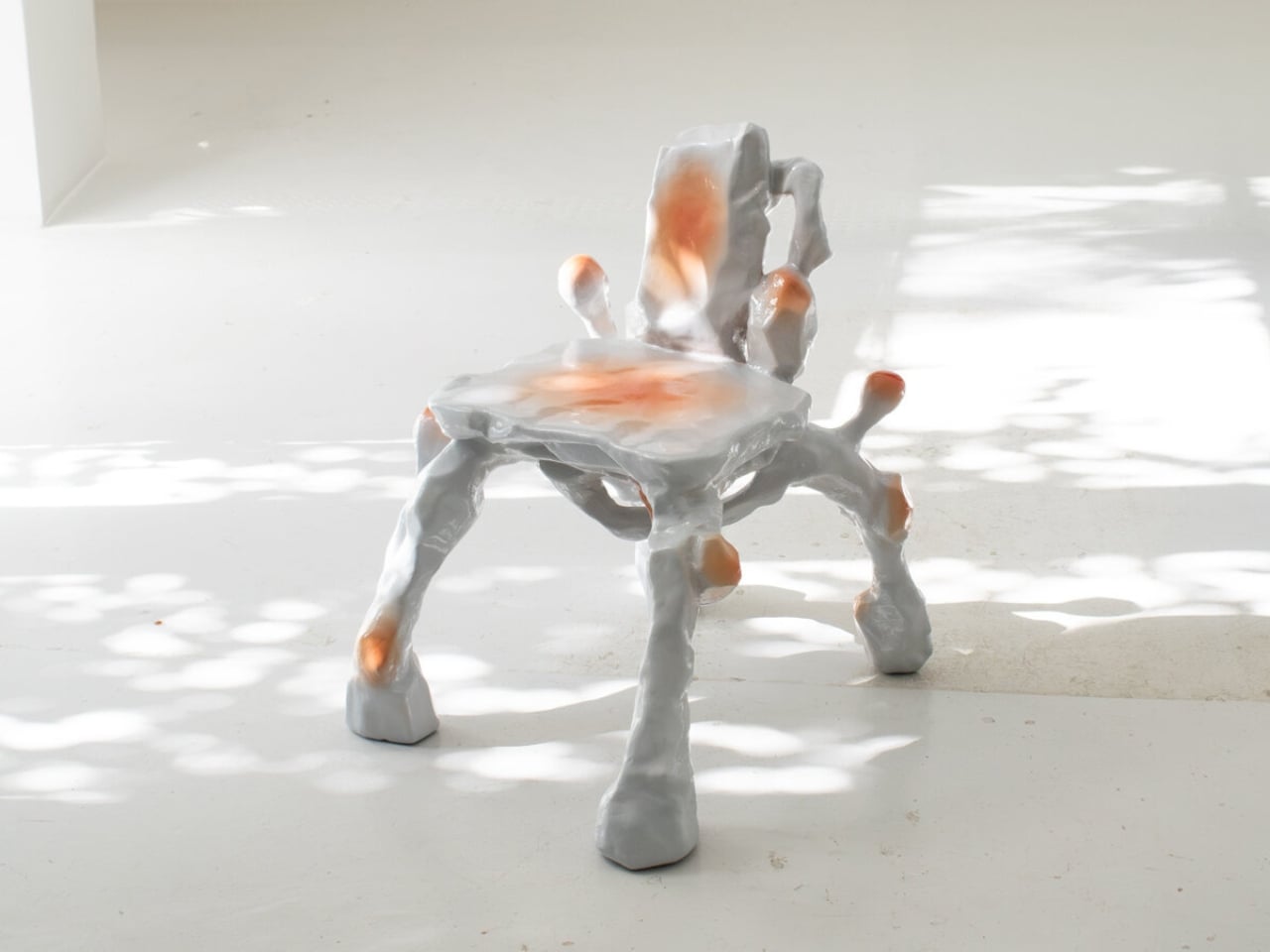
There’s something unsettling and deeply fascinating about furniture that looks back at you. Not literally, of course, but in that way certain objects seem to have presence, personality, almost a pulse. That’s exactly the vibe French designer Vincent Decat is going for with his Living Series, a collection of sculptural furniture pieces that feel less like static household items and more like strange, beautiful companions sharing your space.
Decat, who studied at the prestigious Design Academy of Eindhoven, has built his practice around a provocative idea: what if our furniture behaved like living beings? What if instead of just using objects, we formed relationships with them, caring for them the way we might care for a pet or a plant? It’s a concept that might sound precious or overly conceptual, but when you see the pieces themselves, something clicks. These aren’t just conversation starters. They’re genuinely compelling objects that make you reconsider what furniture can be.
Designer: Vincent Decat
The Living Series includes three main pieces, each exploring different aspects of biological growth and organic development. First up is “One Thing Led To Another,” a sculptural chair that looks like a landscape caught mid-transformation. With its irregular contours and vivid orange elements sprawling across the surface, it suggests something being colonized or regenerated, like coral spreading across rock or moss creeping over stone. The piece combines wood, steel, resin, acrylic paint, and varnish, standing 80 centimeters tall and measuring 70 by 60 centimeters. It’s handcrafted in a way that emphasizes the materiality and the sense that this object has evolved rather than simply been constructed.
Then there’s “Came Uninvited,” a side table that feels like it wandered into your living room from some other dimension. This piece evokes what Decat describes as a “transformed organism,” something that references human impact on natural systems. There’s an element of the uncanny here, the way the forms seem both familiar and alien, organic yet artificial. It’s 60 centimeters tall with a 46 by 50 centimeter footprint, crafted from PLA (a biodegradable plastic often used in 3D printing), resin, acrylic paint, and varnish. The colors and textures suggest something living that has adapted, mutated, or been fundamentally altered by its environment.
The third piece, “Stage One,” takes the biological metaphor to its logical beginning: embryonic development. This tray adopts compact, evolving geometry that suggests growth over time. Fabricated through 3D printing and available in two hand-finished variations (one with acrylic paint, another with aluminum leaf), Stage One feels like witnessing the earliest phases of life. It’s the smallest and most contained piece in the series, but it carries perhaps the most conceptual weight, asking us to see even the humblest domestic objects as things in process, things with potential.
What makes Decat’s work particularly relevant right now is how it taps into our growing awareness of materiality, sustainability, and our relationship with the objects we surround ourselves with. In an era of disposable IKEA furniture and Amazon basics, the idea that furniture could be something you bond with, something that deserves care and attention over time, feels almost radical. The designer positions his work against the throwaway culture of contemporary consumption, suggesting that durability isn’t just about how well something is built, but about whether it can sustain an emotional connection over years.
The Living Series also reflects broader trends in contemporary design, where the boundaries between art, craft, and function are increasingly blurred. These pieces work as furniture (you can actually sit on that chair, use that table, place things on that tray), but they also function as sculptural objects that transform a space. They’re conversation pieces that happen to be useful, or useful pieces that happen to start conversations.
Decat’s approach involves extensive material experimentation and surface treatment. Each piece is carefully finished by hand, which means every one is unique, with its own particular character and quirks. The combination of traditional techniques like woodworking with cutting-edge technology like 3D printing creates objects that feel simultaneously ancient and futuristic.
Ultimately, the Living Series asks us to slow down and reconsider our relationship with the everyday objects we live with. In Decat’s vision, furniture isn’t just something you buy, use, and eventually replace. It’s something you live alongside, something that changes as you change, something that becomes part of your story. Whether that sounds appealing or pretentious probably depends on your tolerance for design philosophy, but there’s no denying the pieces themselves have a compelling, almost magnetic quality that makes you want to reach out and touch them, to understand what they’re made of and how they came to be. And maybe that’s the point: furniture that makes you curious, that invites interaction and care, that refuses to disappear into the background of daily life.
The post This Furniture Looks Like It’s Growing and Evolving first appeared on Yanko Design.