
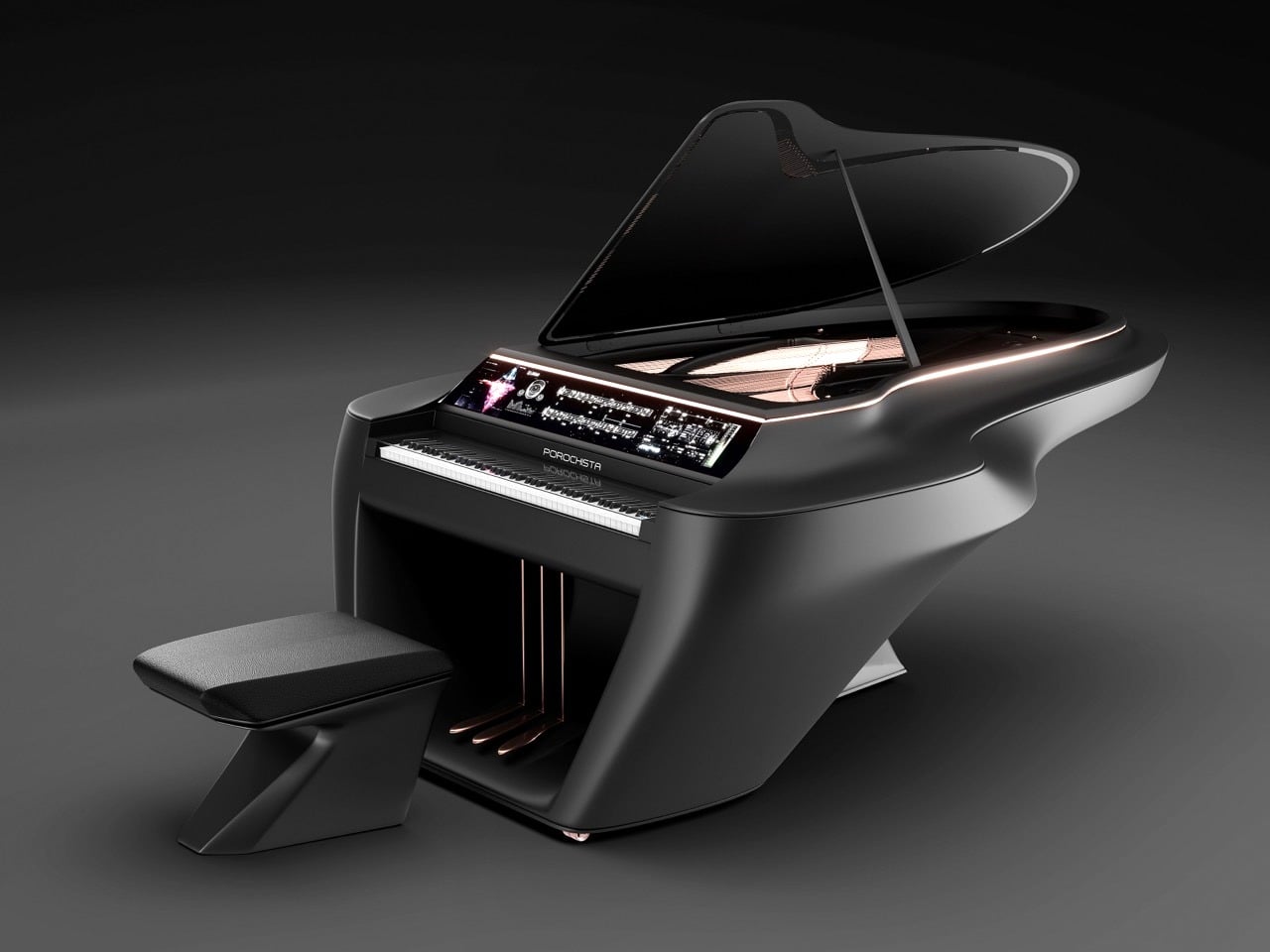
The grand piano has remained visually unchanged for generations, its familiar silhouette a fixture in concert halls and living rooms worldwide. Mohammad Limucci saw this consistency differently. Rather than accepting the traditional form as immutable, he recognized an opportunity to evolve the instrument’s aesthetic while preserving its acoustic soul. His creation, the Porochista Piano, applies automotive design principles to classical craftsmanship.
Measuring 8.7 by 6.2 feet, Porochista combines glass, metal, and matte black composites in flowing organic shapes reminiscent of Luigi Colani’s biomorphic philosophy. The rear section appears to float, creating visual tension between sculptural ambition and structural stability. A large integrated touchscreen offers digital functionality without compromising the acoustic purity professional pianists demand. This fusion of old and new earned recognition at the A’ Design Award, where judges appreciated its ability to attract modern design enthusiasts while respecting the instrument’s heritage. Porochista suggests what tradition might become when filtered through contemporary vision.
Designer: Mohammad Limucci
Designers slap touchscreens onto everything from refrigerators to bathroom mirrors these days, usually with results that make you question basic decision-making processes. A grand piano sporting what looks like a 20-inch display sounds like exactly that kind of misguided thinking. But Limucci clearly studied how supercar manufacturers like Pagani and Koenigsegg integrate function into form, where every curve serves both aerodynamic purpose and visual drama. That swept-back lid with its silver trim could’ve been lifted from a hypercar’s active aero system. The base, with its angular cutouts and geometric voids, solves the eternal design problem of making something massive feel light without actually compromising structural integrity. The solution here involves actual engineering rather than visual tricks.
The Colani influence runs deep, and anyone familiar with the German designer’s work will spot it immediately. Those seamless transitions between surfaces, the way hard edges soften into organic curves, the sense that this object could achieve flight velocity if you just gave it a runway. Colani designed everything from trucks to cameras using the same biomorphic language, always asking why objects should have corners when nature abhors them. Limucci applies that thinking to an instrument that’s been geometrically rigid since the 1700s. Production apparently requires CNC machining and molding techniques borrowed from automotive manufacturing, which makes sense given the compound curves involved. You can’t slap veneer on particleboard and achieve forms like these.
The touchscreen integration could’ve gone full sci-fi nightmare, all glowing edges and pulsing LEDs, but instead it sits flush and purposeful. The digital features (recording, playback, animated notation display) address actual pianist needs rather than adding gimmicks for marketing bullet points. There’s even a hidden compartment up top that slides out to hold sheet music, activated by touching a specific spot. That level of detail suggests someone actually thought about how musicians interact with their instruments over hours of practice, not just how the thing photographs for Instagram. The matte black finish with those copper-toned pedal details visible through the base cutouts gives it presence without screaming for attention, which is harder to achieve than it sounds.
Tehran to Zagreb doesn’t seem like an obvious design pipeline, but apparently that’s where this concept gestated. Whether it ever reaches production remains the question nobody’s answering yet, though the A’ Design Award recognition certainly helps with credibility. The manufacturing complexity alone suggests this won’t be competing with Yamahas at your local music store. Still, seeing someone finally treat piano design with the same innovative energy that automotive and consumer electronics enjoy feels overdue. Professional musicians deserve instruments that fit contemporary spaces without looking like props from period dramas.
The post This Grand Piano Has a 20″ Touchscreen, and a Design Worthy Of A Supercar Showroom first appeared on Yanko Design.