
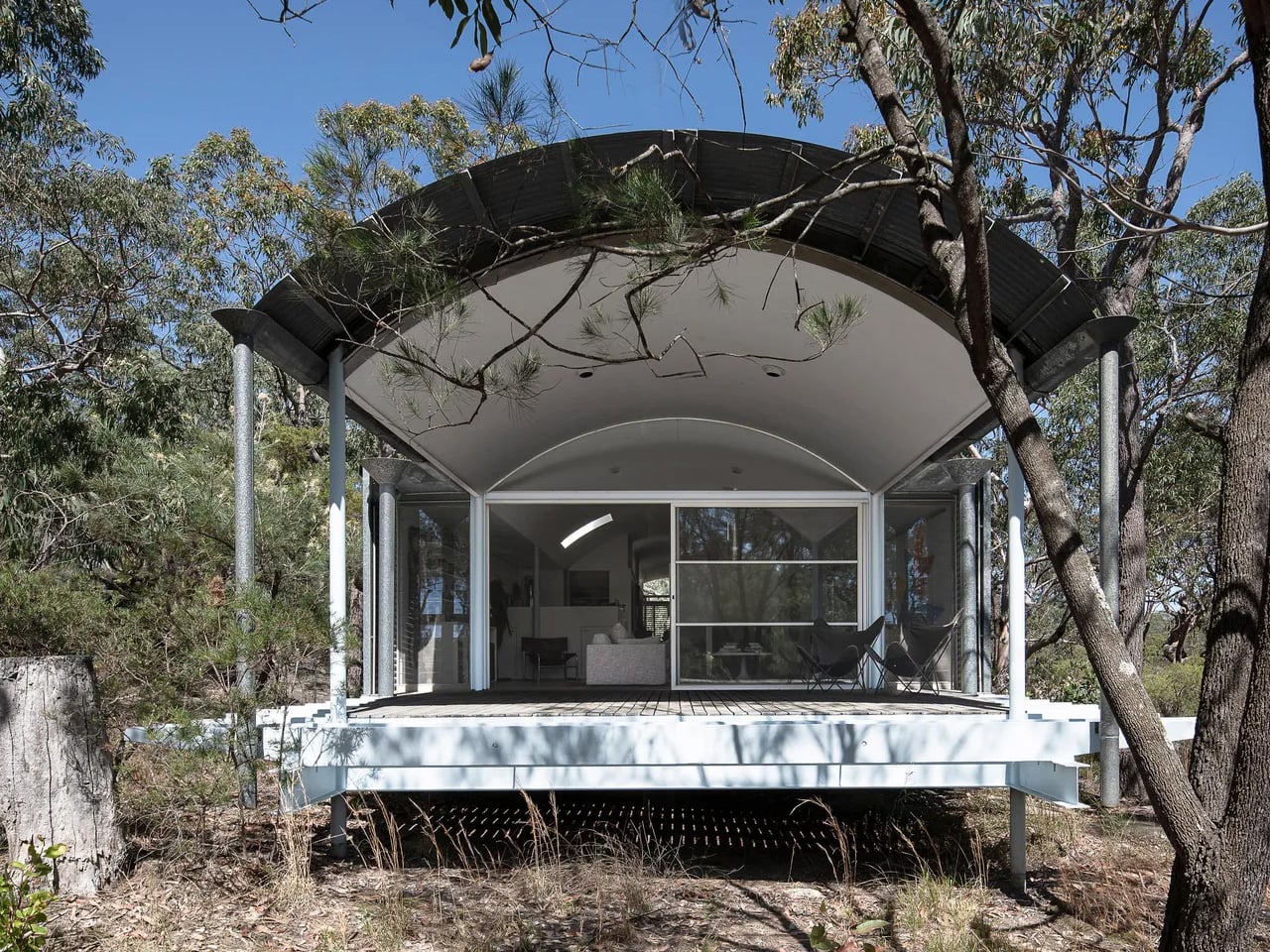
For the first time since its completion in 1983, one of Australia’s most architecturally significant homes is available to buy. The Ball-Eastaway House, designed by Pritzker Prize-winning architect Glenn Murcutt, has been listed with Modern House at a guide price of AUD 2.4 to 2.6 million, an extraordinary opportunity to own a piece of living architectural history.
Set on 25 acres of dry sclerophyll forest in Glenorie, roughly an hour northwest of Sydney, the property feels worlds apart from the city it neighbours. The rugged site presented Murcutt with a natural rock ledge that became the building’s platform, and rather than taming the land, the architect worked with it. Not a single tree was removed during construction, a commitment that shaped every decision made from the ground up.
Designer: Glen Murcutt
The house sits elevated on slender steel pipe columns, its long, low form skimming the earth without disturbing it. Murcutt has long described this approach as “touching the earth lightly,” placing humanity within nature rather than above it. The exterior is clad in corrugated iron, marking the first time Murcutt used the material on a residential project, and its gently curved roofline reads almost like a topographical feature rather than a built structure.
Inside, the design is as considered as the form suggests. Aluminium shading devices and timber-lined interiors regulate heat and light throughout the seasons, while expansive north-facing glazed walls and skylights draw in the kind of soft, sustained light that painters depend on. The home was built specifically for abstract artists Sydney Ball and Lynne Eastaway, and their creative lives are woven into the architecture itself. Ball’s large-scale paintings run the length of an internal wall that forms the spine of the entire plan.
Behind that wall lies a concealed northwest verandah, originally conceived as a meditation space, and two generous studios where many of both artists’ most significant works were made. During a jury visit for the 1984 Wilkinson Award, which the house went on to win, the jury chair called it the most serene space he had ever encountered.
That quality of stillness hasn’t faded. The environmental intelligence built into the structure, passive ventilation, solar orientation, and minimal site intervention, was pioneering in the early 1980s and reads today as a quiet blueprint for how buildings should relate to the landscapes they occupy. The entire ten-hectare site has since been heritage listed, ensuring whatever comes next for the Ball-Eastaway House, its integrity remains protected.
The post This Iconic Australian Bush House Just Hit the Market for the First Time in Over 40 Years first appeared on Yanko Design.