
yorgos lanthimos on the autonomy of photographs
On the occasion of Yorgos Lanthimos: Photographs, an exhibition curated by Michael Mack, on view at Onassis Stegi in Athens from March 7th to May 17th, 2026, the filmmaker offered an unusually candid reflection on his evolving relationship with the still image. Known internationally for the singular cinematic universes of films such as Dogtooth, The Favourite, and Poor Things, Lanthimos speaks about the autonomy of photography, a medium that has increasingly shaped his creative practice over the past few years.
One of the recurring themes throughout the press conference discussion was the sense of independence photography offers compared to the collaborative machinery of filmmaking. Cinema requires crews, budgets, schedules, and the orchestration of countless elements, while photography can emerge from a much simpler encounter with the world.
‘You can be alone, with a camera in your hand, and you can walk,’ Lanthimos says, describing the basic gesture that often begins his photographic process. In that moment, the medium sheds the expectations attached to narrative production. ‘You don’t need to have something specific in your mind,’ he continues ‘You don’t need to have in mind that you have to do something with it at some point. This is freedom.’
all images by Yorgos Lanthimos, unless stated otherwise
from film school technique to photographic practice
For Lanthimos, photography did not begin as a deliberate artistic pursuit but rather as a technical necessity. ‘You immediately learn in film school that cinema is 24 frames per second,’ he explains during the conversation. ‘So technically you have to learn photography first.’ At the time, his ambition was firmly directed toward cinema, and photography functioned as a foundational skill rather than a destination in itself.
‘I didn’t know from the start that I would be so interested in photography,’ he admits. Initially, the still image existed only as preparation for filmmaking, something to master before moving on to what he considered the real objective. Yet the relationship between the two mediums gradually shifted. Working on films meant constantly returning to the camera as a tool of observation, and over time that technical familiarity transformed into something more personal. ‘Gradually, through the process of cinema, which required photography anyway, but also gave me another way out during the creation of film, I started to love it even more,’ he adds.
the show brings together four bodies of work produced over the past five years
a medium of possibilities
The still image, he suggested, operates according to a different temporal logic. Unlike cinema, which must eventually resolve itself into a finished sequence, photography allows meaning to remain open. A photograph can exist independently or become part of a larger collection of images, changing its significance depending on context. ‘A photograph can have a value,’ he reflects, before expanding on the idea. ‘Then many together can have another value and another importance.’
This flexibility extends to the many forms photography can take after the moment of capture. A single image might appear in a book, an exhibition, or another sequence altogether, each time generating a slightly different interpretation. For Yorgos Lanthimos, this fluidity is precisely what distinguishes the medium from cinema’s fixed narrative structures.
‘The fact that photography can make a book, you can present it in an exhibition, you can do different things in the exhibition, another narrative,’ he explains. ‘In general, a great freedom in relation to the practice of photographing something.’ This approach to sequencing finds a tangible form in VISCIN, a photobook launched alongside the exhibition. Designed as a leporello fold that unfolds like a strip of film, the publication assembles photographs taken on the set and locations of Bugonia into a continuous visual sequence.
Even the simplest image can oscillate between complexity and simplicity depending on the viewer’s encounter with it. Some photographs contain layers of tonal or visual complexity, while others resonate through their quiet directness. ‘There are certain images that I think are very complex, tonally complex, visually complex,’ the Greek filmaked notes. ‘There are others that are very simple, that for some reason there’s some affinity to them.’
including images made on the sets of Poor Things, Kinds of Kindness, and Bugonia
the tactile experience of photographs
Another aspect that Yorgos Lanthimos emphasized during the press conference was the physical dimension of analogue photography. In an era dominated by digital circulation, the act of producing a photographic object remains deeply meaningful to him.
‘You can go for a walk, take a roll of film, go home, print two photos, hold them in your hand and look at them,’ he says, describing the almost ritualistic satisfaction of the process. The immediacy of producing a tangible image contrasts sharply with the prolonged timelines of filmmaking, where months or years may pass before the work reaches an audience.‘The satisfaction is great and immediate,’ he adds, suggesting that the tactile relationship with the photograph, the print, the paper, even the smell of the materials, becomes an integral part of the experience.
within these images, Lanthimos moves between subjects
memory as a single image
Perhaps the most revealing moment of the discussion came when Lanthimos was asked about early visual memories. His response shifted the conversation toward the deeper connection between photography and the way people remember their lives.
‘I have a terribly bad memory,’ he says with disarming honesty. Yet despite that admission, he realized something unexpected while reflecting on the question. The fragments that remain from childhood do not appear as sequences of events but rather as isolated images.‘My memories are usually just single images,’ he explains. The observation led him to a broader realization about the relationship between memory and photography itself. ‘Every important thing in my life is an image,’ he says, acknowledging how the still frame seems to mirror the structure of recollection.
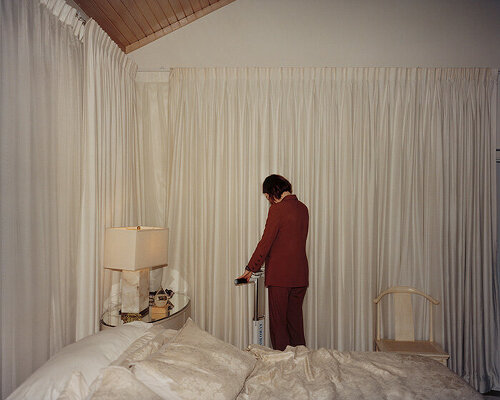
This sensitivity to the power of isolated moments runs throughout the photographs presented in the exhibition at Onassis Stegi. The show brings together four bodies of work produced over the past five years, including images made on the sets of Poor Things, Kinds of Kindness, and Bugonia, alongside a new and ongoing series photographed in Greece. Within these images, Yorgos Lanthimos moves between subjects: people, landscapes, animals, fragments of architecture, or everyday scenes encountered during solitary walks. Each subject, he suggested, carries the potential for narrative without necessarily demanding one.
‘Each has its own meaning,’ the filmmaker shares. A building, a face, or an animal can all hold equal narrative weight depending on the way they are framed and presented. Yet the photograph ultimately reveals as much about the viewer as it does about the subject itself.
portrait of Vyronas, Yorgos Lanthimos’ dog
Emma Stone on set
the sensitivity to the power of isolated moments runs throughout the images on view
people, landscapes, animals, fragments of architecture, or everyday scenes are the protagonists in Yorgos Lanthimos’ images
the exhibition is on view at Onassis Stegi in Athens from March 7th to May 17th, 2026
182 images produced over the past five years form the exhibition
project info:
name: Yorgos Lanthimos: Photographs
photographer: Yorgos Lanthimos | @_yorgos_lanthimos_
location: Onassis Stegi | @onassis.stegi, Athens, Greece
dates: March 7th – May 17th, 2026
The post ‘this is freedom’: yorgos lanthimos on photography beyond cinema appeared first on designboom | architecture & design magazine.