
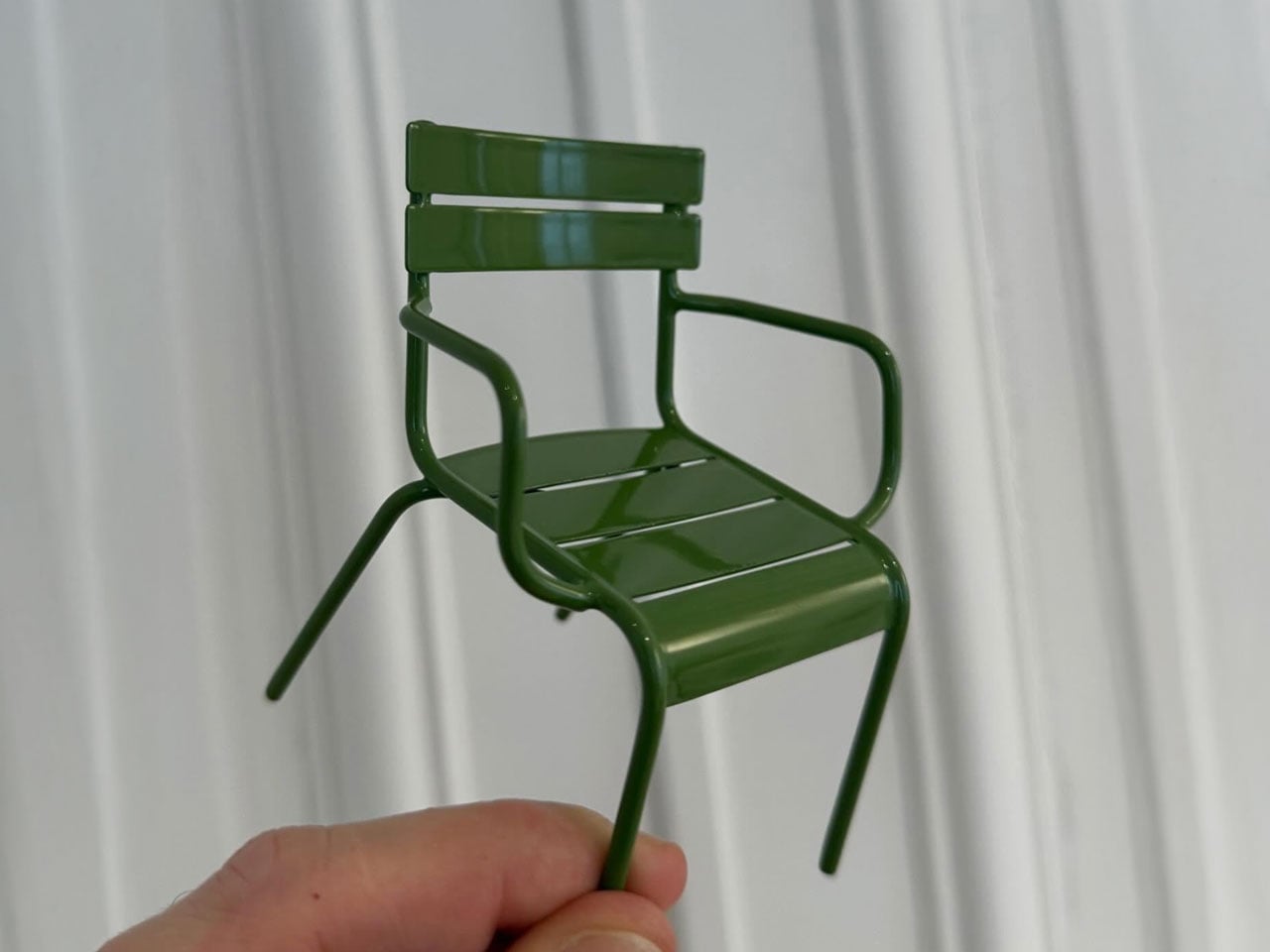
The fashion show invitation has been quietly dying for years. What was once a piece of paper, then a gilded box, then a USB drive shaped like a perfume bottle, has steadily been reduced to an email attachment with an RSVP link and a virtual front row. So when Jonathan Anderson sent physical invitations for his Spring/Summer 2026 Dior debut, that alone was already worth noting. That the invitation turned out to be a miniature replica of the iconic green metal chairs from the Jardin des Tuileries made it something else entirely.
If you’ve been to Paris, you know the chair. That specific shade of green, the wrought iron frame, the slightly uncomfortable curve of the seat that you’d still happily sit on for hours just to watch pigeons and people drift by. The chairs of the Tuileries aren’t precious objects. They’re not behind glass. They’re public furniture, casually scattered across one of the most photographed gardens in the world, and anyone can pull one up. That’s precisely the point Anderson seems to be making.
Designer: Jonathan Anderson
Fashion invitations, at their best, are previews. They’re a designer’s handshake, the first line of the story they want to tell. At their worst, they’re just complicated garbage. Anderson’s chair manages to be neither. It sits somewhere far more interesting: a symbol loaded with Parisian identity but freed from elitism. The Tuileries chair belongs to everyone. Tourists sit in it, locals nap in it, lovers drag two of them together and angle them toward the Seine. For Anderson to choose this as his introductory gesture for one of fashion’s most storied houses reads as a very clear statement of intent.
Anderson is, by now, well-established as a designer who treats objects with the seriousness of a curator. His years at Loewe were defined by a fascination with craft, provenance, and the weight of things. He built a house culture around the idea that what surrounds us matters, that design exists at every scale, from the cut of a coat to the shape of a vase. That sensibility didn’t stay at Loewe when he left. It packed its bags and followed him to the Avenue Montaigne.
What I find genuinely compelling about this invitation is the restraint of it. Anderson could have arrived at Dior with something maximalist and declaratory. He is, after all, the first designer since Christian Dior himself to oversee all of the house’s fashion lines, a pressure point that would send most people reaching for something grand and unmistakable. Instead, he picked a chair. A chair that says: I see Paris clearly. I know what it actually is, not just what it looks like in campaign shots. And I’m asking you to sit down.
The Spring/Summer 2026 ready-to-wear show itself was held at the Tuileries, the very garden where those chairs live, which is a detail worth pausing on. That circularity feels entirely deliberate. The invitation wasn’t just a keepsake or a branding exercise. It was a spatial cue, a way of pulling guests into the landscape before they ever arrived. By the time editors and buyers took their seats in the show space, the chair in their mailbox had already done its work. The object had already oriented them toward something.
There’s a broader conversation happening right now about what fashion shows are for, who they’re for, and whether the spectacle has eclipsed the clothes. Anderson seems to be navigating that tension with real purpose. His debut was notable for beginning with a documentary short by Adam Curtis recapping the entire history of the house, an act that felt less like tribute and more like confidence: here is everything that came before me, and now watch what I do with it.
The chair invitation belongs to that same mode of thinking. It’s not a gimmick. It’s a gesture that understands the difference between noise and meaning. Fashion has plenty of the former. Anderson, at Dior, looks committed to the latter.
The post This Miniature Chair Is Jonathan Anderson’s Smartest Dior Move first appeared on Yanko Design.