
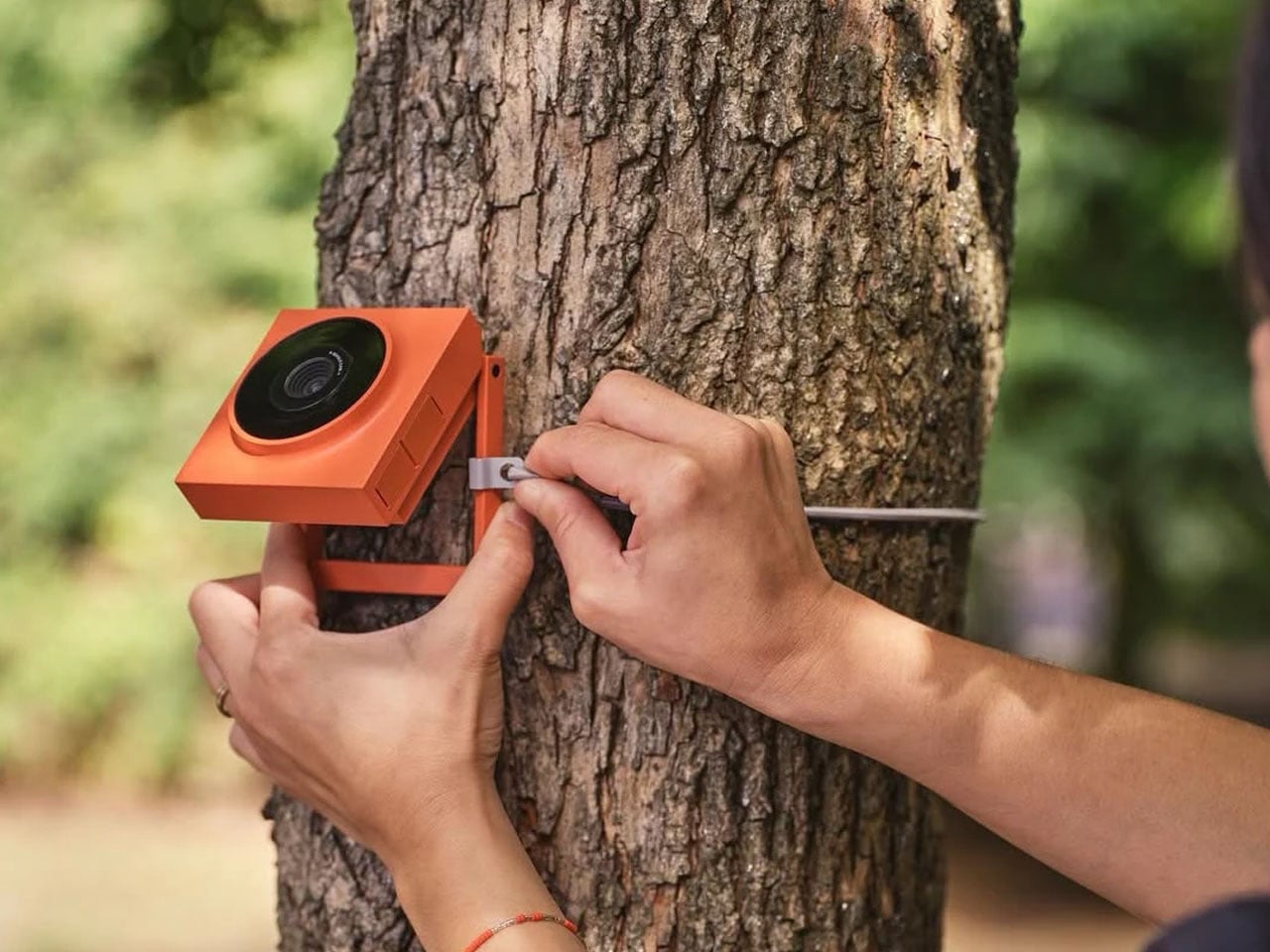
There’s a quiet shift happening in how we observe wildlife. It’s no longer about being physically present with bulky gear and long lenses, but about placing intelligence into the environment itself. This lets technology do the watching while humans step back. And that’s exactly where this minimal AI camera concept positions itself.
Created as a compact, unobtrusive wildlife tracking device, the design strips away everything that feels traditionally “camera-like.” Instead of buttons, screens, or visible complexity, what you get is a clean, almost monolithic form that feels closer to a sensor than a gadget. The idea here is simple: if you’re trying to observe nature, the device itself shouldn’t interfere with it.
Designer: Nicolas Fred and Thomas Fred
The camera leans heavily into minimalism, not just as an aesthetic choice, but as a functional one. Its small footprint makes it easier to deploy in remote locations, while the lack of visual noise helps it blend into natural surroundings. This is particularly important in wildlife monitoring, where even the slightest disruption can alter animal behavior. By reducing its presence, the device becomes less of an observer and more of a silent participant.
What makes it interesting, however, is the integration of AI as a core feature rather than an add-on. Unlike traditional camera traps that simply record footage for later review, AI-enabled systems are increasingly designed to process data in real time—identifying species, filtering out irrelevant motion, and reducing the need for manual sorting. Similar approaches in modern wildlife tech already show how embedded intelligence can dramatically cut down human effort while improving accuracy.
This concept seems to follow that same philosophy, imagining a camera that doesn’t just capture images, but understands them. That shift from passive recording to active interpretation is where the real value lies. It turns a simple device into a tool for conservation, research, and even anti-poaching efforts. The form factor also suggests modularity and adaptability. Whether mounted on trees, placed near water sources, or integrated into different terrains, the design feels versatile enough to function across environments. Its minimal geometry likely aids in durability too, reducing points of failure while making it easier to weather harsh outdoor conditions.
At the same time, there’s an understated elegance to how the device is presented. It doesn’t try to look rugged in the traditional sense. No exaggerated textures or aggressive styling. Instead, it embraces a softer, more refined visual language that aligns with its purpose: observe without intrusion.
This minimal AI camera for the wild feels less like a tool you use and more like something you place and trust. It quietly works in the background, capturing stories you might never have been able to witness yourself!
The post This minimal AI camera blends into the wild while quietly tracking wildlife first appeared on Yanko Design.