
This Perth Home Takes Its Cues From Holidays On Rottnest Island
Architecture
Inside Broome Street House by Philip Stejskal Architecture.
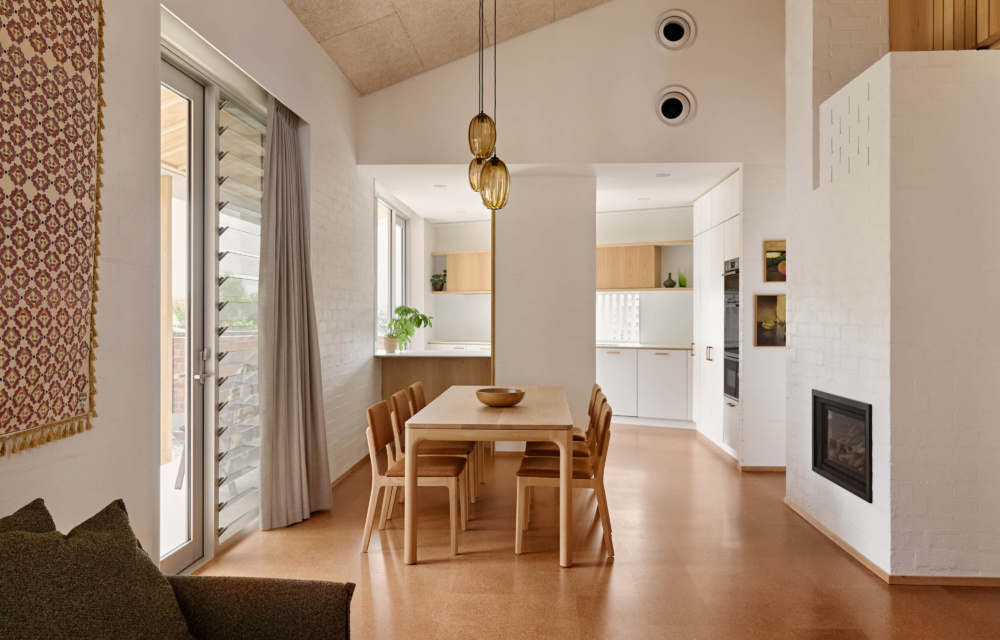
Cork floors and bagged bricks reference the robust and simple interiors of a beach shack.
The sloped ceiling maximises the sense of space inside.
The light and bright living room.
A fireplace adds charm.
The kitchen.
Joinery helps create reading nooks and places for relaxation.
The stairs lead down to the owner’s expansive personal library.
The study.
Pink tiles feature in the bathroom.
One of the bedrooms.
Timber shutters and cutouts modulate privacy and help manage the home’s temperature.
The striking exterior combines robust materials with architectural detailing.
A balcony adjoining the main bedroom upstairs.
A brick base anchors the home and provides thermal mass, while a lighter painted fibre-cement ‘beach shack’ volume sits above.
The sculptural house works to maximise the sloped site.
The streetview.
Just a short ferry from Perth, Rottnest Island/Wadjemup is perhaps one of the most famous holiday destinations in Australia.
Visiting the island almost feels like stepping back in time; it’s predominantly car-free, with a tiny population of residents and holidaymakers who ride bikes around to spot the quokkas, explore sandy white beaches, and swim in sparkling waters filled with marine life.
It was this sense of tranquillity that Philip Stejskal Architecture’s clients wanted to emulate in their new Cottesloe home.
The couple, an architect and librarian, previously lived on the neighbouring heritage cottage before subdividing the land and moving to a vacant 300-square-metre portion of the site.
‘They wanted a home that felt reminiscent of their Rottnest holidays — relaxed, textural, durable and deeply connected to its surroundings,’ director Philip says.
It had to be appropriately urban, yet feel like a rustic beach shack, complete with changing views and plenty of reading nooks and spaces that would feel different depending on the time of day or season.
The resulting home combines a brick base that anchors the home and provides thermal mass, while a lighter painted fibre-cement ‘beach shack’ volume sits above.
It features an angular floor plan spread across three levels to maximise privacy and solar gain, as the strong geometric roofline follows the fall of the land.
‘The steep slope, dual street frontages and foot traffic created complexity, but we treated these as generative conditions. Careful siting, screening and collaboration with engineers and ESD [Ecologically Sustainable Development] consultants helped turn constraints into opportunities,’ Philip notes.
Externally, timber shutters and cutouts modulate privacy and manage sun exposure, as the rooftop solar panels, a water tank, and a heat pump also aid the home’s low energy consumption.
In addition to the clients’ memories of Rottnest, the island’s village-style series of 1970s villas designed by architect Gus Fergerson also served as inspiration for the interiors.
Cork floors, bagged white brickwork, cathedral ceilings and timber detailing provide a nostalgic warmth. There’s a simple charm to each space, adorned with ample built-in bookshelves and cosy corners for reading or quiet retreat.
For Philip, the roof terrace and its panoramic coastal views are some of the standout moments. The ‘occupied landing’ is another — an intimate, elevated nook that captures a surprising urban view.
But above all, it’s the home’s calm atmosphere and effortless liveability, which makes every day feel like a holiday.