
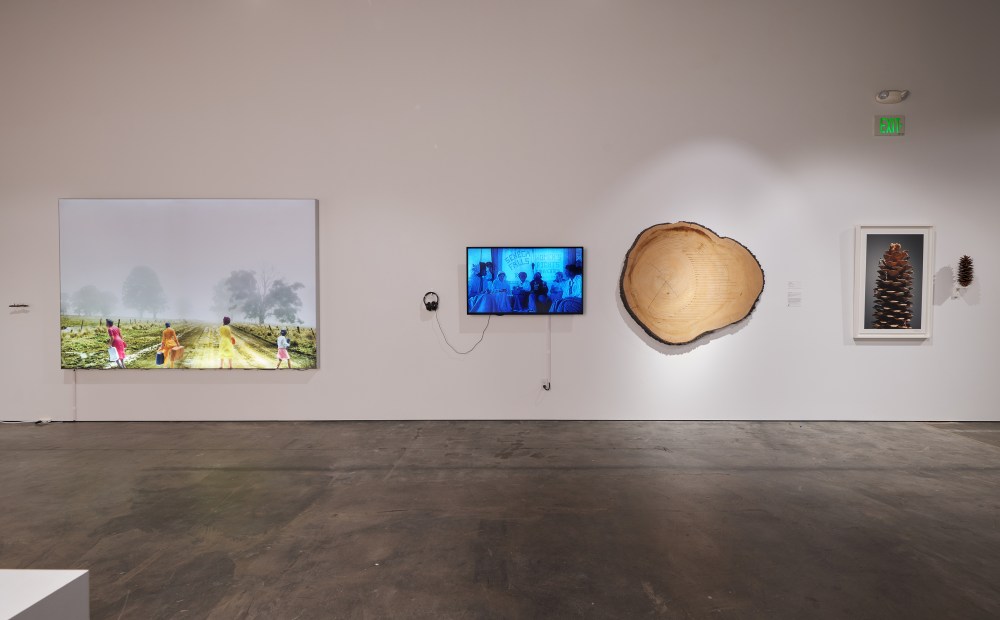
When we look at the cross-section of a tree, we are looking at time made visible.
Each tree ring marks a year; and records years of drought, years of rain, years when the world shifted in ways the tree could never name but nonetheless endured. Dendrochronology is the science of studying tree rings, and the interpretation of these patterns as records of climate and time. But in the work of artists Tiffany Shlain and Ken Goldberg, tree rings become a medium for exploring knowledge, memory, and humanity’s evolving relationship with technology.
Their exhibition Ancient Wisdom for a Future Ecology: Trees, Time, and Technology transforms salvaged wood into a meditation on time itself. Through monumental tree‑ring sculptures, hand‑burned inscriptions, and technology‑driven installations, the artists invite us to reconsider the relationship between nature and technology—not as opposing forces, but as intertwined systems shaping our collective future.
The exhibition grows from a deceptively simple premise: a tree’s rings already form a timeline. But what if those rings could hold the stories of culture, science, philosophy, and human inquiry?
This idea builds on Tiffany Shlain’s earlier work Dendrofemonology: A Feminist History Tree Ring, a monumental sculpture that reimagines history through the lens of women’s lives and struggles for equality. In that work, Shlain inscribed a timeline of feminist history—from ancient goddess worship to contemporary movements like #MeToo—onto a reclaimed cedar cross‑section, transforming the familiar “tree ring timeline” found in national parks into a radically different narrative.
The work challenged a long‑standing convention: the assumption that history unfolds in a single, authoritative sequence. By inscribing overlooked stories into the rings of a tree, Shlain reframed history as something layered, contested, and constantly rewritten. Ancient Wisdom for a Future Ecology expands this approach. Here, Shlain collaborates with Ken Goldberg—roboticist, artist, and UC Berkeley professor—to explore how human knowledge itself evolves across centuries.
At the center of the exhibition stands Tree of Knowledge, a monumental, salvaged eucalyptus trunk inscribed with nearly two hundred questions that have shaped humanity’s pursuit of understanding. Rather than presenting answers, the sculpture foregrounds curiosity itself: questions about philosophy, faith, science, and artificial intelligence spiral across the wood’s surface.
Standing before it, viewers encounter a powerful inversion. History is not presented as a sequence of achievements but as an ongoing inquiry—a reminder that the most important engine of knowledge is the question.
Elsewhere in the exhibition, Shlain and Goldberg continue to reimagine history through the material presence of trees. One sculpture condenses thousands of years of Jewish history into a single circular timeline. Another, Abstract Expression, presents the evolution of scientific thought through thirty‑nine mathematical equations burned into the surface of a massive redwood slab, beginning with the Pythagorean theorem and extending to the transformer equation that powers contemporary generative AI systems.
In these works, time unfolds across multiple scales simultaneously. The slow biological growth of trees intersects with the accelerating pace of scientific discovery. Ancient materials carry the traces of modern thought.
The exhibition also incorporates media installations that extend this conversation into the digital realm. Goldberg and collaborators use machine learning to map urban tree canopies, revealing ecological patterns embedded in city landscapes. In another participatory project, visitors create personalized “tree tributes” using generative AI—digital reflections on trees that matter in their own lives.
These works complicate our understanding of technology. Artificial intelligence, often framed as something radically new, becomes another chapter in a much older relationship between humans and trees. For centuries, trees supplied the paper on which human knowledge was recorded; in this sense, the archive of civilization has always been rooted in forests.
Throughout the exhibition, Shlain’s technique of pyrography—drawing with fire—reinforces this connection. The burned inscriptions echo the natural lines of the wood, blurring the boundary between human mark‑making and the organic patterns of growth. The result feels both ancient and speculative. These sculptures look backward across centuries while asking how we might imagine the future.
Shlain and Goldberg’s collaboration mirrors the exhibition’s central theme: the meeting of disciplines. Their work sits at the intersection of art, science, philosophy, and ecology, demonstrating how new perspectives often emerge when different ways of thinking collide. Yet for all its technological references, the exhibition ultimately returns us to the quiet authority of trees.
Trees measure time differently than we do. A redwood may live for a thousand years; the questions humans ask within that span are brief flashes by comparison. By embedding our intellectual histories into the bodies of trees, Shlain and Goldberg remind us that knowledge itself is part of a much larger ecological continuum.
The rings continue to grow. The questions continue to multiply.
And somewhere between ancient forests and artificial intelligence, the future is still being written.
Ancient Wisdom for a Future Ecology: Trees, Time, and Technology will be on exhibit at di Rosa Art through April 11, 2026. 1150 25th Street, San Francisco. Upcoming events include Ecology Now: Krista Tippett in Conversation with Tiffany Shlain & Ken Goldberg on Thursday, March 26, 6:30 – 8:30 pm and a Closing Night Celebration on April 11, 6:00-9:00 pm.
The post Tiffany Shlain and Ken Goldberg: Ancient Wisdom for a Future Ecology: Trees, Time, and Technology appeared first on PRINT Magazine.