
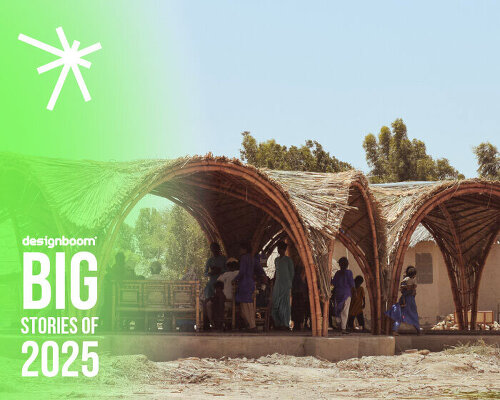
designboom’s Most Impactful Stories of 2025
As 2025 comes to an end, we’re reflecting on the architecture, design, and technology projects featured on designboom that applied creative thinking to address compounding global pressures. Designers increasingly turned their attention to urgent realities, such as intensifying climate-driven disasters and growing resource scarcity. In a year marked by record-breaking temperatures, ongoing displacement crises, and growing debates around waste, water, and energy systems, design emerged not as a passive backdrop but as an active tool for response. Shaped by these shared challenges, these works demonstrate how design can move beyond aesthetics to function as infrastructure, service, and social support. Together, the 2025 social impact stories highlighted here point to a growing emphasis on design as a practical response to global issues, showing how spatial thinking, material innovation, sustainability, and community engagement can contribute to more equitable and resilient futures.
From flood-proof bamboo pavilion within Yasmeen Lari’s zero-carbon Pono village in Pakistan, and Natura Futura’s teak wood bakery, conceived as a hybrid infrastructure led by women and youth, to Toyota’s autonomous wheelchair with foldable tentacle legs that can climb stairs, and Ulf Mejergren’s compact gabled refuge that mounts on a mobile scissor lift to adapt to environments with frequent rainfall and flooding, here are the top 10 social impact stories that addressed pressing social, environmental, and cultural challenges.
REFUGE MOUNTS ON SCISSOR LIFT IN RESPONSE TO CLIMATE CHANGE
image courtesy of Oskar Omne
We are kicking off our list of socially impactful projects with Lift House by Ulf Mejergren Architects (UMA). The project introduces a compact gabled timber house refuge mounted on a mobile scissor lift. Designed for an exhibition setting, the work explores architecture’s capacity to adapt to changing environmental conditions. The installation responds to increasing climate instability, including more frequent rainfall and flooding, by proposing a structure that can temporarily rise above the ground when necessary. The concept is structured around three primary strategies for managing environmental risk: defend, attack, and retreat. Lift House suggests a fourth option, temporary retreat, introducing mobility and flexibility as means of resilience.
read more here
BAMBOO SHAPES FLOOD-PROOF PAVILION IN PAKISTANI VILLAGE
image courtesy of Nyami Studio
As flooding continues to displace communities worldwide, designs shift from mobile shelters to permanent, locally rooted frameworks for resilience. In the flood-prone region of Sindh, Pakistan, the Juliet Center anchors a prototype development for resilient, community-driven architecture led by Yasmeen Lari. Within the Pono Village, conceived by the Heritage Foundation of Pakistan following the devastating floods of 2022, this new bamboo pavilion creates a flexible, open space to empower local residents. The project has thus been completed by Nyami Studio and Jack Rankin with a strong social focus, responding directly to the area’s environmental and economic vulnerabilities that intensified after 2022.
Extending Lari’s broader vision to foster self-sufficiency through vernacular techniques, the Juliet Center is built with low-cost and eco-friendly materials, including bamboo, mud, lime, and thatch. It is shaped as a lightweight, vaulted structure that recalls the traditional domed forms familiar in Sindh, while translating them into a sinuous, modular silhouette. Within the open form framed by bamboo columns, it creates an inviting setting for spontaneous community gatherings while providing a space to host educational workshops, upskilling locals in sustainable building techniques.
read more here
3D PRINTED CORAL REEFS IN MIAMI FIGHT CLIMATE CHANGE
image courtesy of Florida International University and Sara Pezeshk
Moving beyond flood-responsive architecture on land, other projects turn to rising sea levels and underwater environments, exploring how design can restore marine ecosystems. Architects and marine biologists at Florida International University develop BIOCAP tiles, a series of 3D printed coral reefs that combat climate change by creating cooler microenvironments. Designed to support marine life, these modular tiles reduce the impact of waves along the seawalls. They are designed to help water cities like Miami adapt to the rising sea levels, all the while restoring the ecological balance along the shorelines.
The researchers, led by Sara Pezeshk and Shahin Vassigh, enumerate some ways that the 3D printed coral reef seawalls can help fight climate change. Each BIOCAP tile, for example, has shaded grooves, crevices, and small, water-holding pockets. Because of these, they mimic the natural shoreline conditions. They also construct tiny homes for barnacles, oysters, sponges, and other marine organisms that filter and improve water quality. Design-wise, the BIOCAP tiles have swirling surface patterns that increase their overall surface area. On top of that, they give the marine life more space for colonization.
read more here
3D PRINTED DEVICE EXTRACTS DRINKING WATER DIRECTLY FROM AIR
image courtesy of Louisa Graupe and Julika Schwarz
While some designers address rising sea levels and coastal protection, others focus on freshwater scarcity, developing technologies that extract safe drinking water from the atmosphere itself. Designed by Louisa Graupe and Julika Schwarz, Water from Air is a mobile device that extracts potable water directly from the atmosphere using advanced material technology. The prototype addresses the increasing global demand for accessible drinking water by employing Metal-Organic Frameworks (MOFs), a class of materials known for their high porosity and capacity for selective absorption. These materials are capable of capturing water molecules from ambient air and releasing them as usable freshwater. Research into MOFs is currently underway at institutions including the Institute for Materials Chemistry at the University of Vienna and the University of California, Berkeley.
At any given time, the atmosphere holds more water than all of Earth’s rivers combined. Water from Air is a design response that translates this scientific potential into a functional product. While MOFs have predominantly been studied in laboratory contexts, this project proposes a real-world application through a compact, scalable, and energy-independent form.
read more here
ELECTRIC VEHICLE BATTERIES REUSED AS PLANT FERTILIZERS
image courtesy of Teona Swift
Moving from 3D printed devices that turn air into potable water, we look into other innovations transforming post-consumer waste into valuable resources, closing the loop in sustainable material cycles. Engineers at the University of Wisconsin–Milwaukee have developed a way to recycle used lithium iron phosphate batteries from electric vehicles into crop and plant fertilizers. These materials, commonly used in EVs, delivery vans, and buses, are just disposed of when they reach the end of their life, usually after ten years. The researchers hope that by repurposing these used batteries as fertilizers, they can help the agriculture industry and reduce the traditional recycling methods, which are considered costly and complicated, given that the recovered materials from the process, like iron and phosphate, don’t cost much and make battery recycling more expensive than it is.
The engineers, led by Dr. Deyang Qu, the Department Chair of Biomedical Engineering at the University of Wisconsin-Milwaukee, use a chemical method called ion exchange, a process already used in many industries, such as water purification. In this recycling system, the IX process helps replace lithium ions with hydrogen or potassium ions using resin, which works like a filter that can swap certain elements for others. Two types of resins are used to recycle the used batteries from electric vehicles: strong acid cation resins and K-form (potassium-based) resins.
read more here
EGGSHELLS COMPOSE BIODEGRADABLE MODULAR BUTTERFLY NEST
image courtesy of Jayoung Kim, Jungmin Park, and Chaewon Lee
We now move to design interventions that support urban ecosystems, such as this shelter that creates microhabitats for pollinators. EggNest is a sculptural, modular structure developed by Jayoung Kim, Jungmin Park, and Chaewon Lee as a shelter for butterflies in urban settings. Constructed from eggshells and soil, it offers a microhabitat that facilitates pollinator activity and supports vegetation such as moss and flowers. The project addresses the need for biodiversity integration within cities.
As urban environments present challenges for maintaining biodiversity, EggNest proposes a shared ecological space where both human and non-human species can coexist. Rather than designing exclusively for one group, the structure balances environmental and functional needs, creating a compatible setting for butterflies and urban dwellers alike. The system is composed of adaptable modules that respond to varying urban contexts. The modular design is informed by expert input, particularly regarding the thermal and humidity conditions needed for butterfly survival. Gaps between modules allow for the growth of moss and flowering plants, supporting humidity retention while visually functioning as urban planters.
read more here
SOLAR-POWERED BACKPACK PROVIDES SHELTER FOR THE HOMELESS
image courtesy of HomeMore Project
From microhabitats that nurture urban biodiversity, we turn to design solutions that provide immediate, practical support for people navigating vulnerable conditions. The Makeshift Traveler is a solar-powered backpack by HomeMore Project that comes with a sleeping bag and pillow and supports individuals looking for permanent housing. An initiative by the HomeMore Project, the accessory is tailored to the needs of the individuals experiencing unsheltered homelessness, allowing them to sustainably navigate their situation until they obtain permanent shelter.
Looking at the design of the solar-powered backpack, the hardshell exterior allows for a weatherproof surface so the individuals’ personal belongings are safe and stashed inside regardless of the environmental conditions. On top of it lies the solar panel that stores the energy within the accessory’s battery bank, letting the individuals charge their devices using a USB port. The latter part also features cables to charge the backpack as soon as the user has access to a wall charger. A urethane-coated nylon pillow is embedded in the bottom of the solar-powered backpack. In this way, users can rest without needing to bring an extra pillow, lockable using a double zipper system to ward off thieves and protect the individuals’ personal belongings, too.
read more here
BAKERY DOUBLES AS WOMEN-LED LEARNING SPACE IN ECUADOR
image courtesy of Jag Studio
From providing mobile support for individuals to empowering entire communities, these projects demonstrate how design can address both immediate needs and long-term resilience. On Ecuador’s flood-prone coast, where rural communities have long depended on distant urban centers for opportunity, La Panificadora timber bakery by Natura Futura emerges as a self-managed catalyst for local autonomy. This compact, modular project reclaims the everyday act of baking bread, an Ecuadorian dietary staple, as a tool for economic empowerment, education, and community cohesion. The 100-square-meter structure is led by women and youth, enabling skills training, production, and commercialization under one roof.
La Panificadora is built from locally available teak wood and responds to the humid climate through permeable facades, lattice doors, and generous open galleries for cross-ventilation and light. Horizontal floating beams secure the modules above ground, ensuring resilience against coastal flooding. While minimal in size, the space is conceived as a hybrid of infrastructure, school, market, and gathering place.
read more here
TOYOTA’S AUTO WHEELCHAIR WITH FOLDABLE TENTACLE LEGS
image courtesy of Toyota
We highlight individual mobility solutions, like this design that enhances autonomy at a personal scale.
Toyota reveals ‘walk me,’ a concept autonomous wheelchair with foldable tentacle legs that can climb stairs and sit on the floor. The assistive device helps people with reduced mobility to move around places where traditional wheelchairs aren’t able to, including walking up and down between floors and lifting the users to their cars. Toyota’s autonomous wheelchair replaces the traditional wheels with four robotic and foldable legs that move like animal limbs.
Each leg can lift, bend, and adjust its position on its own, and this lets the device move across steps or rough ground. The seat has a supportive frame that holds the user in a safe and upright position, and the backrest curves to follow the shape of the user’s back. The user asks the device to move around using the small side handles or a control interface that can include buttons. The foldable legs of Toyota’s concept autonomous wheelchair also come with soft-looking outer covers to protect the inside parts as well as the sensors.
read more here
AI KITCHEN DEVICE TURNS LEFTOVERS INTO PERSONALIZED RECIPES
image courtesy of Ayah Mahmoud and C Jacob Payne
Finally, this project reimagines everyday activities, illustrating how design can extend human capability. Developed at MIT, Kitchen Cosmo is a speculative AI cooking device that challenges conventional paradigms of smart kitchen technology. Rather than automating tasks or optimizing efficiency, Cosmo fosters a co-creative relationship between user and machine, generating personalized recipes based on available ingredients and six analog input parameters, including cooking time, mood, and dietary restrictions. The device uses GPT-4o, a multimodal large language model capable of processing both images and text in real time. A webcam captures the user’s ingredients; dials and switches communicate contextual preferences. A single API call then translates these inputs into a context-specific recipe, which is printed via an embedded thermal printer. Cosmo’s distinctive interface is entirely screenless and tactile, rejecting voice assistants and digital displays in favor of knobs, sliders, and physical ritual.
read more here
see designboom’s TOP 10 stories archive:
2024 — 2023 — 2022 — 2021 — 2020 — 2019 — 2018 — 2017 — 2016 — 2015 — 2014 — 2013
The post TOP 10 social impact stories of 2025 appeared first on designboom | architecture & design magazine.