
For more than five decades, Edwin Schlossberg has been interested in a deceptively simple question: how do we come to know what we cannot see?
Across his career as an artist, writer, designer, and pioneer of interactive environments, Schlossberg has explored the hidden structures that shape human experience. His work has long operated at the intersection of art, science, language, and perception, probing the ways knowledge is formed through encounter. In his newest body of work, Unseen Layers, that inquiry becomes newly visual, immersive, and expansive.
Portrait of New Metal, 2023
Developed over several years, the paintings in this series explore the threshold between visibility and mystery. Inspired by recent scientific discoveries and the imaging technologies that make them possible, Schlossberg turns his attention toward phenomena that were once entirely invisible: cellular structures, neural networks, cosmic radiation, biological processes unfolding beneath the surface of life. These discoveries do not simply expand our understanding of the universe; they expand our imagination of it. What emerges in Unseen Layers is an attempt to translate those revelations into a visual language that is at once poetic and precise.
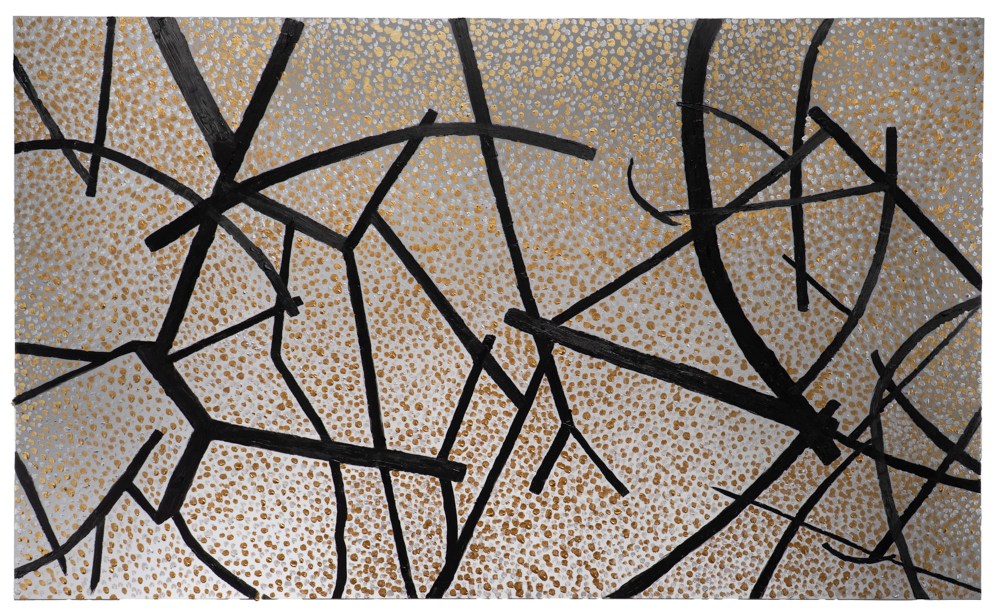
The paintings appear at first as luminous fields of color, densely layered compositions made of metallic pigments and reflective surfaces. Networks of forms cluster, scatter, and multiply across the canvas. Some resemble microscopic organisms. Others evoke astronomical maps or constellations suspended in deep space. Still others seem to echo cartographic diagrams or biological growth patterns, as if charting invisible terrains.
What Schlossberg creates are not representations of scientific images so much as visual analogies for the processes those images reveal.
Each work operates as a kind of speculative portrait. Schlossberg often titles them accordingly: portraits of cells dividing, of neural formations, of cosmic phenomena, of the sun itself. The word portrait here is crucial. Traditionally, a portrait captures the likeness of a person; in Schlossberg’s work, the subject is not a person but a process and an activity of life unfolding across time.
These paintings therefore ask us to reconsider what a portrait can be.
Instead of depicting faces, they depict forces. Instead of recording appearance, they suggest emergence. The works portray systems in motion: networks expanding, organisms multiplying, structures forming and dissolving simultaneously. They remind us that the most essential aspects of life–growth, energy, transformation–often occur beyond the limits of ordinary perception.
To encounter these paintings is to enter a space where the microscopic and the cosmic begin to mirror one another.
Science has repeatedly revealed that the patterns governing life at one scale often echo those at another. The branching structures of neurons resemble galaxies. Cellular divisions resemble planetary orbits. Networks of energy ripple across vastly different dimensions of reality. Schlossberg’s work inhabits precisely this zone of resonance, where the language of biology, physics, and cosmology begins to overlap.
The result is a kind of visual cartography of existence.
But unlike traditional maps, which guide us through physical terrain, these paintings chart landscapes of knowledge and imagination. They invite viewers to navigate relationships between time and memory, matter and energy, perception and understanding. The viewer becomes a participant in the act of discovery, searching the image for patterns, connections, and meaning.
Portrait of Cell Division, 2023
Portrait of Brain Cells, 2024
This participatory quality has always been central to Schlossberg’s practice.
Long before interactivity became a digital buzzword, Schlossberg was designing environments that asked audiences to think, question, and explore. His early work often engaged language directly: phrases, riddles, and conceptual prompts that activated the viewer’s curiosity. In later decades he expanded those ideas into immersive installations and museum experiences, creating spaces where knowledge could unfold through exploration rather than instruction.
In Unseen Layers, the interactivity is quieter but no less profound.
The paintings do not tell us what we are seeing. Instead, they create conditions for perception to unfold. The viewer’s eye moves through layers of color and form, discovering relationships that shift depending on where one stands, how the light moves across the surface, or how long one spends looking.
In this sense, the paintings are less like static images than like systems of perception.
They operate through accumulation and depth. Multiple layers of paint interact with reflective backgrounds, producing subtle optical effects that change with movement and light. What initially appears flat begins to reveal dimensional complexity. The image opens itself gradually, echoing the very scientific processes that inspired it: revelation through deeper observation.
There is also a profound sense of vitality in the work.
The forms in these paintings feel alive. Clusters pulse with energy. Lines branch outward like living organisms. The compositions seem to grow across the surface of the canvas, suggesting systems that extend beyond the frame itself. Schlossberg’s visual language captures something essential about contemporary scientific understanding: that life is not static but dynamic, constantly evolving through networks of interaction.
Portrait of a Stem Cell, 2025
Yet for all their scientific inspiration, these works remain deeply human.
They reflect the enduring human desire to understand the world, and to find patterns in chaos, to discover connections between seemingly unrelated phenomena, to glimpse the underlying order of existence. In this way, Schlossberg’s work echoes a sentiment famously expressed by Albert Einstein: that the most beautiful experience we can have is the mysterious, the feeling that stands at the cradle of both art and science.
Unseen Layers exists precisely in that space of shared wonder.
Art and science, though often treated as separate disciplines, are both methods of inquiry. Each seeks to reveal hidden structures of reality. Each relies on observation, experimentation, and imagination. Schlossberg’s paintings embody this convergence, translating scientific curiosity into aesthetic form.
Standing before these works, viewers are invited not simply to look but to contemplate. The paintings ask us to consider the invisible architectures that sustain life: the cellular processes that allow organisms to grow, the cosmic forces that shape the universe, the neural pathways that produce thought and memory.
Portrait of DNA Unraveling, 2023
What emerges is a quiet but powerful realization: that we exist within vast, intricate systems that extend far beyond what our senses can grasp.
Schlossberg’s paintings do not attempt to solve this mystery. Instead, they celebrate it.
They remind us that knowledge is always unfolding, that every discovery reveals new layers of complexity. They encourage us to remain curious and to continue looking, questioning, and imagining.
In doing so, Unseen Layers offers a visual meditation on the unseen dimensions of existence, and on the extraordinary networks that connect the microscopic to the cosmic, the scientific to the poetic, and the visible world to the vast territories that lie just beyond it.
Edwin Schlossberg’s show Unseen Layers, will be on exhibit at Ronald Feldman Gallery in New York City from March 5-May 22, 2026. 31 Mercer Street, New York, NY 10013
Header Image: Portrait of an Atom, 2023. All images aluminum with scotchlite and acrylic | 36 x 60 in. | © Edwin Schlossberg | Courtesy the artist and Ronald Feldman Gallery, New York
I
The post Unseen Layers: Edwin Schlossberg and the Architecture of the Invisible appeared first on PRINT Magazine.