
Vancouver has always had good bones. The mountains, the water, the way the city sits between them like it was planned by someone with an eye for drama. But for all its natural beauty, its skyline has played it relatively safe. That’s about to change, and the agent of disruption is, of all things, a sea sponge.
Henriquez Partners Architects, a local Vancouver studio, has unveiled designs for 595 West Georgia Street, a 1,033-foot tower that will become the city’s first-ever supertall skyscraper. To earn that designation, a building has to exceed 984 feet, which puts 595 West Georgia just barely in that club and makes it a landmark before a single floor has been built. It’s the centerpiece of a larger trio called Georgia & Abbott, developed by Holborn Group, but this one is clearly the main event.
Designer: Henriquez Partners Architects
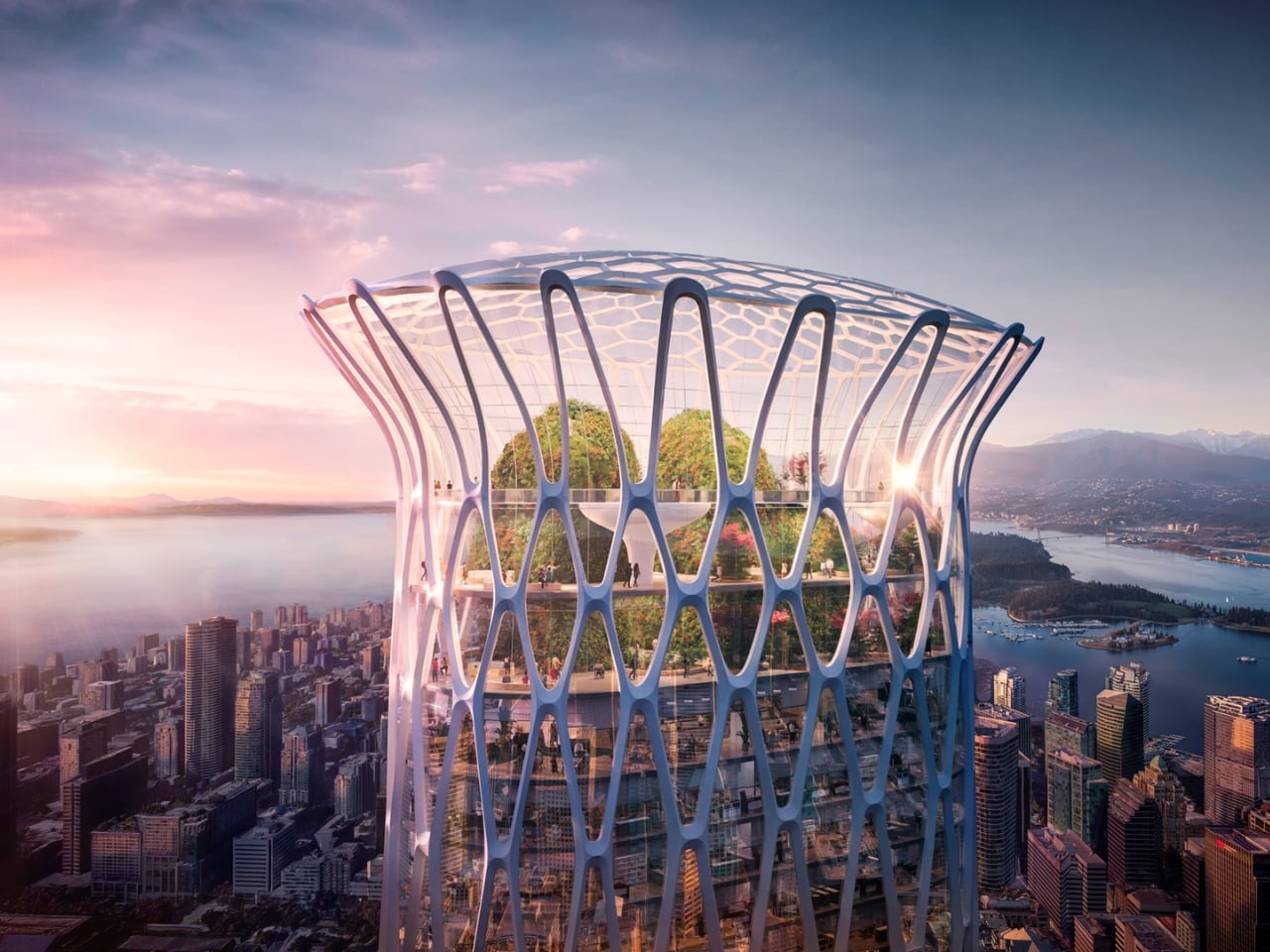
The design draws from the glass sea sponge reefs, specifically hexactinellids, found off the coast of British Columbia. These aren’t the bath sponges you’re picturing. They’re ancient, rare, deep-sea organisms with a crystalline skeletal structure that is simultaneously porous and structurally formidable. Henriquez Partners didn’t just borrow the idea aesthetically; they borrowed it structurally. The building is wrapped in a steel exoskeleton clad in white Glass Fibre Reinforced Polymer panelling, with highly translucent spans of glass filling the rest. That external framework carries the structural loads, which means fewer internal columns, more open floor plates, and a surface that looks woven and textured rather than sealed and flat.
That last distinction matters more than it sounds. Glass-box towers have dominated skylines for decades, and while some are genuinely beautiful, most are just reflective. They bounce light around and blend into each other. 595 West Georgia is going for something different: depth. The lattice of the exoskeleton creates shadows and layers depending on where you’re standing and what time of day it is. It moves, visually, in a way that most modern towers simply don’t, which makes looking at it feel more like watching a living surface than a fixed object.
Henriquez Partners described the design as telling “a story that is unique to British Columbia.” That kind of regional specificity is increasingly rare in architecture, where global firms often produce work that could exist in Dubai just as easily as Dallas. The fact that this building could only make sense in Vancouver, because the glass sponge is native to BC’s coastal waters, gives it a conceptual integrity that goes beyond branding. It’s a building that knows where it lives.
The program is equally considered. 595 West Georgia will function as a hotel tower, with conference facilities, a rooftop restaurant, and a publicly accessible observation deck at the top that will be free for Vancouverites to visit. That detail alone shifts the building’s relationship to the city. A supertall designed to be shared with the public rather than sealed off for guests feels like a genuine gesture, and it suggests that the architects and developer thought about this tower as part of the city’s fabric, not just its skyline profile.
The whole project sits at a compelling intersection of ideas. It’s biomimicry applied at an urban scale, which is a growing conversation in both design and engineering. It’s also a statement about what cities are willing to reach for, literally and figuratively. Vancouver has been measured about its height limits for years, and for good reason. The city’s low-rise character has long been part of its identity. Greenlighting a supertall signals that the city is ready to stretch those boundaries, and having one that can argue its design philosophy this clearly makes that shift feel earned.
Whether 595 West Georgia turns out to be as striking in person as the renderings suggest is something only construction can answer. But the foundational idea, that the most interesting path forward might look like something pulled from the ocean floor, is exactly the kind of thinking that makes architecture worth paying attention to right now. Not every city gets to say its most ambitious tower was modeled after an organism that’s been living quietly underwater for centuries. Vancouver gets to say that.
The post Vancouver’s First Supertall Was Inspired by the Ocean Floor first appeared on Yanko Design.