
a Museum celebrating Huizhou’s vernacular bridge traditions
The Huizhou Vernacular Historic Bridges Micro-Museum, designed by LUO Studio, is located beside Shisanba Bridge in Mazha Town, Huizhou, China. Positioned within a bamboo grove, the project forms part of the ‘Nankunshan–Luofushan Rim Pioneer Zone (Huizhou) Architectural Art Project,’ a regional initiative that introduces architectural interventions and cultural waystations along a 218-kilometer scenic tourism route. The micro-museum is dedicated to documenting and interpreting vernacular historic bridges found across the Huizhou region. The project combines exhibition spaces with visitor amenities, such as tea and coffee service areas, restrooms, and seating, allowing the building to function both as a cultural installation and a small public facility along the scenic route.
The project emerged from field research and archival investigation into traditional bridge construction in Huizhou. Surveys identified two primary vernacular bridge types: the baqiao, commonly referred to as the ‘goose-chest bridge,’ and the gaoqiao, locally known as the ‘bench-leg bridge.’ Baqiao bridges, including the nearby Shisanba Bridge, typically appear in areas where the difference between river level and embankment is relatively small. Their upstream piers are shaped like tapered spindles with slightly raised tips, creating a distinctive structural profile. Stone slabs span between the piers, forming a bridge deck assembled through interlocking construction methods. Gaoqiao bridges occur in locations where riverbanks rise higher above the water and the span is narrower. In these structures, long and slender stone posts splay outward and downward, resembling the legs of a bench. Mortise-and-tenon joints connect the vertical posts with horizontal beams, demonstrating a sophisticated stone-working tradition that also appears in local dwellings and village architecture. Fieldwork also revealed additional vernacular architectural details, including gourd-shaped, semicircular, and triangular openings commonly carved into the walls of local Hakka compounds. These elements later informed aspects of the museum’s architectural language.
all images by Zhu Yumeng – Coppak Studio
LUO studio reinterprets bridge typologies through architecture
During the research phase, the number of historic bridges identified throughout Huizhou exceeded initial expectations. Once central to everyday mobility and agricultural life, many of these bridges have become less visible within contemporary infrastructure systems. The micro-museum was conceived by the design team at LUO studio as a small architectural structure dedicated to recording and presenting this vernacular infrastructure. Located beside Shisanba Bridge, the building operates as both a gallery and a viewing point for the historic structure nearby. Artist Liu Qingyuan, a printmaker based in Guangdong, contributed a series of works documenting the bridges surveyed during the research process. Presented under the theme Bridges of the Countryside, these artworks form the main exhibition within the museum, positioning the architecture as a framework for presenting the narrative of local bridge traditions.
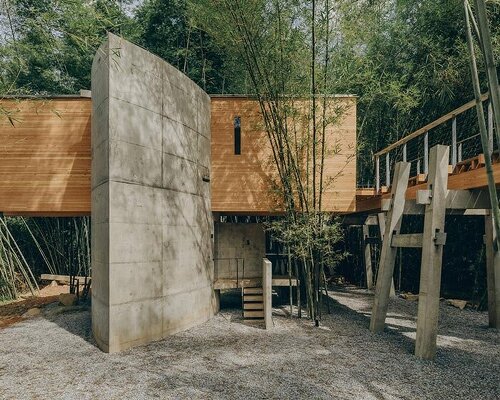
The design integrates two architectural interpretations derived from the local bridge typologies. The building volume references the structural logic of the baqiao system. A spindle-shaped concrete volume represents the bridge pier, while a timber-framed passage passing through the structure recalls the bridge deck. At the end of this passage, a seating area provides views toward Shisanba Bridge and the surrounding river landscape. The concrete volume contains two levels. The ground floor accommodates restrooms, washbasins, the entrance area, and part of the exhibition space. An internal staircase leads to the upper level, which houses the main gallery and a café area with access to an outdoor viewing walkway. The elevated walkway interprets the construction principles of the gaoqiao bridge type. Built from cast-in-place reinforced concrete, its structural system echoes the mortise-and-tenon relationships observed in traditional stone bridges. Slender trapezoidal posts support the walkway, which extends through the bamboo grove and frames views of the historic bridge.
Huizhou Vernacular Historic Bridges Micro-Museum sits beside Shisanba Bridge in Mazha Town
A bridge-like walkway threaded through the bamboo grove
The elevated walkway forms a linear path through the bamboo landscape, recalling the spatial rhythm of both baqiao and gaoqiao bridges. Timber planks are placed across the walkway with widened gaps, referencing the spacing between stone slabs in traditional bridge decks. These openings allow light and shadow to filter through while maintaining visual continuity with the surrounding environment. Geometric openings in the concrete walls reinterpret the gourd-shaped, semicircular, and triangular apertures observed in local architecture. A gourd-shaped stone block recovered from an abandoned house during field research is displayed within the ground-floor gallery as part of the exhibition. Several construction elements were reused within the project. Steel molds used for casting the walkway’s concrete structure were repurposed as outdoor drainage channels guiding water from the washbasins. Surplus concrete beams were installed along the waterfront as a long seating element facing the river.
The design approach prioritizes minimal intervention within the bamboo grove surrounding the site. The elevated walkway passes lightly through the vegetation while maintaining existing trees and natural ground conditions. This strategy preserves the character of the landscape while allowing visitors to move through the grove and observe the nearby bridge. The project aligns with the broader curatorial theme ‘Dongpo’s Delights,’ which references the writings of the Song dynasty scholar Su Dongpo. One poetic image associated with the theme, bamboo seen through a window during light rain, informed the project’s emphasis on landscape views and subtle spatial framing.
The Huizhou Vernacular Historic Bridges Micro-Museum by LUO studio proposes a small architectural intervention that combines research, exhibition, and public infrastructure. By documenting traditional bridge construction and presenting it through spatial experience, the project draws attention to a network of vernacular structures that continue to shape the region’s landscape. Through observation platforms, exhibitions, and architectural reinterpretations of traditional bridge forms, the project encourages visitors to rediscover these historic crossings and the craftsmanship embedded within them.
LUO Studio places the structure within a dense bamboo grove along the river
the micro-museum documents vernacular bridge construction across the Huizhou region
a spindle-shaped concrete mass evokes the bridge pier
the building volume references the structural logic of the baqiao bridge
an elevated walkway reinterprets the structure of gaoqiao bridges
slender concrete posts support the walkway as it threads through bamboo
timber planks with widened gaps echo traditional stone bridge decking
exhibition spaces are combined with a café, restrooms, and resting areas
mortise-and-tenon joints reveal the precision of local stone craftsmanship
the elevated path creates a new vantage point to observe the historic bridge
a timber passage cutting through the volume recalls the bridge deck
the micro-museum by LUO studio stands in harmony with the surrounding landscape
project info:
name: Huizhou Vernacular Historic Bridges Micro-Museum
architect: LUO studio | @luostudio
location: Shisanba Bridge, Mazha Town, Longmen County, Huizhou, Guangdong, China
area: 73.55 sqm
collaborating artist: Liu Qingyuan
design team: Luo Yujie, Wang Beilei, Hong Lun, Cao Yutao, Liang Jiahui
construction drawings: Luo Yujie, Zhang Ergang, Jiang Junjie, Chen Wei, Hong Lun, Cao Yutao, Liang Jiahui
art creation: Liu Qingyuan, Song Qi, Wu Di
developer: Huizhou Huanliangshan Investment & Development Co., Ltd.
project organizer: Shanghai Fengyuzhu Culture Technology Co., Ltd.
contractor: Shinewood Building Technology (Beijing) Co., Ltd.
photographer: Zhu Yumeng – Coppak Studio | @yumeng_zhu_coppakstudio
designboom has received this project from our DIY submissions feature, where we welcome our readers to submit their own work for publication. see more project submissions from our readers here.
edited by: christina vergopoulou | designboom
The post vernacular bridge craftsmanship informs micro-museum set within bamboo grove in china appeared first on designboom | architecture & design magazine.