
What Can Designers Do When Heroes Fail?
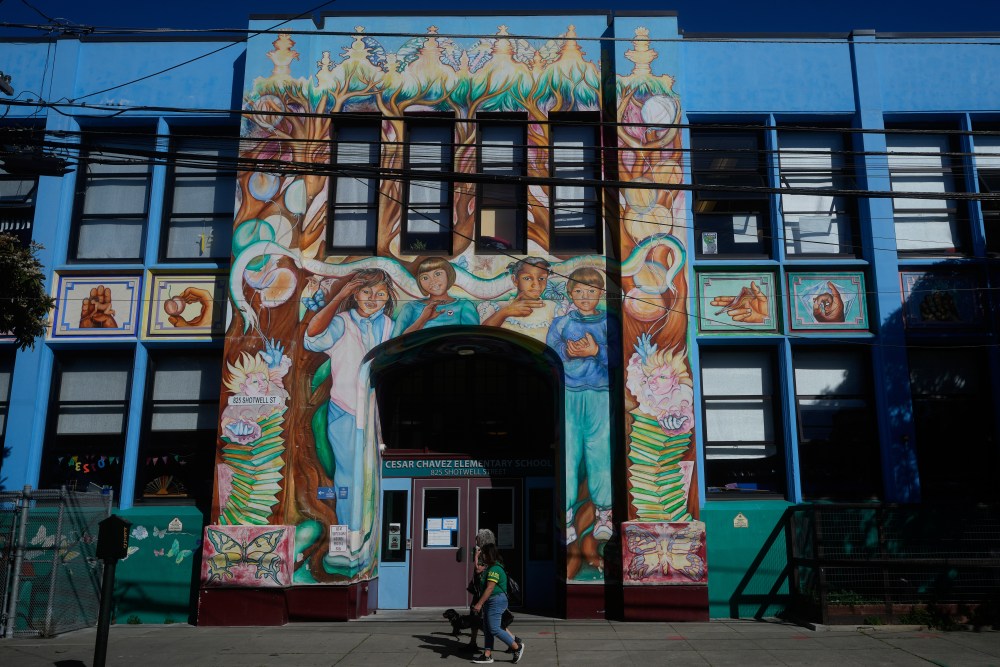
The tragedy of Cesar Chavez swells and reverberates like a social atom bomb. There are the late United Farm Workers leader’s victims, including children, molested or raped by the man held up as a walking embodiment of justice. They bore not only the pain (and in one case, two children conceived by Chavez’s assaults) of his abuse but the pressure to remain silent for decades to avoid tarnishing his memory. There is the betrayal felt by those who admired Chavez for empowering workers and Hispanics. And there are the artists, designers and communities which have honored Chavez, left with a wrenching question: what do we do with the statues, the murals, the Cesar Chavezes imprinted on buildings, including — perhaps most obscenely now — on schools?
César Chavez Elementary School in San Francisco (AP Photo/Jeff Chiu)
The simple solution is already underway. Across the country, governments and organizations are removing Chavez’s name and image from community sites and buildings. California moved quickly to honor March 31, once Cesar Chavez Day, as the newly-renamed Farmworkers Day. It’s notably a clean-up and not a whitewash. The artist Lalo Alcaraz published a cartoon featuring a young girl in overalls, painting over Chavez’s face on a mural that also features UFW activist (and Chavez victim) Dolores Huerta. Chavez’s face is still somewhat visible under the white paint, a reminder that he will no longer be honored, but that his vile behavior will be neither forgiven nor forgotten.
Still, a broader reckoning is needed, one that challenges the lure of hero worship (and its evil twin, the cult of personality) and the temptation to depict movements through individuals, whether it’s a statue or a name etched on a building. We want to honor a movement or an idea, and it’s natural to use an individual as the embodiment of that movement, inspiring others to be like that person. But that falls apart when the person—inevitably flawed at the least, as all people are—turns out to be a monster. Do we really need another hero?
Jha Amazi, director of the Public Memory and Memorials Design Lab, was addressing this long before the revelations about Chavez. The firm where she is senior associate, MASS (Model of Architecture Serving Society) Design Group, partners with communities to create memorials and sites of remembrance that are about the movement and the people affected (and often ignored), as opposed to an individual leader.
The tendency has been to focus on singular hero worship. Which is an issue. Do we value individual people – as we should and we can. There’s a place for that. Or do we value collective action?
Jha Amazi, Senior Associate, MASS Design Group
There’s a long history, of course, in lauding our past through people. In the U.S., that’s often been men on horses, honoring a battle (props to Puerto Rico, where you’re more likely to see statues and artwork of poets, writers and salsa artists than of warriors or politicians). But that ties the validity of the movement to an individual who might not be able to carry the weight.
Statues and commemorations are about the present, not about the past. We set up these people to give us guidance for the future, and that’s always going to be an image that distorts the historical reality.
David Meyer, author of the book How Social Movements (Sometimes) Matter.
“We take something big and condense it down to a single person, and we are vulnerable because no human being can live up to all the expectations we lay on those heroes,” adds Meyer, who teaches sociology and political science at the University of California, Irvine.
When a movement is defined by a person, the underlying ideals are vulnerable to attack or erasure. And when movement heroes are assigned that much power, the movements don’t even have to be real.
No more is that evident that in the cases of Chavez and another man caught up in the public reckoning on sexual abuse and assault: Donald Trump. Found civilly liable for sexual abuse, the president is trying to shake questions about his prior relationship with convicted child sex offender Jeffrey Epstein. But there has been no movement to remove Trump’s name or image from the public sphere. Texas governor and Trump supporter Greg Abbott was quick to announce he would work with state legislators to remove Cesar Chavez Day from state law.
A life-size statue of Cesar Chavez was removed by City of San Fernando workers from Cesar Chavez Memorial Park. Murals throughout the park are also set to be covered as the city determines the site’s future. (Photo by Ted Soqui/SIPA USA)(Sipa via AP Images)
“Reports of the horrific and widely acknowledged sexual assault allegations against Cesar Chavez rightfully dismantle the myth of this progressive hero and undermine the narrative that elevated Chavez as a figure worthy of official state celebration,” Abbott said in a statement.
Note Abbott’s insertion of the word “progressive,” as though Chavez’s political persuasion was somehow connected to child rape. Or that a movement for workers’ rights and dignity is somehow less credible because its leader engaged in disgraceful and criminal behavior.
In Trump’s case, the “hero” is not the movement (which has always been pretty amorphous anyway), but the individual himself, whose followers are more attached to him than any political or ideological quest. There’s no monument to MAGA (and it’s not clear what the movement is, other than to support Trump). But the president—who as a businessman slapped “Trump” on everything from ties to vodka—has had his name added to the Kennedy Center and the Institute of Peace, and is having paper money produced with his signature and a gold coin with his image. The Palm Beach, Florida airport was recently renamed after Trump. It has everything to do with worship of the man, and nothing to do with a movement or idea.
(AP Photo/Danny Moloshok)
(Photo by NIKLAS LARSSON/Bildbyran/Sipa USA)(Sipa via AP Images)
Making monuments to movements, instead of individual leaders, “is in direct response to the understanding that we have, as a society, acknowledged the error in singular hero worship,” Amazi says. “That’s why so many of our Confederate markers are coming down. This obsession with singular narratives and this obsession with the power of one white man. It’s something that we are, as a nation, rejecting. And his response is to say, no, I’m going to double down on it.”
The Trump renamings and rebrandings may well not survive after he’s out of office. And since the movement was built around him, instead of the other way around, his legacy, ironically, may be only about his name.
Lisa Reinertson, the artist who created a sculpture for the Cesar Chavez Plaza in downtown Sacramento, made the work about the whole movement. Yes, Chavez is depicted leading the UFW 1965 march from Delano to Sacramento, but the exhibit also shows images of the history of the movement, including Huerta holding a sign that says “Huelga” (“strike”). Reinertson has offered to remove the image of Chavez from the front of the sculpture.
(AP Photo/Tran Nguyen)
“Humans are problematic. I will sculpt the ones I want to sculpt anyway. And yes, there is much confusion and chaos surrounding every place that has put Chavez‘s name in a position of honor,” Reinertson says in an email.
“And when the time comes, hopefully sooner than later, we will, as a society, decide to hold accountable the living abusers in positions of power, and scrub their names off of buildings,” she adds. “Yes, we can think twice before we put someone up on a pedestal. But it’s more important that we think twice about who we are putting in positions of power in the first place.”
A mural by Emigdio Vasquez depicting Cesar Chavez, at Santa Ana College in Santa Ana, CA (AP Photo/Jae C. Hong)
In Chavez’s case, it’s going to take some time to erase the man from the movement, if only because his victims will never have the opportunity to confront him. But the enduring hero — the fight for human rights — survives the misdeeds of one of its leaders.
The post We Don’t Need Another Hero appeared first on PRINT Magazine.