
the new museum exhibits early visions of new humans
Proposing an unsettling vision of humanity, New Humans: Memories of the Future takes over the New Museum‘s recently completed expansion. Curating the exhibition, the museum’s Artistic Director Massimiliano Gioni gathers more than a century of artists’ responses to moments when technology and society reframed the meaning of being human. Across four floors of the OMA-designed building, earlier visions of the future are presented alongside present-day questions that remain unresolved.
For Gioni, this moment of change feels symbolic, and he tells designboom during an interview ahead of the opening: ‘We are living in a moment in which some changes in the world of technology are coming to an existential questioning.‘ He points to the experience of being asked by a machine to prove one’s own humanity, an uncanny reversal that has now become familiar.
He suggests that, within that uncertainty, people turn toward myth. He explains: ‘We come to a place where science and technology are so mysterious they appear magical,‘ Within this frame, artists operate as storytellers who help make sense of the shifting and uncertain world around us. In some cases they imagine utopias — in others, they envision something darker.
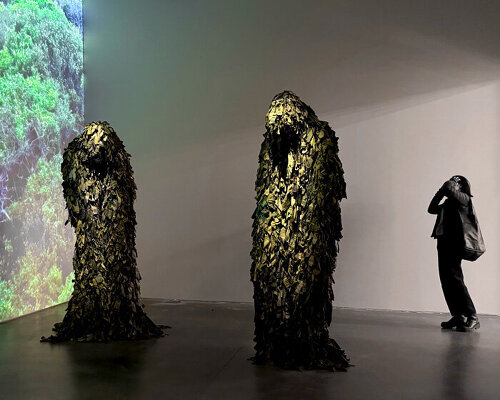
Klára Hosnedlová, Shelter. image © designboom
monstrous and progressive humanity on display
New Humans: Memories of the Future opens alongside the New Museum’s physical expansion, a context that shapes Massimiliano Gioni‘s outlook. Opening a new building today carries a different set of expectations than it did in 2007, and he describes the project as ‘a vote of confidence in the future,’ even while acknowledging a sense of hesitation. Even the architecture by OMA reinforces that direction, with a form like an arrow pointing forward. Meanwhile, the curatorial approach turns back to history’s attempts at imagining what lies ahead.
This backward glance becomes a method. Structured through what Gioni calls a ‘bifocal lens,’ the exhibition places archaeology beside prophecy. It traces optimistic futures that once felt possible alongside those menacing worlds that ultimately became realities with frightening consequences. Some artworks recall visions tied to progress and expansion, while others render humanity’s most monstrous moments.
All together, they suggest that the concept of utopia remains unsettled, shaped through competing ideas of what a future might demand. In this sense, ‘New Humans’ evokes both ambition and consolation, and invites visitors to consider how earlier imaginations of humanity inform what comes next.
Massimiliano Gioni ahead of the New Museum opening. image © designboom
Dialogue with Massimiliano Gioni
designboom (DB): The show explores moments when technological or social shifts changed how people imagined the future of humanity. What made this the right moment to revisit that idea?
Massimiliano Gioni (MG): It’s a few considerations. One is that we are living in a moment in which some changes in the world of technology are coming to, I don’t know if it’s an existential threat, but certainly to an existential questioning.
In my catalog essay I use the examples of computers asking you to prove you’re not a robot. No longer do we just question if we are speaking to a machine or a person — we have actually come to a point in which a machine is asking you to demonstrate that you’re a person. In these moments of existential doubt, I think we retreat in the space of myth. We come to a place where science and technology are so mysterious they appear magical.
And so we enter again into the space of myth. Artists, as the makers of myths, are probably the ones to start from to learn and understand the stories that we tell each other to understand such changes. So there is that, which let’s call the historical moment. And secondly, there is a more private or personal moment, which is the opening of the New Museum.
New Humans: Memories of the Future, 2026, exhibition view. New Museum, New York. image © designboom
MG (continued): To open a building today in 2026 is a very different proposition than when we opened in 2007. Ideas around expansion and novelty were different eighteen years ago. Today, maybe in the wake of COVID, ideas of growth and expansion are certainly different. They come with different expectations, responsibilities, self-doubt, and questioning.
So we thought, we are opening a new building that is somehow a vote of confidence in the future. It means we still believe there is somewhere to go. And we open also with a building that is somewhat futuristic in its evocation. The structure is literally shaped like an arrow pointing forward. So it seemed somehow inevitable to look back at different ideas of the future, some of them that have arrived, some of them that arrived with terrible consequences. Through interrogating those futures, I think we maybe see a way forward.
The show is built on a symmetry or a bifocal lens. It’s split between archaeology and prophecy. By doing so, it looks at some future pasts from which we can receive a warning. The show is also full of terrible ideas connected to ‘new men’ and ‘superior men.’ On one end, that serves as a warning of futures we don’t want to inhabit ever again. On the other, it also serves as a consolation in the sense that, if we have survived previous moments of change, we will hopefully survive this one as well.
New Humans: Memories of the Future, 2026, exhibition view. New Museum, New York. image © designboom
DB: Our editorial theme this season is Utopia, Applied, with utopia being a dissatisfaction for things as they are, and an eternal desire to make them better. We’re interested in utopia less as an abstract ideal and more as something that can shape real thinking and action.
In your view, how does this exhibition engage with that kind of utopian thinking?
MG: That’s a very good question, to which, in a way, I don’t have a full answer. I’m curious to read reviews, because I’m sure people will criticize the show on the account of certain ideas that maybe I’ll go back to.
On one hand, it’s very much about ‘utopias’ in almost the literal sense of a non-place or a different place. The fourth floor is all about cities of the imagination. Utopias are also first and foremost cities — they’re a topos, it’s a place.
I was thinking about the show and reading the book Is There Any World to Come? by anthropologist Eduardo Viveiros de Castro. He asks at this moment in time if it even makes sense to imagine a world to come. He borrows from Bruno Latour a very interesting distinction about two types of utopias. One is the ‘Plus Ultra’ utopia — of which there is a lot in this show — which calls for more technology, more things, improved access to resources or ideas or technology.
New Humans: Memories of the Future, 2026, exhibition view. New Museum, New York. photo © Dario Lasagni
MG (continued): The opposite way of thinking is an ideal future that is not created through constant abundance and growth, but more as a practice of coexistence, as a scaled-down economy of decrease rather than increase. The idea of the ‘future as more’ may not necessarily be the answer. The answer could be a ‘future of less.’ Take Indigenous wisdom, for example. We have a beautiful commission by Santiago Yahuarcani, who’s actually an Indigenous artist from the Amazon.
I also don’t want to be nostalgic in the idea that necessarily less will be the future. They are probably both possibilities. But yes, I think one criticism could be that the show imagines technology as progress and advancement, and maybe the future doesn’t necessarily have to pass that way. But again, I’m not evaluating these futures and giving them words of efficiency or sanity.
There are a lot of futuristic ideas that, thank goodness, failed, or ideas that unfortunately took place. The idea of a ‘new man,’ particularly, was associated also with very frightening ideas that became a reality, of ‘inferior’ races, of racism and so on.
New Humans: Memories of the Future, 2026, exhibition view. New Museum, New York. photo © Dario Lasagni
DB: Do you think artists today still imagine the future with the kind of bold optimism that defined earlier avant-garde movements, or has that attitude changed?
MG: I don’t know. We live in a time in which we are expected, also as museums, as curators, to somehow give a vote to the politics and ethics of artists. It’s a very specific moment in time. It wasn’t like that. I’m not necessarily comfortable with that. My job is not to give a license of goodness.
I hope this show presents a bigger question. I don’t necessarily subscribe to any of the ideas or ethical positions shown throughout the exhibition, because I would also be a monster. To show a poster of Mussolini doesn’t mean that I think Mussolini is a great guy, or that his politics were correct.
New Humans: Memories of the Future, 2026, exhibition view. New Museum, New York. image © designboom
MG (continued): So I don’t know if artists are thinking optimistically or not. Some of the greatest work of art in the history of humanity revealed the horror of us as humans. It would become very narrow if we were to think that museums have to just subscribe to the positiveness of human life. There is plenty of it, but there is also lots of horror. Maybe because I’m Italian I tend to think tragedy is superior to comedy.
I do think there is an instructiveness in looking at negative examples, if anything, to avoid repeating. In the exhibition catalogue I quote from Is There Any World to Come?, which references a ‘prophylactic apocalypticism,’ which means we envision the worst so that it will not happen.
I think some artists envision the world so that it will not happen — if you can imagine it in a way, hopefully it won’t happen.
New Humans: Memories of the Future, 2026, exhibition view. New Museum, New York. image © designboom
The post ‘we will survive this moment as well’: massimiliano gioni revisits history’s ‘new humans’ appeared first on designboom | architecture & design magazine.