
OBRO Transforms Leather Waste into Transparent PVC Composite
OBRO is a material development project by OKUNOTE Tokyo Studio that combines leather production waste with PVC to create a new composite material positioned between leather and plastic. By integrating finely ground leather edge powder into semi-transparent PVC, the project explores alternative approaches to material reuse while examining visual depth, translucency, and surface texture.
The project emerged from the collaboration between a PVC processing manufacturer established in 1947 and a leather goods factory specializing in high-quality bags. During leather manufacturing, offcuts and edge remnants are generated through cutting and finishing processes. Although these remnants retain the same material quality as the finished products, their irregular dimensions typically limit opportunities for reuse. OBRO approaches this by processing leather edges into fine powder and incorporating them directly into PVC sheets, challenging conventional PVC production methods that prioritize uniformity and material purity.
all images courtesy of OKUNOTE Tokyo Studio
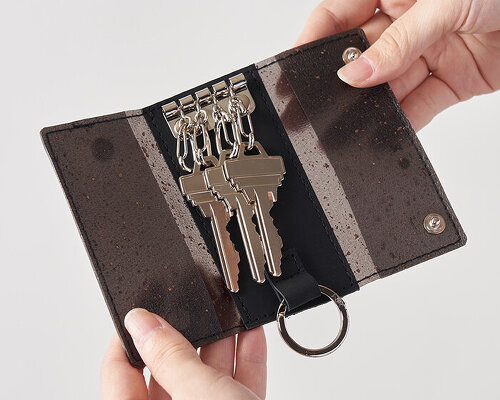
Through iterative prototyping, the combination of leather powder with semi-transparent black PVC produced a layered visual effect in which leather particles remain visible within the material. The resulting surface exhibits controlled translucency, with embedded particles responding subtly to changes in light. An embossed finish inspired by leather grain was added to enhance tactile qualities, producing a surface that balances resin durability with a warmer, more organic feel. The material retains the functional properties of PVC, including light weight, water resistance, and structural stability, while introducing visual and tactile characteristics commonly associated with leather. Variations in particle distribution occur naturally during production, resulting in sheets with distinct patterns and degrees of opacity.
The name OBRO is derived from the Japanese word oboro, referring to a soft or indistinct visual condition, such as mist or diffused moonlight. This concept informs the material’s semi-transparent quality, which partially conceals contents rather than fully obscuring them. The initial application of OBRO appears in a collection of bags and small goods, where the composite material is paired with full-grain leather. Developed in collaboration between OKUNOTE Tokyo Studio and skilled craftspeople, these products are designed to accommodate wear over time, allowing surface changes to register through use. OBRO positions material reuse as an integral design strategy, demonstrating how manufacturing byproducts can be reintroduced into new material systems with distinct visual and functional qualities.
project info:
name: OBRO
designer: OKUNOTE Tokyo Studio | @okunote.tokyo
designboom has received this project from our DIY submissions feature, where we welcome our readers to submit their own work for publication. see more project submissions from our readers here.
edited by: christina vergopoulou | designboom
The post wearable collection repurposes leftover leather powder as translucent composite material appeared first on designboom | architecture & design magazine.