
Sensors collect signals for wearable smart necklace revoice
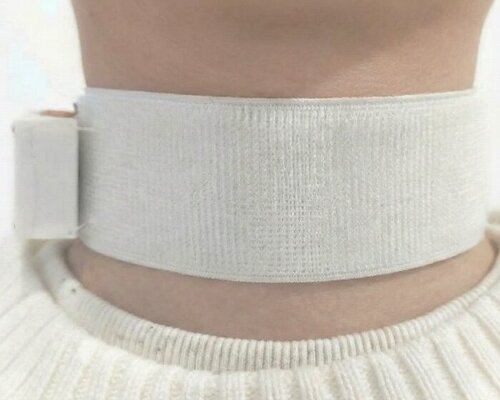
Researchers at the University of Cambridge have developed Revoice, a wearable smart necklace that helps patients who suffered from stroke speak naturally again. The device was created to help the patients communicate in a more natural way without surgery or brain implants in hopes of bringing their old voices back. It is a soft, flexible wearable device that looks like a fabric choker worn around the neck. From the textile, it is lightweight, comfortable, and can be washed like regular clothing. The modest design allows users to not feel like they’re wearing medical equipment.
The wearable smart necklace Revoice aims to turn silent or unclear speech movements into clear, full sentences that other people can understand, working in real time, so users can take part in conversations. Revoice uses ultra-sensitive sensors to collect signals from the body. First, they pick up tiny vibrations from the throat muscles when a person mouths words, even if no sound comes out. Second, they measure the person’s heart rate, which can give clues about their emotional state, such as stress or frustration.
all images courtesy of the researchers and Universitry of Cambridge
AI systems turn short phrases into full sentences
The signals collected by the sensors are sent to two artificial intelligence systems, also called AI agents. Each AI agent has a different job. The first AI focuses on speech reconstruction, and it takes the small throat movements from silently mouthed words and figures out what words the person is trying to say. Even if the person can only mouth a few short words, the AI can recognize them. The researchers say that the second AI looks at emotion and context. It uses heart rate data and simple information like the time of day or the situation to understand how the person might be feeling. For example, a faster heart rate could mean stress or discomfort.
This AI helps turn short phrases into full, natural sentences that match the person’s feelings and situation. In a small study with five stroke patients who had dysarthria, the wearable smart necklace Revoice shows that the device made very few mistakes, with low word and sentence error rates. The researchers add that the participants reported feeling more satisfied and more confident when communicating. In an example, a patient mouthed the words ‘We go hospital,’ and the wearable smart necklace Revoice turned this into a full sentence, explaining that the person wanted to go to the hospital because it was late. So far, the device is still in a prototype phase, and with more testing and future improvements, it can improve the recovery of patients who have suffered from stroke.
it is a soft, flexible wearable device that looks like a fabric choker worn around the neck
the wearable smart necklace Revoice aims to turn silent or unclear speech movements into clear, full sentences
the device uses ultra-sensitive sensors to collect signals from the body
project info:
name: Revoice
institution: University of Cambridge | @cambridgeuniversity
Researchers: Chenyu Tang, Shuo Gao, Cong Li, Wentian Yi, Yuxuan Jin, Xiaoxue Zhai, Sixuan Lei, Hongbei Meng, Zibo Zhang, Muzi Xu, Shengbo Wang, Xuhang Chen, Chenxi Wang, Hongyun Yang, Ningli Wang, Wenyu Wang, Jin Cao, Xiaodong Feng, Peter Smielewski, Yu Pan, Wenhui Song, Martin Birchall, Luigi G. Occhipinti
study: here
The post wearable smart necklace helps patients who have suffered from stroke speak again appeared first on designboom | architecture & design magazine.