
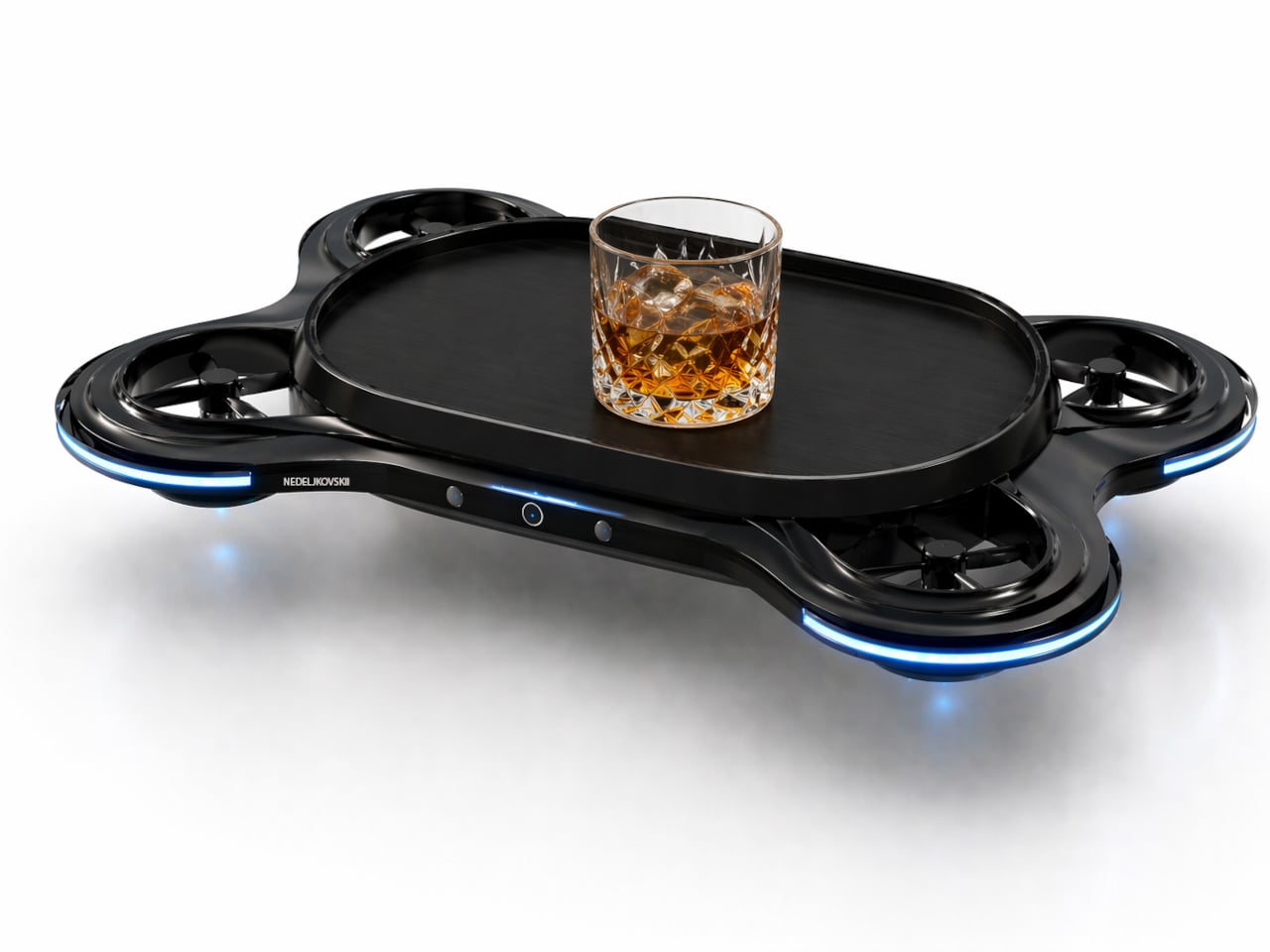
Smart home technology has reshaped how we think about convenience, but most of it still assumes you’re the one who has to reach for things. Appliances respond to voice commands, lights adjust to your mood, and thermostats learn your schedule. Yet the objects we grab dozens of times a day, from a glass of water to the TV remote, still sit wherever you last left them.
Designer Ivana Nedeljkovska’s ORBIA concept takes a different angle on this problem. Rather than adding another smart feature to a home setup, it asks a more fundamental question about object design itself: why do objects have to stay still? ORBIA is envisioned as an autonomous flying serving tray that moves through space, navigates around obstacles, and delivers objects directly to wherever the user happens to be.
Designer: Ivana Nedeljkovska
It’s a concept that doesn’t fit neatly into any existing product category. The design is built around an intelligent navigation system that enables ORBIA to understand its surroundings, read the space it moves through, and adjust its path in real time. That capability is what separates it from the static, fixed-in-place gadgets that populate most homes today, no matter how sophisticated those gadgets might be.
Think about a quiet evening at home. You’re in the middle of something, and your drink is across the room. With ORBIA, you wouldn’t need to interrupt what you’re doing. The concept is designed to respond to a call without requiring any physical contact, operating quietly and precisely, functioning as a kind of unobtrusive assistant that simply appears when needed and retreats when it’s done.
The same thinking applies in a hospitality setting, where service efficiency has always been a balancing act. In a restaurant or lounge, ORBIA could handle the routine deliveries that currently require constant back-and-forth from staff, moving between spaces with the same quiet precision it brings to a living room. The system reads its surroundings continuously, adjusting course around obstacles and adapting to different spatial conditions in real time.
Where the concept gets particularly compelling is accessibility. For someone with limited mobility, having to rely on others to bring everyday objects can quietly erode a sense of independence. ORBIA is designed with that in mind, offering support that lets people access things around them on their own terms, without having to wait or ask someone else for help each time.
Visually, ORBIA doesn’t try to announce itself. The form is clean and minimal, built around a large oval tray surface with a brushed matte finish, carried by a quad-rotor body whose contours flow outward in smooth, organic curves. Blue LED lighting runs along the underside and rotor housings, giving the whole thing a quiet, purposeful glow that integrates naturally into a contemporary interior.
There’s still a long way between this concept and something you could buy, and the engineering involved is genuinely complex. But ORBIA isn’t trying to be a product announcement. It’s a design argument, one that makes the case for a future where objects go beyond being smarter to becoming fundamentally more active, bringing things to you rather than waiting to be carried.
The post What If Your Drink Could Fly Itself Across the Room to You first appeared on Yanko Design.