
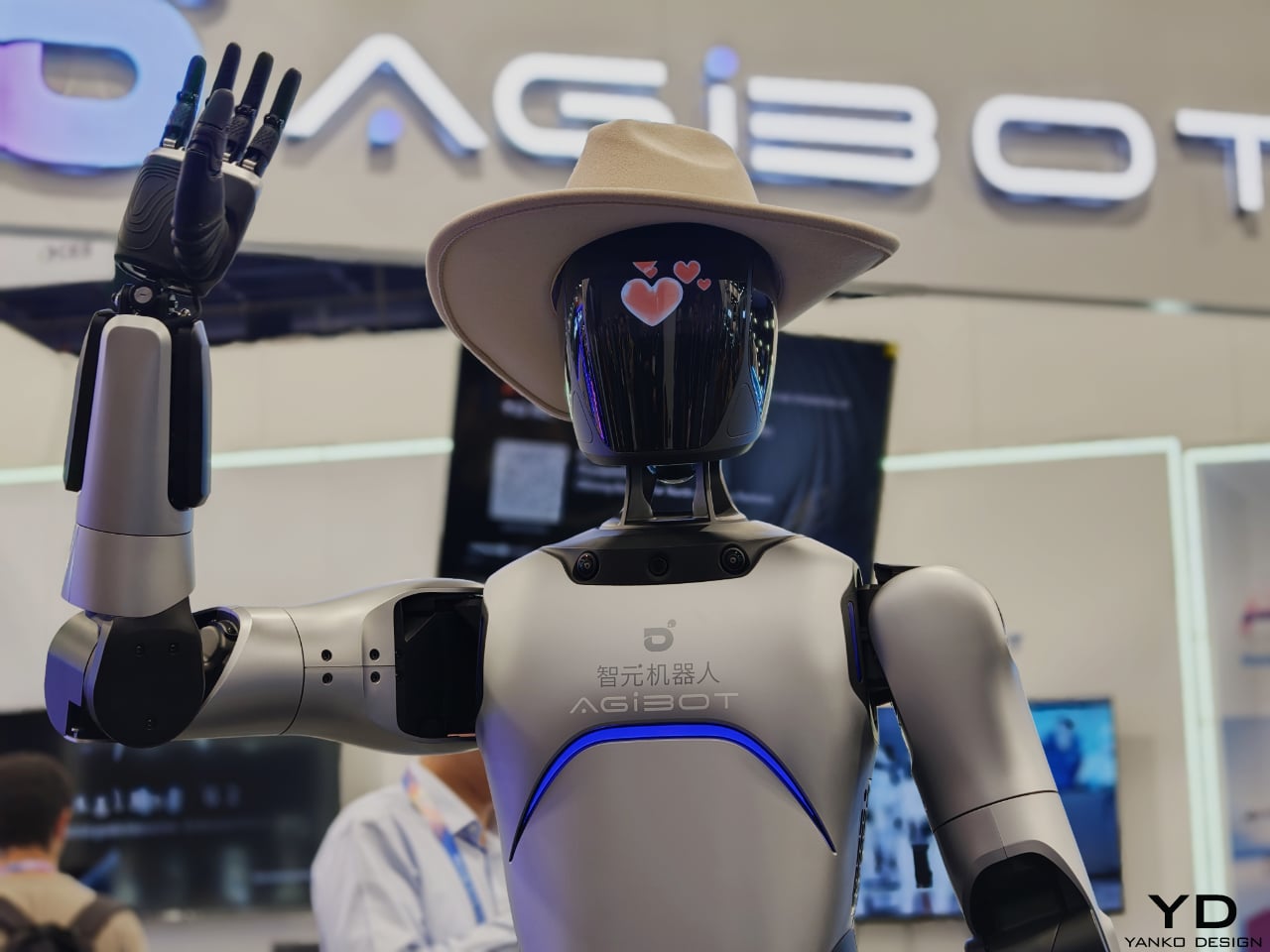
Agibot entered the U.S. spotlight at CES 2026 as a company that has been busy actually building and shipping robots instead of just talking about what might be possible someday. Founded in 2023 with the ambition of creating robots that can live and learn alongside people, it has already moved 5,000 humanoid units into real deployments worldwide. That number matters because it puts AGIBOT past the prototype stage, where many humanoid projects still sit, and into a space where robots are expected to be reliable, repeatable, and ready for everyday use.
Instead of centering everything on one showpiece machine, AGIBOT has built out a broad portfolio that stretches across very different environments. At CES 2026, the company showed full-sized humanoids for public and customer-facing spaces, compact expressive robots for entertainment and research, industrial units aimed at factories and logistics centers, quadrupeds for inspection in complex terrain, and a dexterous robotic hand system. Each product has its own job, but they all share a simple expectation. Robots should be able to move through the world, communicate with people, and carry out useful work without constant human babysitting or elaborate staging.
Designer: Agibot
You really feel that philosophy when you stop reading spec sheets and just stand in front of one of the robots. On the CES show floor, my colleague in a blue sweater walked up to an AGIBOT A2 and greeted it from directly in front. The robot answered with an easy “hello,” then followed up with a friendly compliment that referred to her as “the lady in blue.” The recognition landed instantly with no visible lag, no frozen expression, and no glitchy audio. The exchange felt less like triggering a scripted demo and more like stepping into a light, everyday interaction with a staff member who just happens to be a humanoid robot.
The A2’s digital face helped make that moment feel approachable rather than uncanny. Instead of a fixed set of cartoon features, the display shifted through different visual modes as the interaction unfolded. At times, it showed a simple, stylized face that made it clear where its attention was focused. At other moments, it flipped into a flowing heart animation or playful emoji-like graphics that matched the energy of the show floor. Those changes acted as live signals that the robot was listening, processing, or responding, and they gave the encounter a kind of emotional rhythm that pulled people in instead of pushing them away.
A second interaction underlined how aware the robot could be of what people were doing around it. While I stood in front of the A2 snapping photos, the robot clocked what I was doing and casually acknowledged that I was taking pictures. It did not sit there waiting for a wake word or a preset gesture. Instead, it folded that small piece of context into the way it responded, treating the camera as part of the scene rather than a distraction. In the middle of a crowded, noisy hall, that ability to notice and adapt in real time made the robot feel present and attentive rather than mechanical.
What makes these scenes interesting is not simply that a robot can spot a blue sweater or a raised smartphone. It is that the whole exchange runs at a human pace. There are no long pauses while the system silently catches up, no handlers stepping in to reset things, and no sense that the robot is about to break character. The conversation and the gestures move forward with the timing you expect from a front desk host or a showroom guide. That sense of ease is hard to fake, and it hints at how much careful engineering it takes to keep perception, speech, and movement in sync under real-world pressure.
Agibot’s broader deployment history helps explain why those details feel so polished. The company’s robots are already working in reception and hospitality roles, performing in entertainment settings, supporting industrial manufacturing, sorting items in logistics operations, patrolling for security, collecting data, and serving as platforms for research and education. Each environment stresses the systems in different ways, from handling background noise to navigating cluttered layouts and unpredictable human behavior. The lessons from those deployments fed directly into the behavior visitors saw at CES 2026, where the robots had to cope with constant traffic and curious crowds without losing composure.
Looking back at the show, Agibot’s U.S. debut feels less like a distant promise of what humanoid robots might one day become and more like a grounded snapshot of where they already are. Multiple robots moved in coordinated demonstrations, interacted with people, and handled small but meaningful tasks in full view of a demanding crowd. In that context, the A2 recognizing a passerby in blue and another visitor behind a camera is not a show trick. It is a quiet, convincing example of a company that has decided to measure progress by what its robots can do on an ordinary day, in a very public place, with no second take.
The post When a Robot Compliments Your Blue Sweater: Inside AGIBOT’s Surprisingly Natural Humanoids first appeared on Yanko Design.