
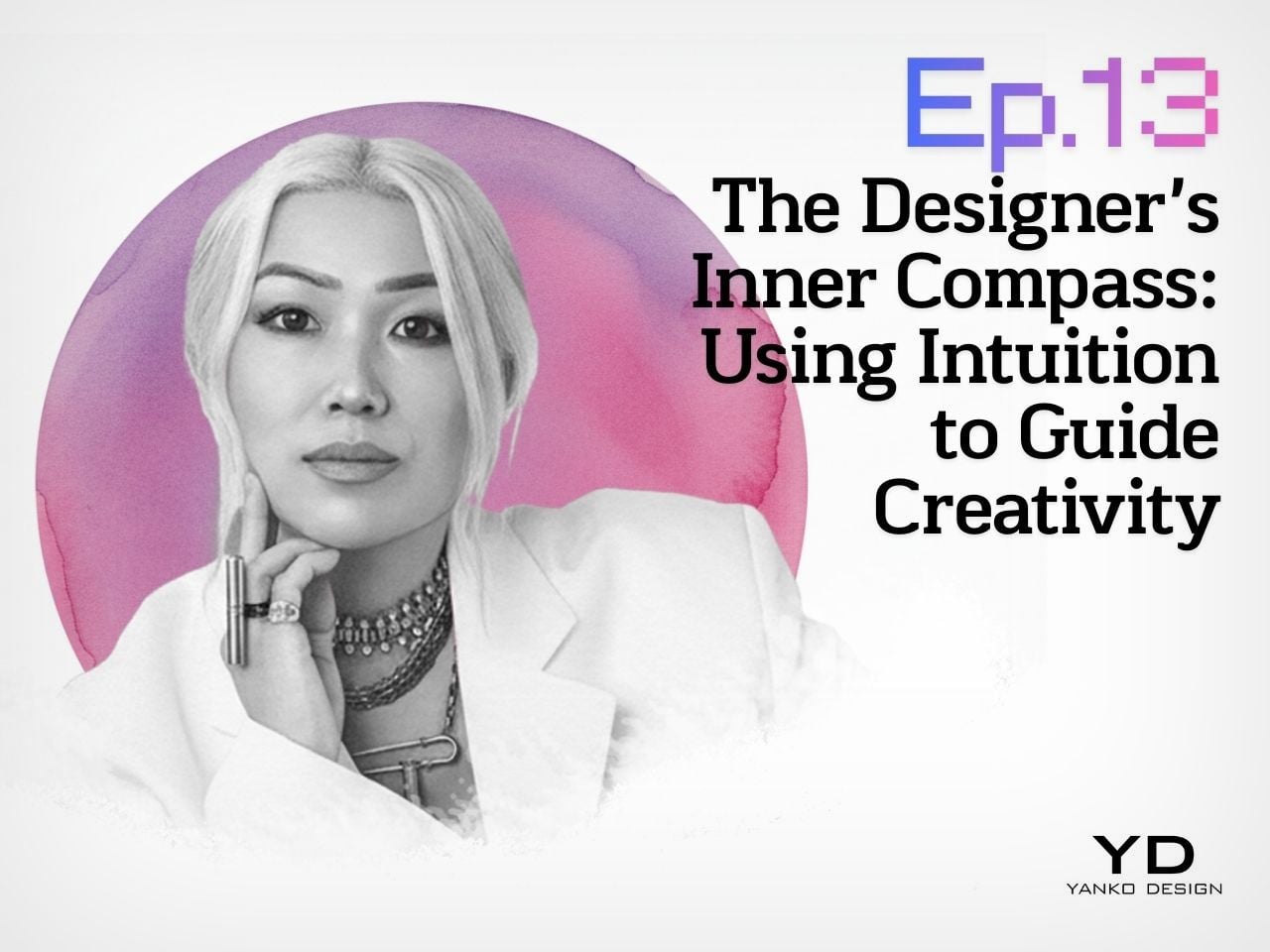
Design Mindset, Yanko Design’s weekly podcast powered by KeyShot, is quickly becoming a space where designers unpack how ideas actually move from gut feeling to shipped product. Episode 13 zeroes in on something every creative feels but rarely names clearly: that inner voice that pulls you toward a risky idea long before the data looks friendly. Host Radhika Singh calls it “that mysterious inner voice that guides our best work,” the sensation when “data says one thing but something deeper says let’s try something else instead.” A new episode drops every week, and this one sits right at the intersection of intuition, taboo, and cultural change.
This time, Radhika speaks with industrial designer and entrepreneur Ti Chang, Co Founder and Chief Design Officer at CRAVE, the San Francisco company behind design led vibrators and “pleasure jewelry” for women. Ti has spent her career trusting her creative compass in one of the most stigmatized consumer categories. From Duet, an early crowdfunded USB rechargeable vibrator, to necklaces that double as vibrators, she keeps making moves that look commercially reckless on paper and then quietly create new product categories. The episode becomes a compact playbook for using intuition without abandoning rigor.
Download your Free Trial of KeyShot Here
Trusting your inner compass when no one else sees it
Ti does not treat intuition as a vague vibe. It is the core of how she decides what to make. “Intuition is something that have guided me throughout my process,” she says. Her first filter is simple: if a concept does not resonate deeply with her, it is unlikely to resonate with others. “If you follow your intuition to create something that resonates with you, there’s a much higher chance that you’ll resonate with somebody else.” She borrows that framing from Rick Rubin’s The Creative Act, but applies it in a very concrete way to industrial design.
Her career choices follow a three part test. “I’ve been able to find something that serves people and that I’m interested in and I have the skill set to do, and the marriage of these three is what has allowed me to I think have a quite a fulfilling life so far.” Intuition, for her, is not anti research. It is what tells you which questions to ask, which users to serve, and which ideas deserve the grind of engineering and validation. When Radhika asks what trusting that compass feels like, Ti is blunt: “It feels scary. It feels scary and it feels isolating because you’re the only person who sees it and nobody else quite understands it. And so for a long time, you’re going to just be in a scary kind of alone, a lonely spot.” Being early, she suggests, comes with that loneliness baked in.
Nudging culture from the middle, not the extremes
Designing for intimate wellness means walking a tightrope between too safe and too provocative. Ti describes her job as knowing her “playground.” On one edge are clinical, anonymous forms that keep taboos intact. On the other are objects so polarizing that they scare off the very people she wants to reach. Her goal is to live in the middle, where aesthetics are aspirational enough to move culture, but digestible enough that people actually buy and use them.
“You want to be able to nudge people along, bring them along with an aesthetic that they find acceptable and that they can digest, while all the while pushing, you know, aspirational and also creating room for a little more edginess, you know, without completely polarizing them.” She is clear about the commercial reality too. “If I created something that was just so polarizing, I’m sorry, like I would probably sell three a year, you know?” That is not just bad business, it is misaligned with her mission. “I know my playground. I know what will work for the agenda that I am trying to help people have a more open conversation about pleasure.” That agenda shapes choices around materials, silhouettes, and how proudly a product can sit on a bedside table without broadcasting its function.
Duet and pleasure jewelry, when “crazy” ideas become categories
CRAVE’s Duet is a neat case study in how Ti blends intuition with hard engineering. Long before USB everything became standard, she and her team asked why intimate products still relied on disposable batteries and clumsy chargers. The answer became a slim metal vibrator that plugged directly into a USB port, with the motor and electronics separated for safety and durability. This was 2008, pre Kickstarter playbook. Ti self funded prototypes, sourced metal work in China, and took early units to an adult products trade show. Instead of over indexing on focus groups, she watched buyer behavior. Immediate purchase orders were her market validation that the gut call was reading the culture correctly.
If Duet was bold, pleasure jewelry was the move that really made people think she had lost it. In the rapid fire round, when Radhika asks for “one decision you made on pure intuition that everyone thought was crazy,” Ti answers instantly: “Pleasure jewelry.” Turning necklaces and bracelets into fully functional vibrators that can be worn in public contradicted every convention in the category. Investors struggled to imagine why anyone would want their vibrator around their neck. Only once the pieces existed, and early adopters responded emotionally, did the idea begin to make sense to the market. Ti is careful not to claim that empowerment lives in the object. She rejects the notion that women must wear pleasure jewelry to feel powerful, framing empowerment as internal, with products as optional tools that some people find resonant and others simply do not.
Selling intuition to data driven stakeholders
A big chunk of value in this episode lies in how Ti translates a private hunch into something investors, engineers, and retailers can actually work with. Stakeholders do not fund “I have a feeling.” They fund roadmaps and artifacts. Visualization tools sit at the center of that bridge. KeyShot, the episode’s sponsor, is part of her daily workflow, letting her explore materials, textures, and finishes in real time. Those renders are not just for pitch decks. They help her test her own instinctive reaction to an object’s presence. In intimate categories, she often finds those visceral responses more useful than sanitized focus group quotes.
At the same time, she respects data enough to let it overrule her when the stakes are commercial rather than artistic. She laughs about being wrong on colors. “I’ve seen myself thinking like this color is going to be amazing. I’ve been wrong many times. And when you’re wrong with something as, like, in product, when it comes to color, you’re stuck with a lot of inventory and you do not want that. That is not good for business.” In a hypothetical startup challenge, where user testing clearly favors a more clinical aesthetic over a playful one the designer loves, she is clear. If this is not an art project, you ship what users are ready for. Yet she refuses to let numbers become the only voice. Asked what designers who only trust data are missing, her answer is sharp and short: “Missing their heart and soul.”
Prototyping life, not just products
Later in the conversation, Ti talks about being diagnosed with ADHD and autism as an adult. Hyperfocus on topics like gender equality, pleasure activism, and emotional design has been a quiet engine behind her work, letting her stay with difficult ideas long after others would have moved on. The flip side is that when she is not deeply interested, progress stalls. Instead of fighting this, she now uses it as part of her compass, choosing projects she knows she can stay obsessed with for years.
Underneath all the specifics of sex tech and crowdfunding, the operating system stays the same. When you cannot see the full path, you prototype. Ti treats “try, learn, iterate” as both a design tactic and a way to navigate an unconventional career. When Radhika asks if she would still design something her intuition loves even if she knows it will not sell, Ti says yes, “if I think it’s going to be a fun journey.” Some ideas exist to move markets. Some exist to keep the creative self alive. Episode 12 of Design Mindset captures that balance cleanly, showing intuition not as the opposite of research, but as the spark that tells you which risks are worth taking in the first place.
Listen to the full conversation on Design Mindset (powered by KeyShot), available every week on YouTube, to hear more insights from one of the industry’s most decorated design leaders.
Download your Free Trial of KeyShot Here
The post When Data Says No And Your Gut Says Go: What Designers Can Learn From Ti Chang first appeared on Yanko Design.