
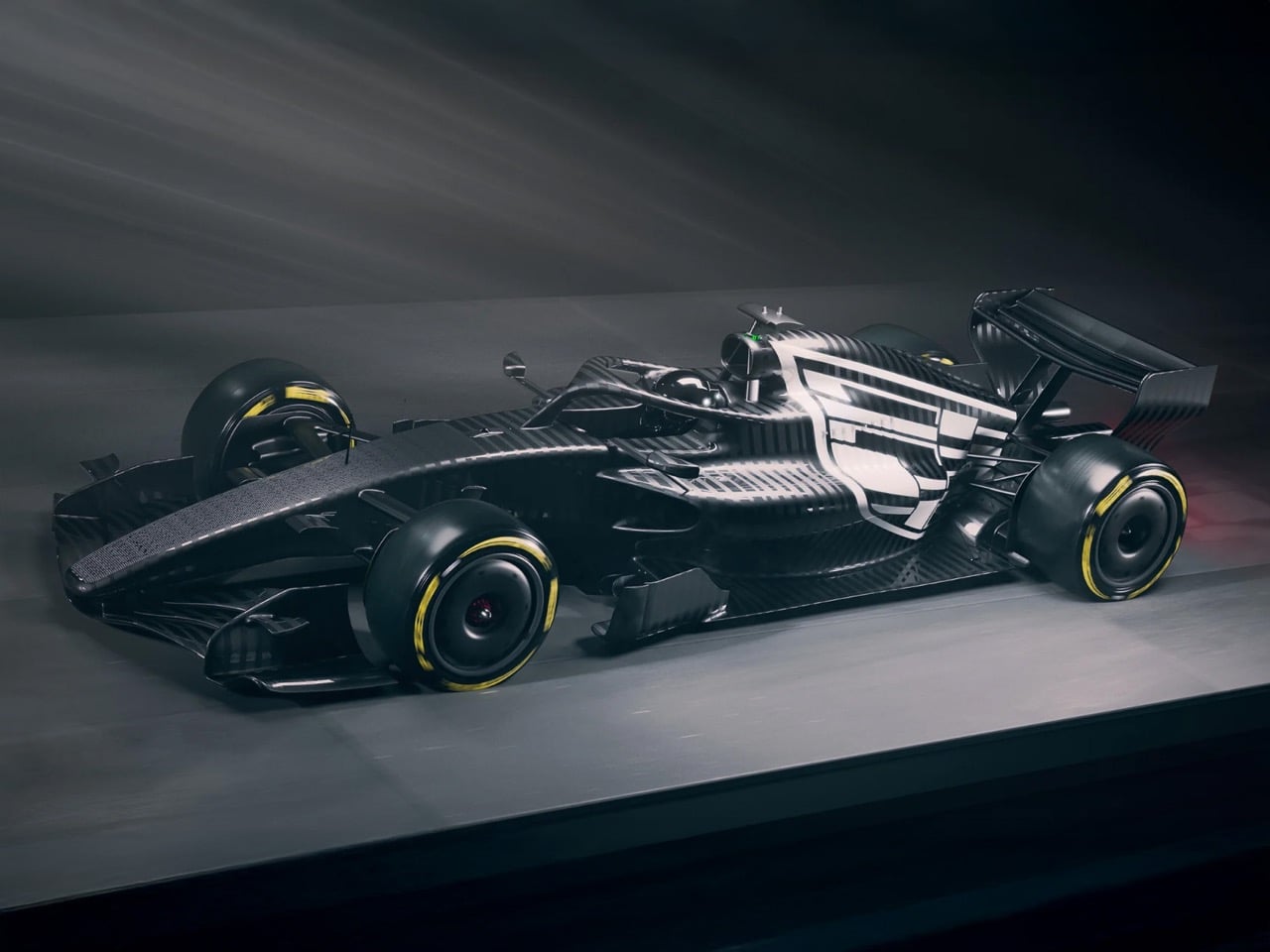
Formula 1 teams revealed their 2026 testing plans weeks ago, creating a strange temporal problem. Everyone knows Cadillac will run at Barcelona’s closed-door shakedown on January 26. Everyone knows the real livery reveal happens during the Super Bowl broadcast on February 8. That leaves a two-week gap where the team exists in public view but hasn’t officially launched. Most teams would treat this like dead air.
Cadillac’s response was to design specifically for that liminal space. The testing livery features what they call “the Cadillac precision geometric pattern” in gloss and matte sequences, turning functional camouflage into brand vocabulary. They’re using the constraint of secrecy to communicate design philosophy, establishing that their approach blends automotive prototype discipline with motorsport theater. The giant Cadillac crest draped across the engine cover isn’t trying to hide anything. It’s declaring that the space between stealth and spectacle is itself worth designing for.
Camouflage As A Design Language
Cadillac didn’t reach for F1’s usual testing camouflage playbook. They reached for Detroit’s. The vertical geometric pattern running front to back uses alternating gloss and matte treatments, which is straight out of automotive prototype testing methodology. When manufacturers test pre-production vehicles on public roads, they use dazzle camouflage patterns to break up body lines and prevent photographers from capturing accurate proportions. The gloss-matte alternation specifically disrupts how light reads surface contours, making it harder to discern where one body panel ends and another begins. Cadillac has imported that exact technique onto their F1 car, establishing a visual link between their production vehicle development and their racing program before anyone sees them turn a wheel.
This matters because F1 test camouflage typically aims for generic obscurity. Teams either run bare carbon fiber (functional, boring) or apply random geometric patterns (functional, slightly less boring). What Cadillac did requires actual design development work. GM’s press release confirms the testing livery came from “a cross-continental collaboration” between their global design office and the F1 team’s operations spanning the US and UK. They committed design resources to a livery that will only exist for four days of closed-door testing in Barcelona between January 26-30. That’s an unusual allocation of effort for something most teams treat as throwaway content.
The monochrome palette reinforces the automotive prototype reference while giving Cadillac room to establish brand identity without committing to race colors. Black and silver create what GM describes as “a striking and premium appearance” linked to “a modern interpretation of the iconic Cadillac crest and shield”. Translation: they want you thinking about Cadillac’s luxury automotive positioning while accepting that you’re looking at operational camouflage. The cognitive dissonance is intentional.
Founder Names as Front-End Real Estate
Cadillac embedded the names of their founding team members from both the US and UK facilities onto the nose section. This is where the design brief gets interesting from a messaging perspective. F1 teams occasionally acknowledge personnel on liveries, usually through small decals or subtle typography. Cadillac made founder recognition a primary design element on arguably the most visible part of the car during front-facing photography. The nose gets scrutinized heavily during testing because it’s where teams often trial different aerodynamic configurations. Every photo analyzing nose geometry will also capture those founder names.
The positioning serves dual purposes: it humanizes what could have been pure corporate branding while reinforcing that this program exists because specific people made it happen. Cadillac can’t claim decades of F1 heritage like Ferrari or McLaren, so they’re building a founding mythology in real-time. The test livery becomes the origin story document. When people look back at Cadillac’s first F1 laps, those founder names will be visible in every archive photo. That’s smart long-term brand narrative construction disguised as a nice gesture.
It also signals confidence. Teams worried about looking amateurish during their debut typically minimize branding and keep things conservative. Cadillac put a massive crest across the engine cover and devoted premium nose real estate to personnel acknowledgment. They’re treating Barcelona testing like it matters as a brand moment, which suggests they believe their on-track performance won’t immediately embarrass them. Whether that confidence proves warranted remains speculation until they actually run, but the design choices indicate they’re comfortable being highly visible during the shakedown.
Designing for the Gap Between Testing and Launch
The Barcelona test runs January 26-30. The Super Bowl reveal happens February 8. Official pre-season testing in Bahrain starts February 26, where all teams must appear in their actual race liveries. Cadillac carved out a specific design approach for that middle window when they exist publicly but haven’t officially launched. Most teams would use placeholder graphics or early-reveal their race livery to fill that gap. Cadillac treated it as its own design challenge requiring a distinct solution.
This approach mirrors product launch strategies in consumer tech, where companies often deploy teaser campaigns that reveal design philosophy without showing final products. Apple does this constantly with cryptic event invitations that establish aesthetic direction before unveiling actual devices. Cadillac applied that thinking to F1, using the testing livery as a teaser that communicates brand values (precision, Detroit heritage, automotive development discipline) while maintaining suspense about the race livery. The testing design becomes a prologue rather than a placeholder, giving them two separate moments of visual impact instead of one.
The gamble is whether anyone cares about F1 testing liveries enough for this strategy to matter. Cadillac clearly believes the Barcelona shakedown will generate significant coverage despite being closed to the public, likely because they’re the first new F1 team since Haas in 2016. They’ve got Sergio Perez and Valtteri Bottas driving, both former race winners with existing fan bases. Media attention will be high regardless of access restrictions. By creating a testing livery with actual design intent, Cadillac ensures that coverage focuses on their visual identity and brand positioning rather than just “new team testing in generic camo.”
The Super Bowl Gambit: Two Reveals, Two Audiences
Announcing a February 8 Super Bowl reveal for the race livery turns the testing design into an explicitly temporary statement. Cadillac could have just revealed the race livery now and run it in Barcelona, but separating the reveals creates narrative momentum. The testing livery establishes that Cadillac takes design seriously and imports automotive development discipline into F1. The race livery reveal during America’s biggest television event positions F1 as mass-market entertainment rather than niche European motorsport. Two different messages for two different audiences, with the testing livery handling the credibility building while the Super Bowl moment handles scale and spectacle.
The testing livery will also be on display at the Detroit Auto Show through January 25, giving Detroit-area fans a chance to see it in person before Barcelona. That’s a local market play that reinforces the “Detroit design heritage” messaging GM President Mark Reuss emphasized during the unveiling. Cadillac is working multiple audience segments simultaneously: F1 enthusiasts who’ll scrutinize Barcelona testing, Detroit locals who can visit the auto show, and mainstream American viewers who’ll catch the Super Bowl reveal. The testing livery serves the first two groups while building anticipation for the third.
Whether this layered approach actually moves the needle on Cadillac’s brand perception or F1’s American growth depends on factors beyond livery design. But treating the gap between testing and launch as a design opportunity rather than dead space shows sophisticated thinking about how modern brand reveals work across multiple channels and timelines. The testing livery exists because Cadillac recognized that the waiting room deserves its own design language.
The post Why Cadillac Designed Its F1 Camouflage to Actually Stand Out first appeared on Yanko Design.