
zha to design key cultural buildings in Hangzhou, china
Zaha Hadid Architects (ZHA) is selected to design key cultural buildings within the Qiantang Bay Cultural District, a major canal-side regeneration project in Hangzhou, China. Anchored by the Qiantang Bay Central Water Axis in Xiaoshan district, the scheme transforms former industrial land along the Zhedong Canal into a continuous landscape of parks, gardens, and civic spaces.
Conceived as a green corridor threading through the city, the Central Water Axis reorganizes the canal basin into a sequence of landscaped terraces and waterfront promenades. New bridges and pedestrian paths stitch together both sides of the canal, reconnecting surrounding neighborhoods to the water while establishing a network of plazas and performance spaces designed for everyday use as well as large gatherings. Cultural and educational buildings line this axis, each oriented toward the public realm and shaped by views, circulation patterns, and seasonal solar exposure.
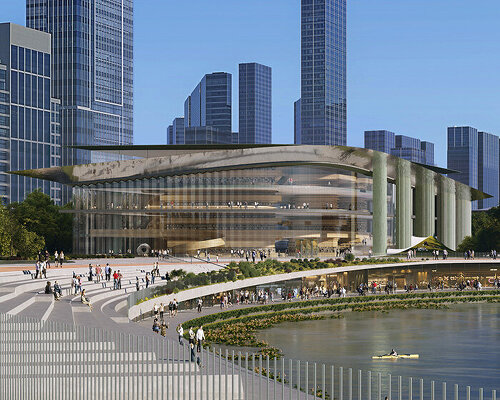
library at Qiantang Bay Cultural District | all renders by Atchain, unless stated otherwise
the library as civic anchor of the regeneration project
Within this setting, ZHA’s library proposal becomes both an architectural and symbolic anchor. Its structure is organized around a series of inhabitable columns that function simultaneously as load-bearing elements and spatial containers. The team conceived these columns as assembled ‘stones of knowledge,’ housing book collections, archives, reading rooms, and community spaces, while allowing the structural logic of the building to directly express its civic role.
Materially, the library draws from Hangzhou’s regional history, referencing the area’s 5,000-year tradition of jade craftsmanship. Precision-crafted masonry tiles echo the tonal depth of jade, while folded glass elements are embedded within the facade to diffuse daylight deep into the interior.
youth centrer at Qiantang Bay Cultural District | render by Proloog
youth, exchange, and climate-driven urban infrastructure
Complementing the library, the International Youth Centre extends the cultural focus of the district toward exchange and collaboration. Defined by its waterfront position, the geometric composition of the building responds to the canal’s edge and continues inward through a carved interior of interconnected auditoriums, studios, and flexible spaces for seminars, exhibitions, conferences, and performances. Canal-facing terraces expand this program outdoors, supporting informal gatherings and public events along the water.
Across the wider development, environmental performance is integrated at both architectural and landscape scales. Energy-efficient systems and on-site power generation are combined with strategies shaped by local ecology and climate. The Central Water Axis landscape forms part of Hangzhou’s established sponge-city infrastructure, using permeable surfaces, planted swales, and water-retention features to manage stormwater and reduce flood risk.
youth centrer at Qiantang Bay Cultural District | render by Proloog
library at Qiantang Bay Cultural District | render by Proloog
the scheme transforms former industrial land into a landscape of parks, gardens, and civic spaces
the library columns are conceived as assembled ‘stones of knowledge’ | render by Proloog
referencing the area’s 5,000-year tradition of jade craftsmanship
project info:
name: Qiantang Bay Cultural District
architect: Zaha Hadid Architects | @zahahadidarchitects
location: Hangzhou, China
principal: Patrik Schumacher
competition project directors: Lei Zheng, Simon Yu
competition associate: Jinqi Huang
competition project architect: Yenfen Huang
competition project leads: Yenfen Huang, Charles Harris, Sonia Magdziarz
competition team: Joshua Anderson, Nils Fischer, Charles Harris, Jinqi Huang, Yenfen Huang, Yvonne Huang, Ruzena Maskova, Sonia Magdziarz, Svenja Siever, Yaobin Wang, Ke Yang, Simon Yu, Lei Zheng
The post zaha hadid architects to design series of cultural buildings along canal in hangzhou, china appeared first on designboom | architecture & design magazine.