
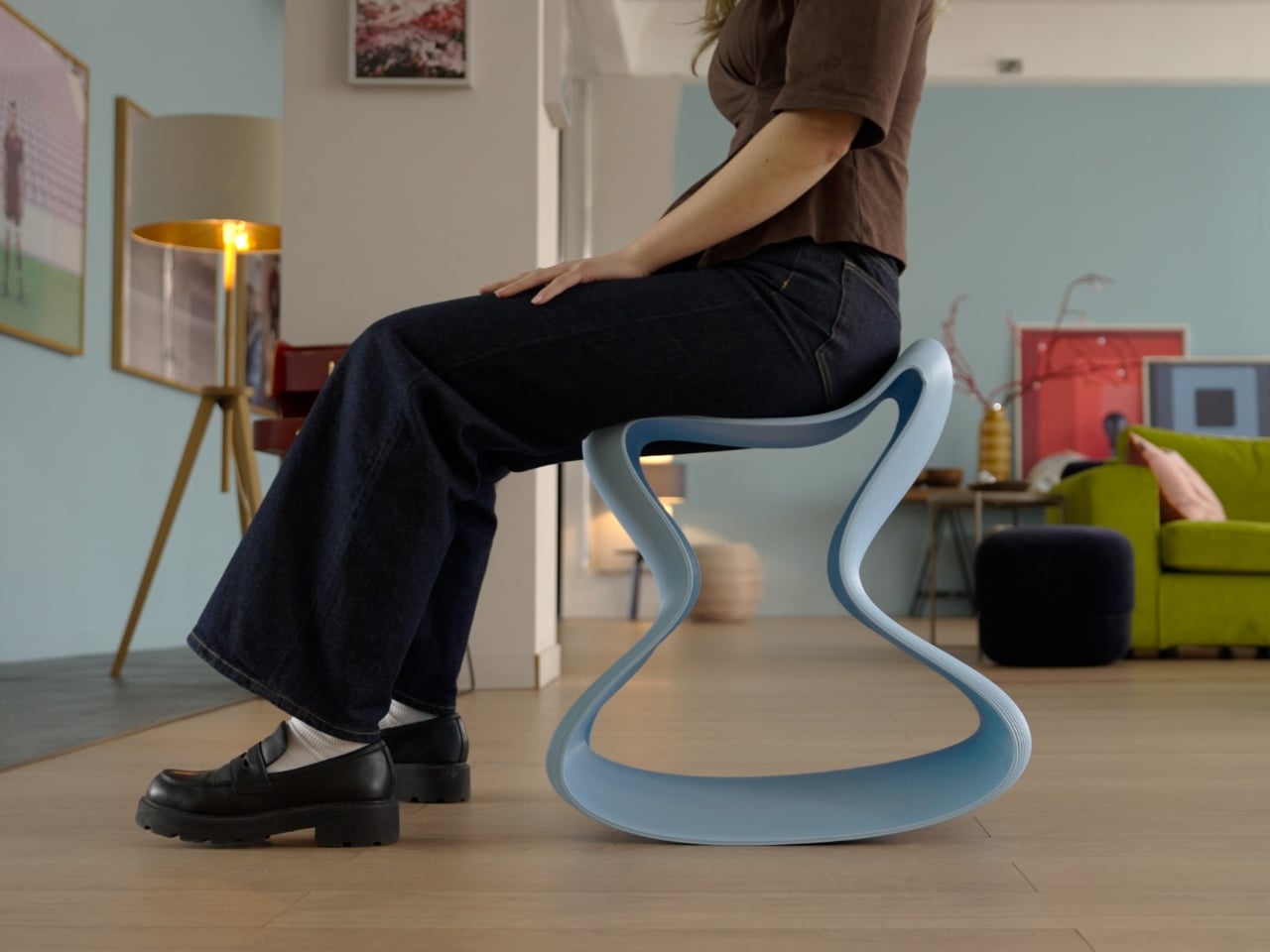
The first time I looked at the Flow Chair, I thought it was a sculpture. The sinuous, looping form bending into itself like a standing wave frozen mid-motion. No visible joints, no screws, no padding, no legs in the traditional sense. Just one continuous ribbon of material that somehow, impossibly, holds a person’s weight while gently rocking beneath them.
That last part surprised me. The Flow Chair, designed by Daniel Streilein and Henry Boy of the German studio Boldobjects, is not actually a chair in the way we typically think about chairs. It’s a rocking stool, and it functions through the intelligence of its shape rather than through any kind of mechanism. You shift your weight, and it responds. You lean forward to concentrate, and it follows. You settle back, and it adjusts. No moving parts. No knobs to turn. No assembly required. The geometry does all the work.
Designers: Daniel Streilein and Henry Boy (Boldobjects)
I’ve been thinking about this a lot lately, specifically the idea that so much of modern ergonomic furniture design has overcomplicated the act of sitting. We’ve added lumbar supports and pneumatic height adjustors and tilt-tension knobs, and yet most office workers still end the day with a stiff back and a neck that sounds like a bowl of cereal. The Flow Chair is a direct argument against all of that. Its proposition is simple: give the body room to move, and it will figure out the rest.
The manufacturing process is just as interesting as the design itself. The Flow Chair is produced using large-scale pellet 3D printing, a more industrial cousin of the desktop 3D printing most people are familiar with. This process allows for the kind of fluid, organic geometry that would be nearly impossible, and almost certainly cost-prohibitive, to achieve through traditional molding or casting. You can actually see the layer lines running across the surface of the chair, horizontal bands that trace the path of the print head as it built the form up from nothing. Most designers would treat those lines as a flaw. Streilein and Boy treat them as texture, a visual record of how the object came to be. I find that genuinely compelling. The chair doesn’t hide what it is.
What makes the sustainability story here worth paying attention to is that it isn’t just a marketing footnote. The Flow Chair is made from a single material: recycled PETG. No adhesives, no hardware, no secondary components of any kind. When the stool eventually reaches the end of its life, it can go back into the production cycle without complex processing. The branding is embossed directly into the base material rather than applied as a separate label. Even the decision to manufacture locally in Germany shortens the supply chain in a meaningful way. Every design choice reinforces the same intention, and that kind of coherence is rarer than it should be.
It also comes in a range of colors including deep forest green, powder blue, sage, and near-black, which tells you something about how Boldobjects is thinking about this object. It’s not purely a functional tool. It’s a considered, designerly thing meant to live in real spaces with real aesthetics. Looking at the photographs, it holds its own in a warm, book-lined study just as well as it does in an eclectic living room. That versatility is harder to engineer than it looks.
The Flow Chair sits, if you’ll allow the pun, at an interesting intersection. It belongs in a conversation about sustainable materials and digital fabrication, yes, but it also belongs in a conversation about what good design actually feels like to live with. Not just to look at. Not just to Instagram. To actually use, day after day, in the small and ordinary act of sitting down. That turns out to be a higher bar than most furniture ever clears.
The post The 3D-Printed Chair That Moves With You, Not Against You first appeared on Yanko Design.