
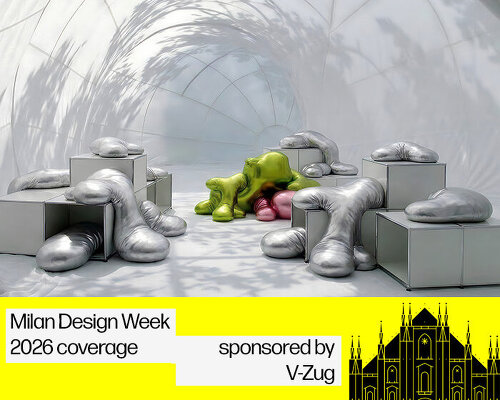
renaissance of the real: an ethereal landscape in milan
Snøhetta partners with USM Modular Furniture to create Renaissance of the Real, an otherworldly installation during Milan Design Week 2026. It unfolds in the garden of Fondazione Luigi Rovati as a lightweight space that frames the relationship between structure, body, and perception.
The project reads as a constructed landscape. From the exterior, USM’s familiar grid extends across the lawn in low platforms and open frameworks, its green panels catching filtered light beneath the trees. These modular volumes act as a permeable scaffold that organizes movement and allows the garden and surrounding architecture to show throughout.
images © Snøhetta
usm’s framework holds something softer
A large white form is designed by the architects at Snøhetta as a textile membrane that swells and compresses gently, and is held in place by the rigid logic of the USM Haller system. The contrast is immediate and legible. Steel lines define edges and thresholds, while the inflated volume resists geometry, pushing outward in smooth, continuous curves. The installation builds tension between these two conditions without forcing a resolution.
The USM system, developed over decades as a language of modular precision, shifts here from furniture to spatial infrastructure. It becomes a frame that supports and reveals, extending beyond storage into a role closer to architecture. According to the project material, the grid acts as a structural skeleton for the soft enclosure, creating a condition where engineered order and physical softness coexist within the same field.
Renaissance of the Real unfolds in the garden of Fondazione Luigi Rovati in Milan
moving from garden to interior
The approach by Snøhetta and USM into the Milan installation is gradual. Visitors move across the lawn, through the open grid, and toward an entry that compresses slightly before opening into the interior volume. This transition is handled with restraint. There is no abrupt threshold, only a shift in light, acoustics, and material feedback.
Inside, the atmosphere changes completely. The textile surface diffuses daylight into a soft, even glow, while shadows of surrounding trees register as slow, moving patterns across the curved walls. The floor and seating elements are arranged using modular blocks, echoing the external grid but softened by the environment. Inflated forms in metallic finishes rest across these surfaces, their weight suggested through gravity and contact rather than mass.
the USM modular grid extends across the lawn as a low open framework
snøhetta tunes perception through material and sound
The spatial sequence is designed by Snøhetta and USM as a recalibration of attention for visitors during Milan Design Week. Light is filtered, sound is subdued, and surfaces invite touch without directing behavior. The experience remains open-ended, yet highly controlled in its environmental parameters. According to the press material, the installation integrates subtle sound frequencies, scent, and tactile cues to draw focus back to the body and its immediate surroundings.
Daily vinyl listening sessions introduce another layer to the space. Hosted within the installation, they bring analog sound into a context shaped by softness and enclosure. The presence of recorded music on physical media reinforces the project’s interest in tangible experience. It situates listening as a spatial act, tied to acoustics, proximity, and shared presence.
a large white textile volume expands within the rigid steel structure
balancing system and atmosphere
Snøhetta’s role becomes clear in how the installation is choreographed across scales. The project operates simultaneously as an object in the garden and as an interior environment. Circulation, compression, and release are handled with a consistency that links the exterior grid to the interior volume without flattening their differences.
Anne-Rachel Schiffmann describes the USM grid as both a framework and an invitation, one that filters the outside world and draws attention inward toward light and proximity between people. That reading aligns with the way the installation performs in space. The grid never closes itself off. It remains open, allowing the softer interior condition to stand out through contrast.
the installation contrasts precise modular systems with soft inflated forms
modular seating echoes the exterior grid in a softened spatial condition
analog vinyl sessions reinforce the focus on physical presence
project info:
name: Renaissance of the Real
architect: Snøhetta | @snohetta
brand: USM | @usmmodularfurniture
dates: April 20th — 24th, 2026
designboom’s milan design week 2026 coverage is supported by V-ZUG. fueled by a share curiosity, we join forces to explore the hidden exhibitions, must-attend talks, and standout installations that define this year’s landscape. this collaborative lens includes a deep dive into table rituals—a poetic installation about innovation that places the human at the center. discover a space where everyday rituals take centerstage at V-ZUG studio milano at piazza san marco 4.
The post oozing inflatables shape this modular milan installation by USM and snøhetta appeared first on designboom | architecture & design magazine.