
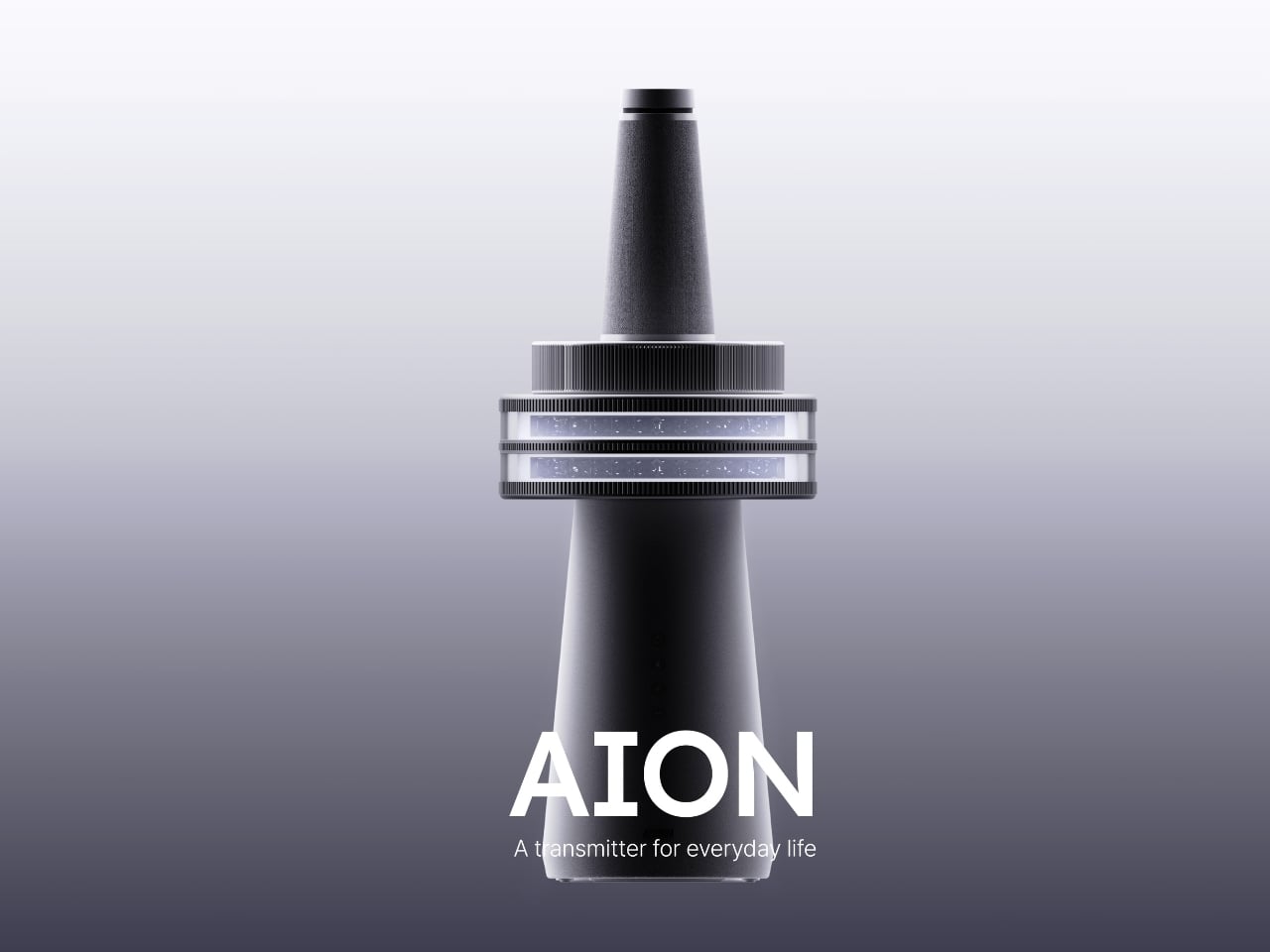
Namsan Tower stands at the center of Seoul like a declaration. It doesn’t just sit on a hilltop watching over the city; it has always been a transmitter, physically sending signals outward to every corner of a metropolis that never slows down. For most people, it’s a tourist destination, a date-night landmark, the place you go to lock a padlock and feel poetic about love. But for Juhyun Lee, a design student at Hongik University, it was a brief. A very interesting brief.
AION is Lee’s concept for an AI assistant device, and the connection to Namsan Tower isn’t decorative or coincidental. The tower’s original function as a broadcast tower, a structure purpose-built for transmitting information across an entire city, is the actual design philosophy behind it. Lee took that idea and scaled it down: what if a single object on your kitchen counter, or your desk, or your bedside table, could do something similarly intentional? Not just respond to commands, but transmit meaning through light and sound in a way that actually fits how you live? That question is what makes AION more interesting than the average concept speaker.
Designer Name: Juhyun Lee
The device combines speaker and lighting functions, but the point isn’t really the hardware. The point is how it communicates. AION is designed to provide context-aware information, meaning it adapts to what you actually need in the moment rather than just playing music until you ask it something. In a design landscape crowded with smart speakers that are essentially cylinders with microphones, a concept that thinks about situational awareness and ambient communication feels genuinely worth the attention.
Light as a communication tool is an underused idea in home technology, and it puzzles me that more designers haven’t pushed harder here. We’re surrounded by screens that demand our eyes, and speakers that demand our ears. The quiet alternative, light that shifts and signals without interrupting you, is something AION seems to understand. There’s a reason we find a lamp calming and a notification alarming. The difference is mostly about how information reaches us, not what the information actually is.
The name AION is borrowed from Greek, where it carries meanings of “age” and “eternity,” a word associated with cyclical time and continuity rather than a single moment. That choice doesn’t feel arbitrary. A tower that has broadcast through decades of a city’s history, and a home device designed to integrate into the ongoing rhythm of daily life, share a certain kind of permanence in their logic. They aren’t built for a single interaction. They’re built to always be there, doing their job quietly in the background.
What’s refreshing about Lee’s approach is the restraint. Concept design can easily become an exercise in maximalism, stacking features and rendering a product that looks cinematic but has no real relationship to how humans actually use things. AION doesn’t appear to fall into that trap. The Namsan Tower reference isn’t about aesthetics alone; it’s a framework that disciplines the design. You start with a clear function, a clear reason for existing, and you build outward from there.
Hongik University has produced a lot of notable designers over the years, and Lee’s project earns its place in that tradition not because it’s technically revolutionary, but because it’s conceptually coherent. The thinking is visible. You can follow the logic from inspiration to outcome, and that kind of transparency in a design brief is rarer than it should be.
Whether AION ever moves past concept stage is probably the wrong thing to focus on. The more useful takeaway is what it suggests about the future of AI devices in general: that the most compelling ones won’t necessarily be the smartest or the loudest, but the ones that know when to speak in light instead of sound, when to blend into the room, and when to make themselves known. Seoul’s tower has been doing exactly that for decades. Someone just finally took notes.
The post A Seoul Design Student Built an AI Speaker Around Namsan Tower first appeared on Yanko Design.