FRANKFURT REGION GETS GERMANY’S FIRST WORLD DESIGN CAPITAL TITLE
In 2026, Frankfurt RheinMain will not just host a design festival, it will function as a regional laboratory for civic agency. Awarded by the World Design Organization (WOD), the region is the first in Germany to hold the title of World Design Capital (WDC). Moving beyond the traditional understanding of design as mere styling, the initiative treats design as a social glue meant to bridge the gap between bureaucratic administration and civil society. Under the guiding vision ‘Design for Democracy. Atmospheres for a better life,’ the program activates a region of 5.8 million people through up to 2,000 events and 450 projects.
‘We understand design not as a passive product to be consumed, but as an active dialogue. Our DNA is about involving people so they don’t just ‘attend’ an event, but literally take part in shaping it. We move from ‘styling’ to ‘self-efficacy,’ opens Kai Rosenstein, Chief Experience Officer of ‘WDC’ 2026, the conversation with designboom on the vision behind the World Design Capital year.
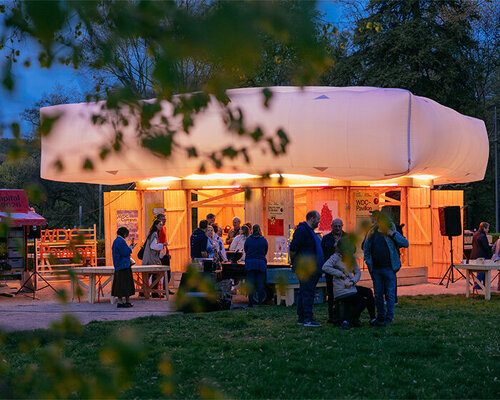
impressions from the soft opening of ‘WDC’ Pavilion | image © Ben Kuhlmann
A DESIGN FESTIVAL TURNS INTO A COLLABORATIVE ECOSYSTEM
The project is jointly financed by the State of Hessen, the City of Frankfurt, and the Frankfurt RheinMain Cultural Fund, reflecting a unique cooperation of 31 cities and counties. This organizational structure allows the WDO team to move away from top-down curation toward a model where local stakeholders define their own challenges. Viewing these municipalities as active laboratories rather than just venues, the program ensures that design methodologies are used to solve real-world problems faced by residents daily.
‘True participation begins when we stop merely asking people for their opinions and start treating them as co-creators. It’s about building a shared regional identity through ‘doing.’ By fostering transdisciplinary networks, we ensure that the lived expertise of residents directly informs the planning processes, turning the entire region into a collaborative ecosystem,’ explains Barbara Lersch, Chief Programme Officer of WDC 2026.
Lantern Festival presented by the German Architecture Museum (DAM) at Frankfurt’s Paulsplatz | image © Ben Kuhlmann
‘DESIGN FOR DEMOCRACY’ – A COLLABORATIVELY DEVELOPED PROGRAM
The program of WDC 2026 is structured as a year of experience, anchored by signature formats that create diverse platforms for networking and co-creation. At the heart of this regional activation is WDC Hub at the Museum Angewandte Kunst in Frankfurt, which functions not just as a gallery, but as a starting point for visitors to engage with design as a social practice. This approach is echoed in WDC Pavilion, a mobile meeting point that tours cities like Wiesbaden and Darmstadt to host site-specific workshops and participatory interventions.
‘Every physical space we activate acts as a prototype for communal living — moving away from mere transit zones toward a modern ‘Agora’ where people feel a true sense of belonging and agency,’ states Lersch, explaining how these activated physical environments foster agency.
AGORA Roundtable – Empowering the redesign of work-life spaces | image © Hessen Design
The dialogue turns to the region’s intellectual and industrial backbone during WDC Campus, which connects 25 universities to tackle issues like climate change and social justice through design. Lersch emphasizes that this format is critical for dismantling rigid educational silos:
‘For us, ‘lifelong learning’ means that education becomes an integrated part of everyday life. By designing spaces that encourage intergenerational exchange and treat failure as a necessary part of the creative process, we replace the fear of mistakes with the joy of shaping and designing one’s own environment.’
student project ‘Parking Garage’ by Ruonen Wang and Moritz Maier
This educational shift is complemented by June’s ‘Future Cycles’ theme and the Open – Design Week, where the region’s powerful industrial sector opens the doors to reveal design as a driver of economic resilience. Kai Rosenstein explains that this industrial engagement is a strategic necessity for the future:
‘Industry leaders already know we must operate within planetary boundaries. The question isn’t ‘if,’ but ‘how.’ Design is the bridge that moves innovation from the lab to the market. Take our region’s startups, like the one in Darmstadt developing bio-based leather: this isn’t just eco-friendly; it solves a massive resource problem for the automotive industry. Responsible design is a form of risk management against supply chain fragility and resource scarcity. There are several ‘Hidden Champions’ from various industry sectors in the region that show design isn’t just about the surface — it’s about circular processes and lean services that make a company future-proof and resilient.’
‘how to design a revolution’ exhibition | image © Pep Herrero and Disseny Hub Barcelona
Every element of the extensive WDC program year is assigned to one of five thematic focus areas. Each theme takes centre stage during specific months, together forming the narrative thread that runs through the year: Shaping Living Environments Together, Rethinking Learning, Exploring Design, Future Cycles: Design, Crafts and Industry, Engaging all the Senses and Design in Dialogue: in Politics and Society. From the Floating Space exhibition ship on the River Main to the concluding Policy Days, which will present a formal ‘Design Action Plan’ at St. Paul’s Church, the year ensures that the ‘Design for Democracy’ theme translates into a permanent legacy for Frankfurt RheinMain.
‘By the end of the year, I want residents to feel a sense of ‘Zukunftsmut’ — the courage and confidence to face change. I want them to feel that transformation isn’t something that happens to them, but something they can actively co-create. We are institutionalizing design as a permanent lever for regional development. The ‘WDC’ 2026 title is the spark, but the legacy will be a region that functions as a collaborative network, where ‘participation’ is no longer a project, but a shared regional identity,’ concludes Rosenstein.
‘A sky full of hope’ installation by Janet Echelman | image © Atelier Markgraph / Studio Echelman
views of the Mishpocha exhibition at the Jewish Museum Frankfurt | image © Ben Kuhlmann
a social interactive arena for design enthusiasts inside WDC Hub at the Museum Angewandte Kunst Frankfurt
World Design Capital 2026 at El Barrio festival | image © Ben Kuhlmann
public-space exhibition showcasing the reconstruction of Frankfurt’s Old Town | image © Uwe Dettmar
a street festival in the Bockenheim district of Frankfurt | image © Ben Kuhlmann
project info:
name: World Design Capital Frankfurt RheinMain 2026
organization: World Design Organization | @worlddesignorg
theme: Design for Democracy. Atmospheres for a better life
The post design for democracy: how world design capital frankfurt rheinmain activates civic agency appeared first on designboom | architecture & design magazine.