I’ve surprised myself at just how much you can still do with something as simple as paper.
Marion Eichmann
German paper collagist and sculptor Marion Eichmann is an artist in the truest sense of the word. The sort who radiates a limitless drive to build worlds and create in many forms with their hands; the sort who simply always knew they’d be an artist, and thank God for that.
Stacked from 6 images. Method=B (R=8,S=1)
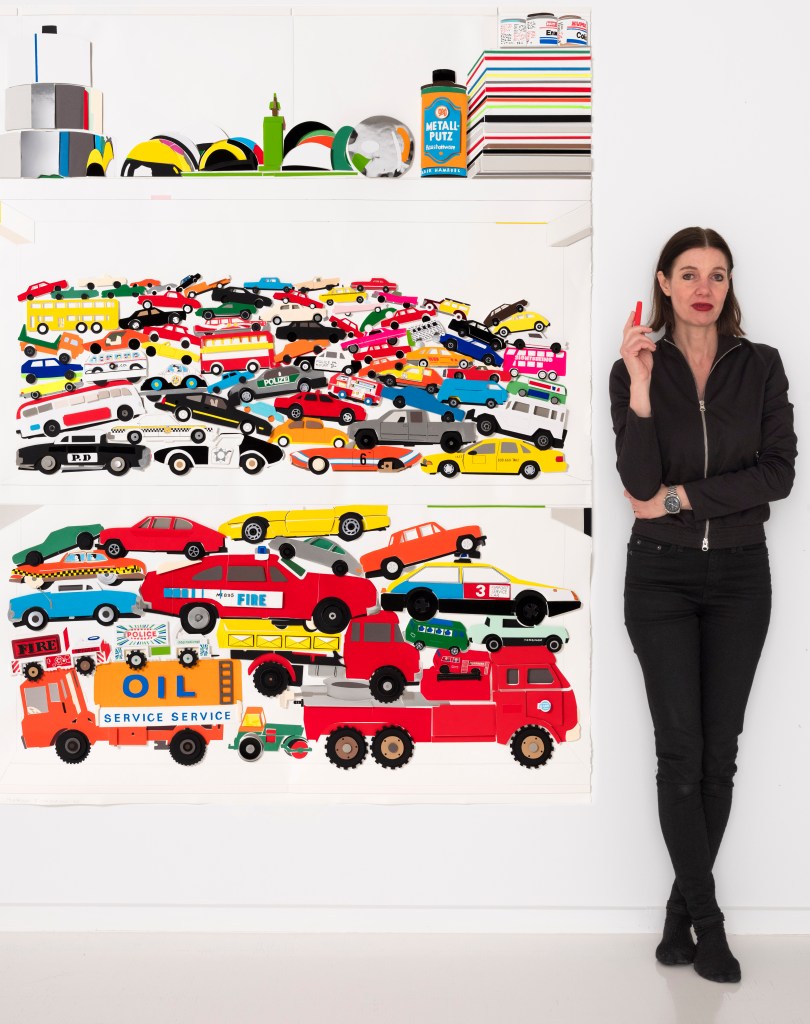
Car Collection Shelf, 2026
Eichmann lives and works in Berlin, making a name for herself for her master’s dissertation entitled *Maschen* (2002), which was a space she created entirely knitted together with everyday objects. The acclaim she received for this project earned her residencies around the world, including in Tokyo, New York, and Istanbul.
Since then, Eichmann’s distinctive and immersive sculptures, spatial installations, and drawings have been featured throughout the art world internationally, within group exhibitions and solo shows, as well as in public and private collections. In 2021, she was invited to develop works for the German Bundestag. This resulted in a one-year project in which she explored the spaces and architecture of the Bundestag buildings in the 110 pieces she build by hand, some of which are still on display. Most recently, in 2024, Eichmann was invited to take part in two exhibition projects for the European Capital of Culture Salzkammergut.
Left: Blumen in gelber Vase, 2025
Eichmann has turned her art practice into a style and genre all its own, and has deservedly been heralded for her uniquely graphic works. Through striking use of bright colors within the starkness of black and white spaces in much of her work, Eichmann has developed a distinct perspective throughout her career and continues to impress with her fine art work and brand collaborations.
She reflects on her journey, practice, and love of paper below.
Can you tell me a bit about your artistic background? Your career to date
I’ve been painting and drawing for as long as I can remember. By the age of three, I already knew I was going to be an artist. Whether at school, at home, or whilst traveling—painting and drawing have always been the most natural thing in the world to me. As a child, I travelled the world a lot with my parents; I didn’t go to school for two years, I captured everything I saw in drawings. I “drew” many diaries, rather than writing them.
By the age of three, I already knew I was going to be an artist.
I then went to Berlin and initially studied textile and surface design at the Weissensee Academy of Art, only to realize that I just wanted to do my own art. My final project was a room that I knitted, complete with furniture and myself. That immediately attracted a lot of attention, and I was then invited to Tokyo by Issey Miyake. But even there, I’d rather do my own thing than work for his studio.
In Tokyo, I started drawing and making collages again. Then later when I was in Istanbul and New York, I created more city series.
Eichmann creating a room installation in Tokyo
In your own words, how would you describe your artistic style or aesthetic? How did you develop your own style in illustration and sculpture?
I’ve never really asked myself that question, I’ve simply always followed my own interests. In doing so, I seem to pay particular attention to details and bold colors, which I then try to balance in my pictures.
Eichmann’s studio
Eichmann’s studio
I always start with something I’ve seen. I’m always thinking about how I can bring that to life using the tools at my disposal. That could be anything from a yellow bin to a few flowers or a toilet window with lace curtains, which can be quite amusing to me. I also always need something of a challenge, which usually involves a lot of effort and hard work. That’s how I ended up spending a year touring the Bundestag at their invitation, taking everything in and incorporating it into my work.
What’s most important to me though, is that, in the end, something emerges that radiates and shines on its own and stands on its own merits.
Chantelle 2 teilig, 2024
What are the main inspirations and influences that have shaped your artistic vision?
I respond very directly to what I see and how I perceive the world around me. That is my inspiration. There have been many other artists who have probably felt the same way. But I’ve always been interested in design as well. Design, fashion, graphic design and architecture are also things that I respond to.
Hermès Artist Window
What exactly is it that you like so much about working with paper? What does paper allow you to do that other media cannot?
I see paper as one possibility among thousands when it comes to making art. I came to it through drawing. So it was natural for me to also understand paper itself as a material. Initially, this was drawing and collage. Nowadays, I mostly use paper in a spatial, relief-like way. I also incorporate the frame, which is unavoidable in works on paper. These are mostly the pieces where I have directly recreated an object. This went so far that I recreated an entire laundromat 1:1 as an installation, with the rows of washing machines formed from individual framed collages.
I keep coming up with new ideas for how to create things using paper. It’s an ongoing process.
Through the work itself, I keep coming up with new ideas for how to create things using paper. It’s an ongoing process. There are some works where I started by cutting out the lines of the drawing and then loosely attaching them to the same drawing so that they stand out in relief.
I’ve surprised myself at just how much you can still do with something as simple as paper.
The post Marion Eichmann’s Love of Paper is an Ongoing Process appeared first on PRINT Magazine.