
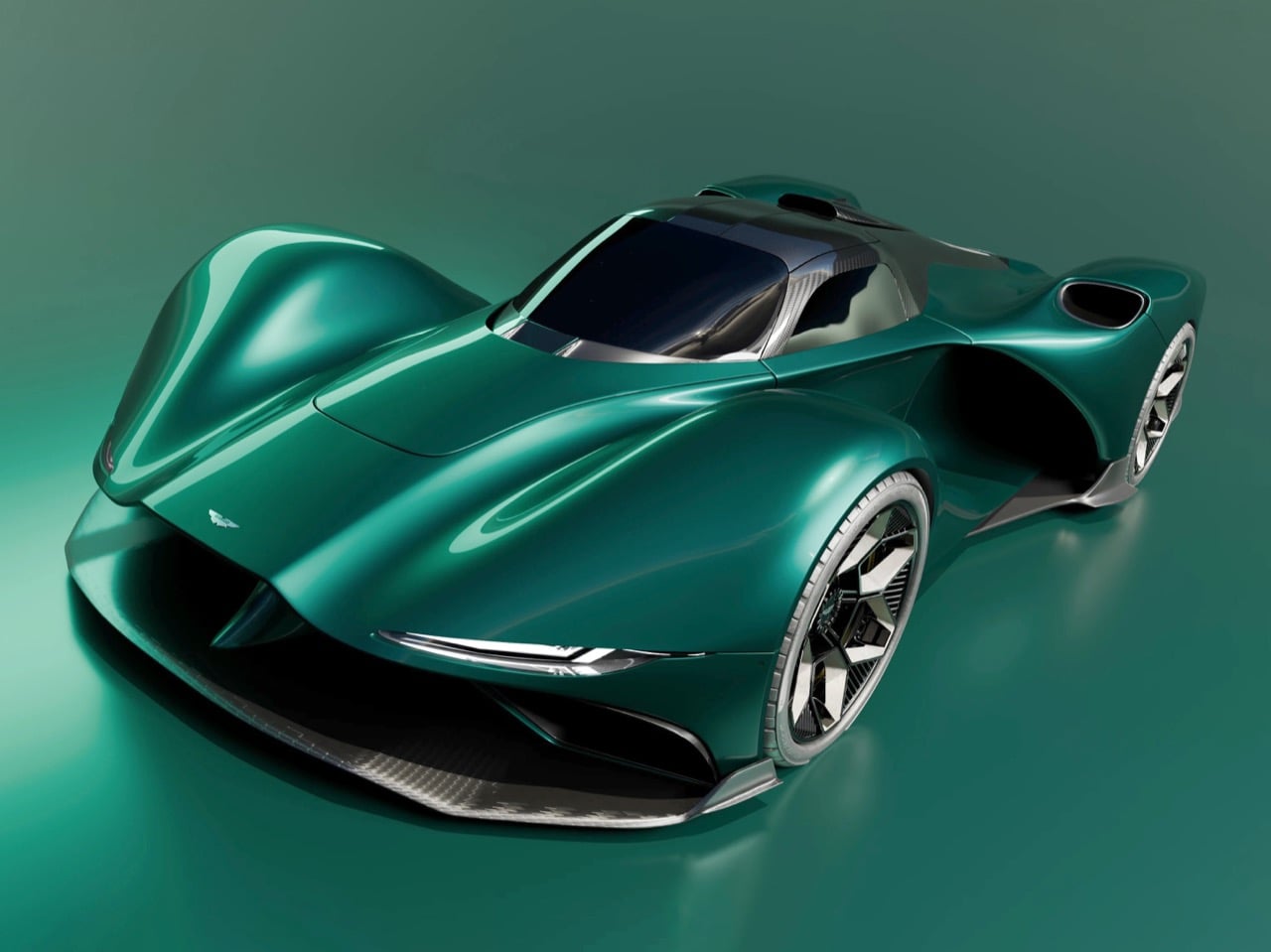
Aston Martin’s hypercar trajectory over the past decade has followed a clear arc: the Valkyrie brought F1 aerodynamics to road car design, the Valkyrie AMR Pro pushed that concept to track-only extremes, and the Valhalla promised a more accessible (relatively speaking) interpretation of the same philosophy. Hyunwoo Kim’s Veil concept asks a different question entirely. What if you took that same performance intent but wrapped it in surfaces that flow like liquid metal rather than faceted carbon fiber? The result is a hypercar concept that trades the Valkyrie’s angular muscularity for something closer to organic sculpture, where every surface transition happens so smoothly you’d need calipers to find the break points. The teal paint, a near-perfect match for Aston’s current F1 team livery, catches light like water, emphasizing the continuous curves that define the entire form language.
Kim developed the concept through an unusual process that started with paper mock-ups, physically exploring three-dimensional forms before committing to digital modeling. The approach paid off in ways that pure CAD work rarely does, producing proportions and surface relationships that feel discovered rather than designed. From above, the Veil reads like a manta ray or a fighter jet, with massive rear fender volumes extending from a central spine that bisects the cockpit. The track photography showing the concept alongside Aston Martin F1 team members suggests this caught someone’s attention at Gaydon, which makes sense. This is the kind of design exploration that belongs in a manufacturer’s advanced studio, where production constraints can be temporarily suspended in service of pushing the brand’s visual language into new territory.
Designer: Hyunwoo Kim
The cockpit architecture is pure Le Mans Hypercar, with a central spine running the length of the cabin that appears to house structural elements while creating a visual separation between driver and passenger space. The canopy looks like a single piece of formed glass, which would be a nightmare to federalize but makes perfect sense for a track-focused prototype where visibility and weight reduction matter more than crash regulations. That spine continues rearward past the cabin, creating a vertical stabilizer element that would provide high-speed stability without the drag penalty of a traditional rear wing. It’s smart aero thinking disguised as sculptural drama.
The rear fender volumes are doing the heavy lifting here, both literally and aerodynamically. They’re not just aesthetic flourishes but functional channels that guide air along the body sides and over the rear diffuser, creating the kind of ground-effect downforce that current regulations are pushing Le Mans prototypes toward. The negative space carved between those fenders and the central body creates tunnels that would accelerate airflow underneath the car, feeding the diffuser with high-velocity air for maximum suction. You can see diffuser strakes underneath, multiple elements suggesting active management of that airflow to prevent stall at different speeds and ride heights.
From above, the silhouette becomes even more dramatic. A central spine runs from the nose through the cockpit and terminates at the rear, bisecting the car into two distinct halves. This isn’t purely stylistic theater. That spine likely houses a vertical stabilizer fin, the kind of element you’d find on the Valkyrie AMR Pro or the Mercedes-AMG One, designed to provide high-speed stability without the drag penalty of a massive fixed rear wing.
The front end is deliberately minimal, almost to the point of being featureless. There’s no traditional grille, because there’s likely no traditional front-mounted radiator. Cooling has been pushed to the side intakes, which are substantial enough to handle serious heat rejection from what would presumably be a mid-mounted hybrid powertrain. The headlights are slim horizontal elements that emphasize width rather than aggression, a departure from the angry-eye aesthetic that dominates the current hypercar segment. It’s a more mature approach, one that prioritizes visual cleanliness over intimidation.
The diffuser dominates the rear view, with multiple vertical strakes channeling air from underneath the car. This suggests the Veil relies heavily on ground effect for downforce, using the floor as a giant wing to generate vertical load without the drag penalty of traditional aero elements. It’s the same philosophy underpinning the current generation of F1 cars and Le Mans prototypes, where managing airflow underneath the car has become more critical than what happens above it. The exhaust outlets are integrated into the diffuser structure, which is both aesthetically cleaner and functionally smarter than the typical quad-pipe arrangements you’d find on a Lamborghini or Pagani.
What makes the Veil genuinely compelling is how it navigates the tension between heritage and innovation. Aston Martin’s design language has always leaned heavily on elegance, even when building something as unhinged as the Valkyrie. The Veil preserves that elegance while acknowledging that the next generation of hypercars will be shaped more by aerodynamics and electrification than by nostalgic callbacks to DB5s and vintage racers. The form is contemporary without being aggressively futuristic, a balance that’s harder to strike than it looks. If Aston’s internal advanced design studio isn’t already exploring something similar, they should be.
The post Aston Martin Veil Concept Reimagines What Comes After the Valkyrie Hypercar first appeared on Yanko Design.