
paf atelier turns cinema into an introspective environment
At Milan Design Week 2026, designboom collaborates with Paf atelier to present Cinema of Dreams inside the ROOM FOR DREAMS takeover at ME Milan Il Duca. Conceived by Christopher Dessus and his studio, the installation frames cinema as an environment where space becomes the medium through which images, bodies, and imagination intersect.
Paf atelier constructs what Dessus describes during our conversation as ‘a space of dreams,’ a place where visitors can ‘be in connection with the ideas’ and reflect on ‘the optimism and the new possibility of the new generation.’ Anchored within the intensity of Milan Design Week, the project introduces a more introspective rhythm, inviting audiences to pause. Cinema, in this context, becomes a tool for mental projection. It is less about consuming content and more about creating the conditions to engage with it differently, aligning with the broader ROOM FOR DREAMS framework that treats imagination as a catalyst for cultural transformation.
‘I’m dreaming all the day but not all the night,’ the French designer reflects, linking his creative process to a continuous act of projection. This mindset ultimately defines the installation, which treats design as a way of making ideas tangible. ‘My job is to create a new dream for people,’ he tells us. In Milan, that ambition takes the form of an immersive capsule that resists spectacle in favor of presence.
images © designboom, photography by Camilla Mansini with Giorgio Gagliano
a dark, disorienting interior invites visitors to slow down
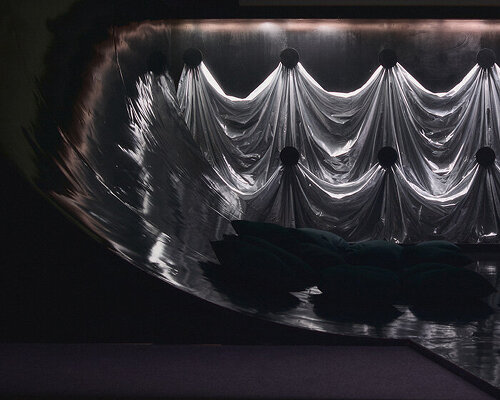
Inside the Cinema of Dreams, reflective fabric is stretched and gathered into rhythmic drapes, pinned by circular nodes that pull the material into soft, wave-like formations across the walls. The liquid-looking surface catches light in shifting gradients of silver and blue while dissolving the room’s boundaries. A curved floor extends this language, scattered with cushions that invite the body to recline directly within the scenography.
‘The circle, the curtains and the waves are the only ingredients of this project,’ Dessus tells designboom, emphasizing a deliberate reduction of elements. For the Paris-based studio, clarity emerges from precision. ‘Just one form expresses the concept of the project,’ the designer explains. This minimal vocabulary is paired with an equally restrained material approach. ‘We want to create a space without too many materials,’ the designer continues, framing the environment as a continuous surface rather than a composition of parts.
Entry into the Cinema of Dreams is intentionally destabilizing. ‘When people first enter the cinema, there’s a sense of disorientation,’ Dessus notes. The darkness delays immediate comprehension, requiring time for the eyes to adjust and for the body to settle. ‘It’s very dark, very cozy… and after a few minutes you can see each other,’ he says, highlighting a gradual shift from disorientation to awareness. This temporal unfolding becomes a key design tool, encouraging visitors to remain within the space rather than move through it quickly. ‘It’s not about moving through quickly, it’s about pausing and taking a moment.’
At the core of the project is a spatial ambiguity between seating and projection. ‘The seat and the screen are in the same form,’ Dessus explains, dissolving the conventional hierarchy of cinema. Instead of facing the image, visitors inhabit it. This physical proximity reframes the act of watching. ‘It’s not just in your mind, it’s also physical,’ he adds, describing the installation as a paradox where tangible forms host immaterial experiences. Dreaming, here, is not observational but embodied, ‘not to watch the dream, but to be inside the dream,’ as Christopher Dessus mentions.
the curved, enveloping architecture creates a cocoon-like space
dreaming as production, not escape
For Dessus, the notion of dream extends beyond atmosphere into method. ‘A dream is not to create the impossibility but all the possibilities to create something new,’ he shares with us, positioning imagination as a productive force.
This perspective is embedded in the studio’s broader practice, which operates across architecture, scenography, and design. Rather than decoration, the work aims ‘to create a new energy together with good people,’ where ‘emotions and forms’ are brought into alignment.
Developed as a first collaboration between Paf atelier and designboom, the Cinema of Dreams emerges as a space for collaboration and encounter, an ‘idea to collaborate and meet people,’ as Dessus puts it, rooted in optimism and openness.
Within the wider program of screenings, interviews, and discussions, the settings shape how content is experienced. As part of ROOM FOR DREAMS, it becomes ‘the beating heart’ of a temporary ecosystem, where moving images and spatial design converge into a unified narrative about creativity and possibility.
visitors inhabit the scenography directly
glimpses through thresholds frame the installation as a layered environment
visitors settle into the the dimly lit Cinema of Dreams
reflective drapery signals the transition into the cinematic environment
metallic drapery cascades in rhythmic folds
pillows scattered across the reflective floor invite prolonged occupation
seated viewers face the glowing screen as metallic folds catch and diffuse light
constructing a soft yet structured spatial environment
close-up of the suspended fabric system
Christopher Dessus, founder of Paf atelier
The Cinema of Dreams is free for all upon registration. Discover the day-to-day program in detail here, and RSVP to access the space here.
project info:
name: Cinema of Dreams
location: ME Milan Il Duca, Piazza della Repubblica, 13, 20124 Milano MI
dates: April 20–26, 2026 (public days: April 21-26)
opening hours: 10:00 – 20:00 daily
partners: SolidNature, Paf atelier, Ressence, La Marzocco, OPPO, INDX|GLOBAL
cinema partners: Louisiana Channel, 9sekunden, Bêka and Lemoine, Beatrice Minger & Christoph Schaub, and more
photographers: Camilla Mansini | @camillamansini with Giorgio Gagliano | @giorgiogagliano
This article is part of designboom’s Dreams in Motion chapter, exploring what happens when we treat our dreams and reveries as an active, radical rehearsal for impending material realities. Explore more related stories here.
The post at milan’s cinema of dreams, paf atelier immerses viewers in a suspended time capsule appeared first on designboom | architecture & design magazine.