
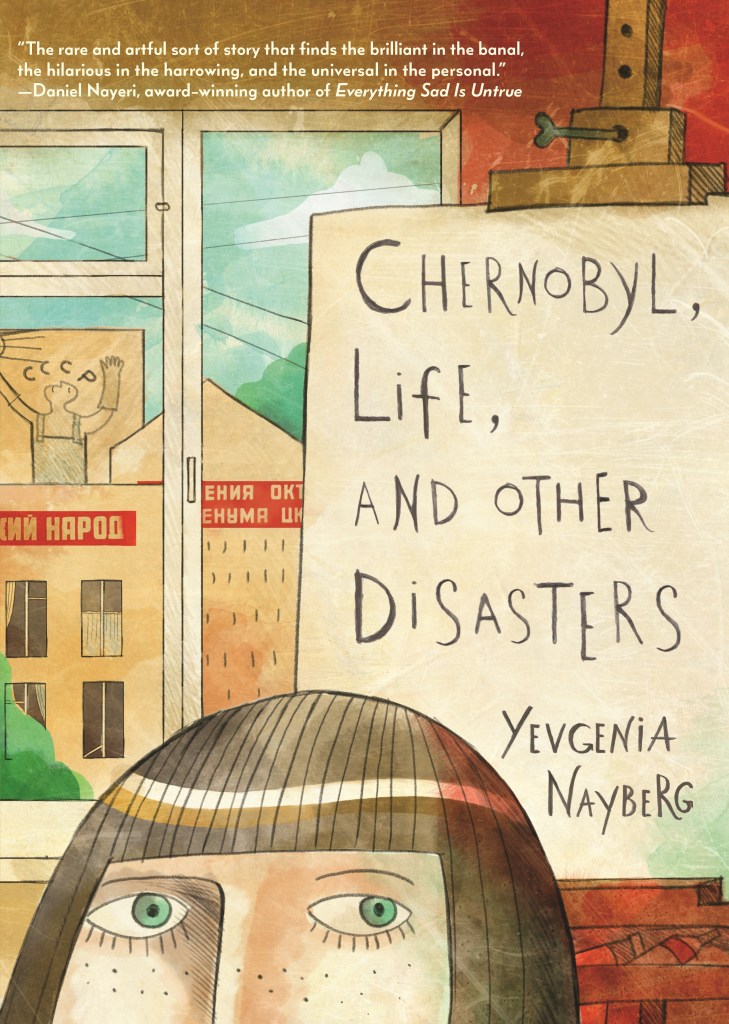
In Yevgenia Nayberg’s Chernobyl, Life, and Other Disasters, strong-willed Genya sets her mind to attending art school in Ukraine, amidst the turmoil of Soviet control, the Cold War and the unfolding Chernobyl nuclear disaster. Created in Nayberg’s strikingly unique art style, the deeply personal graphic memoir also offers a glimpse into broader Soviet intelligentsia experiences. Nayberg’s sly, sardonic sense of humor irresistibly permeates the story, making it impossible not to root for Genya and keep turning pages.
The middle-grade book is sure to give today’s tweens a window into what it was like growing up in such turmoil, and offer inspiration to persevere in the face of uncertainty. I am pleased to have this eloquent interview with Genya to start the week off on a pitch perfect note.
Yevgenia, I’m very engaged by the voice in which you tell your story and the beauty of the calming drawing style. There is an optimistic quality that belies the narrative to come. Did you struggle to find the best graphic voice to tell this harrowing memoir?
I did not consciously choose a style for the book—I sort of let it happen naturally. I have a playful hand as an artist to begin with, and the way I see the world is through an ironic lens. That seemed to fit well with the writing style. Or, perhaps, the other way around—I can’t tell anymore what came first!
I feel as though the arc of your story is written as a storyboard for animation. Did you have any such ambition?
I’ve done character and background design for animation, which I enjoyed a lot. I did get to spend some time at the animation studio where my mom worked, and I was always very interested in her process. As a kid, I loved seeing her storyboards, but I also loved reading what was called a “director’s script,” which contained all the visual notes that weren’t in the original script. I think this is when I started to learn how the text and the art complete each other rather than repeat each other.
The cityscape of Kyiv is so lovely, it is hard to imagine what’s happened since this time. Is it hard for you to revisit this through your work?
This awful war has been going on for over four years already. A part of me wants to contain how I feel, because I don’t want my heart to burst. But I can show how I feel through art, where Kyiv presents itself as this fairytale-like, magical city—half real, half imaginary. I’m looking at it as if it were someone I loved who has moved on. What I feel is a sort of limerence—that’s why it looks so unashamedly beautiful.
You were living in a tinderbox—how did you cope with Soviet society in relation to your art?
Most artists in the USSR could not stand the official government-issued art. We all tried to experiment as much as we could on our own, which, for many, meant never having a chance to show their work—or, worse, being prosecuted for it. That duality of life: Soviet Realism vs. underground art, literature and music was a normal part of our reality.
What was running through your mind when you were required to attend military training classes?
I was only 7! I just wanted the class to be over so I could go back to drawing, or reading, or playing with my friends. I don’t think any of us understood the context of what was happening. But I still remember the rubber smell of the gas masks.
Did you always feel out of place?
Yes, in a broader sense. But on the other hand, when I find my kindred spirits, I feel so incredibly joyful and connected. The beauty is in the contrast.
What did Chernobyl mean to you? Was it a portend of doom? After all, the government said, “The situation is under control.”
I remember the uncertainty about the future. We were all wondering what consequences the radiation exposure would have on us. For years, I wondered whether I’d be able to have children. Also, it was around then that I realized the official media could not be trusted. Obviously, most adults knew that all along. In that sense, it was my initiation into the complicated grown-up world.
How much was death part of your life? How did it influence your sense of existence?
Like most, I have lost people I loved, but I must admit, I have this ridiculous optimism about my own existence, as well as the completely unfounded hope that the best days of my life are still ahead of me.
The post The Daily Heller: Under a Cloud, Genya Tells All appeared first on PRINT Magazine.