
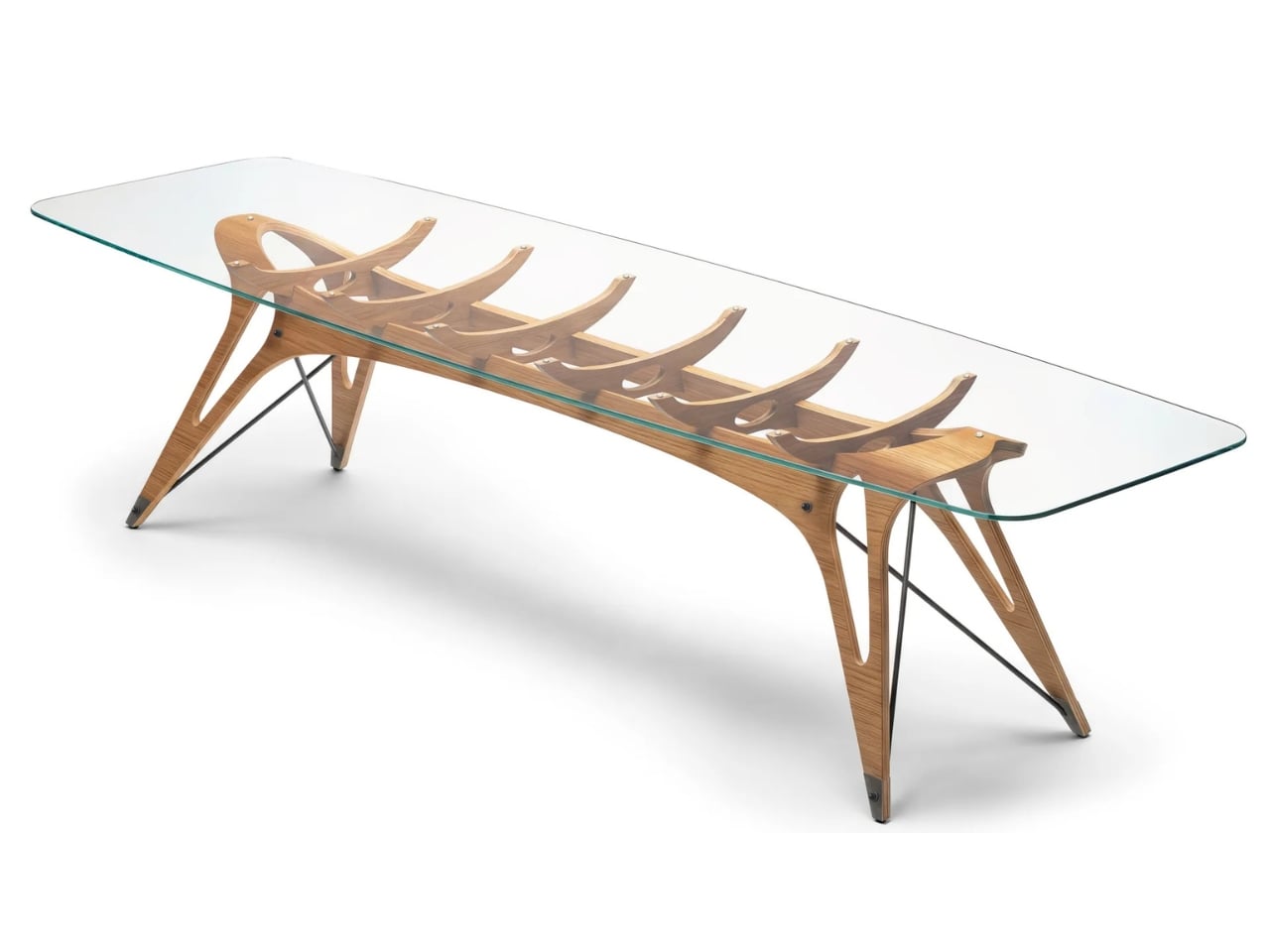
Some designs don’t age. They just wait. The Vertebra table by Carlo Mollino has spent the last 75 years doing exactly that, existing in the margins of design history as a tantalizing “what if.” Created in 1950, the piece was only ever realized in two physical examples, both of which eventually found their way to auction houses where collectors paid serious money to own a slice of Mollino’s particular brand of genius. The rest of us could only stare at photographs.
That changes this week. Italian design house Zanotta has acquired the Carlo Mollino archive from the Italian State through a public tender, securing exclusive rights to produce 30 of his designs. The first piece to come out of that deal is the Vertebra table, which is making its industrial production debut at Milan Design Week 2026. For anyone who follows design even loosely, this is a genuinely exciting moment.
Designer: Zanotta (Carlo Mollino)
If the name Carlo Mollino isn’t immediately familiar, here’s the short version: he was a Turin-born architect, designer, photographer, racing driver, skier, and aviation enthusiast who lived from 1905 to 1973 and made everyone around him look like they weren’t trying hard enough. He synthesized Expressionism, Futurism, Organicism, and Surrealism into a design language that felt simultaneously ancient and far ahead of its time. His furniture didn’t follow trends. It followed the human body.
That’s precisely what makes the Vertebra table so arresting. The name isn’t decorative. Mollino perceived furniture not as mere decoration, but as an extension of the body in motion, and the Vertebra’s sinuous, almost skeletal structure makes that philosophy literal. Its base is formed from a single continuous sheet of plywood that curves and flexes in ways that feel less like woodworking and more like anatomy. Look at it long enough and you start to see ribs, joints, a spine caught in mid-motion. It’s the kind of design that makes you forget you’re looking at a table.
The production history adds a certain poetry to the moment. Mollino spent much of his career working with a carpentry workshop in Turin to create pieces in limited runs, often for specific clients. The Vertebra was originally designed for the Lattes publishing house in Turin. That it never made it to industrial production during his lifetime is one of those quiet design world tragedies that don’t get talked about enough. His furniture was always collector territory, commanding extraordinary prices at auction and sitting in the collections of major design museums. Beautiful, but locked away.
What Zanotta is doing here feels like more than just a business move. By going through the Italian State, winning a public tender, and committing to serial production, they’re essentially arguing that Mollino’s work belongs to a wider audience. That’s a stance worth appreciating. Good design shouldn’t only exist in the hands of people who can afford auction house prices, and bringing a piece like the Vertebra into serial production opens up a real conversation about access, legacy, and what it means to steward a designer’s archive responsibly.
The unveiling at Milan Design Week is set within an immersive installation inside the Zanotta flagship store, where curtains fluidly define space and the organic forms of the human body serve as a visual reference. It sounds like exactly the kind of environment that would make Mollino feel at home. He was always staging things, always thinking about how space, form, and the presence of the body existed in relation to each other.
The broader archive Zanotta now holds includes tens of thousands of drawings, sketches, photographs, handwritten notes, and typed documents alongside those 30 production-ready projects. That’s a significant responsibility, and how they steward it over the coming years will say a lot about their real commitment to doing Mollino’s legacy justice. For now, though, the Vertebra is the headline. A table that waited 75 years to be made at scale, by a designer who saw furniture as something alive. It’s the kind of debut that reminds you why design history is worth paying attention to.
The post The Ghost of Carlo Mollino’s Best Table Has Finally Arrived first appeared on Yanko Design.