
the surreal cartography archive of writer ursula k le guin
At the University of Oregon, in the state where science-fiction writer Ursula K Le Guin called home at the end of her life, there is an archive of her work. Within it, there is a vast collection of maps that the author had created. Some are scribbles on a piece of 8.5 by 11-inch piece of paper. Others are scrawled over multiple sheets that need to be puzzle-pieced together. While they often contain traditional markers of land formations — a compass rose, mountains, waterways — they also contain more mythic symbols. There are instructions on how to depict a dragon. There’s a representation of a valley based solely on the relative position of talismans, or magical objects.
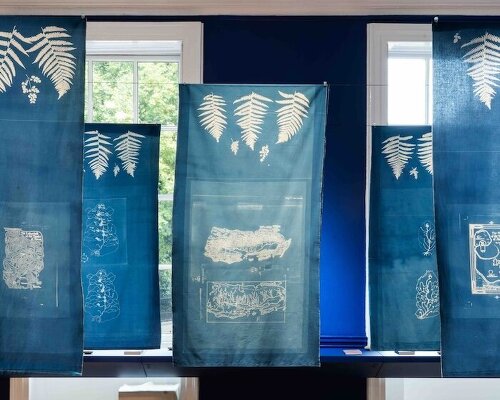
Fascinated by the existence of these maps, Sarah Shin and her co-editor, So Mayer, sought to create the book ‘The Word for World: The Maps of Ursula K Le Guin’, published in 2025 by Silver Press and AA Publications. It accompanied an exhibition at the AA School in London in the winter of 2025 which, together, brought to life the cartographic musings of the American science fiction writer. Through collected texts from philosophers, poets and Le Guin’s son himself, The Word for World uses these maps as a jumping-off point for the inquiry: What makes a map a map? And what could that mean for the place we call the world?
In conversation with designboom, curator Sarah Shin discusses her longtime affection for the writer, the creation of the text, and what there is to learn from Le Guin’s penchant for cartography.
all images by Elena Andreea Teleaga, courtesy the publisher
‘the word for world’ asks existential questions through maps
When asked about her initial encounter with the author, Shin recalls reading The Dispossessed when she was a teenager in her first years of university as an English literature major. She rolls off a line from the story that she has memorized verbatim. ‘To be whole is to be part; true voyage is return,’ she recites before adding the verbal asterisk of otherwise having a poor memory.
‘Le Guin does not do things in any sort of formulaic way,‘ Shin goes on to say about what continually attracts her to the writer’s oeuvre. ‘She constructs her world as places where she can explore things according to the rules of that world. So in that sense, it’s one of the varieties of science fiction, for sure. But otherwise, she’s not playing by any sort of tropes that would be carried over from our world, such as patriarchy.‘
portrait of Ursula K Le Guin
Sarah Shin and So Mayer unearth author’s dreamworld
From this interest sprang this project which takes its title from Le Guin’s 1972 book ‘The Word for World Is Forest’, which follows the colonization of the Asthe people. Shin explains how in the Asthean culture, the words for ‘forest’ and ‘world’ are one and the same. ‘There, the forest is not separate. It’s imbricated with the dreaming mind of the Athsheans, who are a dreaming culture. So that sort of that psycho-cosmological connection between the internal and the external, or the landscape and the psyche, is not just in this text, but explored elsewhere in her works.’
It’s this relationship – between a map and the land, representation and reality – is where ‘The Word for World’ sinks its teeth. Theo Downes-Le Guin, in his essay for the book titled ‘The Geography of Imagination,’ teases out his mother’s tricky relationship with abstraction. In conversation, Shin describes it saying, ‘I think that she was very suspicious of [it] in the service of capitalism and profit. And turning everything into a quantifiable measurement is part of this rational mindset that she is seeking to undo and unmake in, for example, [her essay] ‘A Non-Euclidean View of California as a Cold Place to Be.’ In her maps, I think that she’s instead interested in scale according to different metrics. For example, the talismanic map is emblematic of the ‘The Word for World’ show and book because of this direction of her thinking… The idea is that the elements of landscapes are their signs: the axes in the maps take landforms as their axes, almost reconnecting the relationship between reality and its representation, that abstraction severs.’
the book was accompanied by an exhibition at the AA School in London
exhibition in london sees map-making as a way to reframe reality
Ultimately, Downes-Le Guin reconciles map-making and all its needs for gaps in information as a form of imagination. ‘And within her imagination,’ he recounts, ‘Ursula carved out an exception for cartography – a form of symbolic abstraction, to be sure, but one that worked for her.‘
Speaking about how viewing these maps has changed her relationship with the writer, Shin goes on to say, ‘this is a side of her creative practice that really not many people know about. So it was wonderful to bring them to light, but it was a hobby for her. I think her enjoyment really comes across in the images as well… I’ve always loved how Le Guin describes writing as translating, asking ‘What is the other text, the original?’ Similarly, I think that drawing maps, for Le Guin, was a way of making visible what already exists elsewhere in the source: ‘the deep sea where ideas swim, and one catches them.‘
the book cover for ‘The Word for World: The Maps of Ursula K Le Guin’
Ultimately, the compilation of these works reveals another side of the author: an uncharted territory and working-through of her fantastic ideas. ‘So dreams were very much part of the thinking as a sort of counter to the usual rational function of maps.’ Shin says of how the maps and the writing converge and diverge in meaning, ‘To bring the unconscious together with the consciousness; and with the visibility of the maps, to also invoke what’s not present, emphasizing fluidity and metamorphosis and nature, because Le Guin’s worlds, a dream or a story, too, can be a map.‘
project info:
name: ‘The Word for World: The Maps of Ursula K Le Guin’
author: Ursula K Le Guin
publisher: Silver Press/Spiral House
editors: So Mayer and Sarah Shin
photography: Elena Andreea Teleaga, courtesy the publisher
The post mapping the dreamworld: inside ursula k le guin’s unseen cartographies of myth and mind appeared first on designboom | architecture & design magazine.