
CONTEMPORARY UZBEK CRAFT AT MILAN DESIGN WEEK 2026
During Milan Design Week 2026 the Uzbekistan Art and Culture Development Foundation (ACDF) presents Uzbek craft with the exhibition ‘When Apricots Blossom.’ Hosted at the prestigious Palazzo Citterio in Brera, the showcase offers a vibrant exploration around textiles, food and shelter of the Karakalpakstan region. Commissioned by Gayane Umerova (ACDF Chairperson) and curated by Kulapat Yantrasast (Founder of WHY Architecture), it unfolds as a reinterpretation of traditional heritage into contemporary design.
‘When Apricots Blossom’ main gallery at Palazzo Citterio | all images courtesy of ACDF
‘WHEN APRICOTS BLOSSOM’ BY ACDF
Named after a 1930’s poem by Uzbek playwright and literary scholar Hamid Olimjon – an ode to spring, optimism and possibility – ‘When Apricots Blossom’ traces a narrative of ecological legacy through craft and design in the Aral Sea region, which has lost 90% of its volume since the 1960s. Curator Kulapat Yantrasast, an architect who worked with Tadao Ando, describes Uzbek’s craft as a ‘living knowledge’, a form of material intelligence that channels memory across generations.
With this collaborative vision, part of the country’s long term commitment to revitalising the Aral Sea region, ACDF places Uzbekistan’s rich cultural heritage onto the global design map, bringing together twelve contemporary designers, including Bethan Laura Wood, Marcin Rusak, and Nifemi Marcus-Bello, to work alongside Uzbek artisans, strengthening the idea that design is an evolving process.
commissioned work by Studio CoPain
THE WORKS OF TWELVE DESIGNERS DECODE KARAKALPAK CULTURE
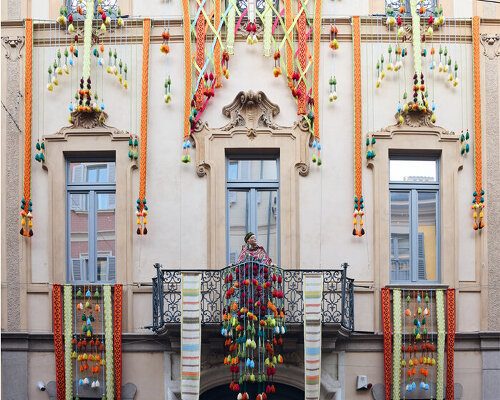
The exhibition at Palazzo Citterio explores Karakalpak culture through three powerful themes: textiles, food, and shelter. Kicking off the experience, visitors are welcomed by a vibrant tapestry crafted by Bethan Laura Wood in collaboration with Uzbek artisans, featuring hand-woven ribbons and tassels traditionally used to adorn nomadic yurts. The main gallery then unfolds the story of the Aral Sea, and the initiatives shaping its future. The Aral School, Aral Culture Summit and a specially commissioned film Where The Water Ends are presented within an undulating topography of reed-like rods that evokes the region’s landscapes, also designed by WHY Architecture.
Connecting the installation to everyday life, designers present custom-made bread trays and stamps (chekich), celebrating the essential role of bread (non) in Uzbek hospitality through intricate pieces made of wood, silk, felt, reed and ceramic. Finally, the historic garden hosts a gathering space inspired by traditional dwellings, a ‘deconstructed yurt’ designed by WHY Architecture, ensuring a contemporary take on artisanal construction. It will host the public program – a series of talks, workshops, guided tours – and special events throughout the week.
See the exhibition until April 26 at Palazzo Citterio in Brera during Milan Design Week 2026 or visit their Instagram account to stay tuned.
commissioned work by Sanne Visser
commissioned work by Sevara Haydarova Donazzan
artifacts selected by participants of the aral school
A Thousand Voices – When Apricots Blossom – by Ruben Saakyan and Roman Shtengauer
garden pavilion at Palazzo Citterio
garden pavilion at Palazzo Citterio
garden pavilion at Palazzo Citterio
cooking demonstration led by Bayrangul. video still from the film Where the Water Ends by Manuel Correa and Marina Otero 2026
Uzbek hand-weaving mat workshop in Nukus
creative collaborator Kulapat Yantrasast in Uzbekistan
Mazlumkhan Sulu Mausoleum, Mizdakhan Necropolis
Sirgabaeva Saxibjamal reads a poem by Berdaq. video still from the film Where the Water Ends by Manuel Correa and Marina Otero 2026
project info:
installation: When Apricots Blossom
foundation: Uzbekistan Art and Culture Development Foundation (ACDF) | @acdfuz | @uzbekistanmdw
design studio: WHY Architecture | @why_site
location: Palazzo Citterio, Brera
dates: April 20-26, 2026
The post when apricots blossom: twelve global designers show uzbek craft at palazzo citterio appeared first on designboom | architecture & design magazine.