
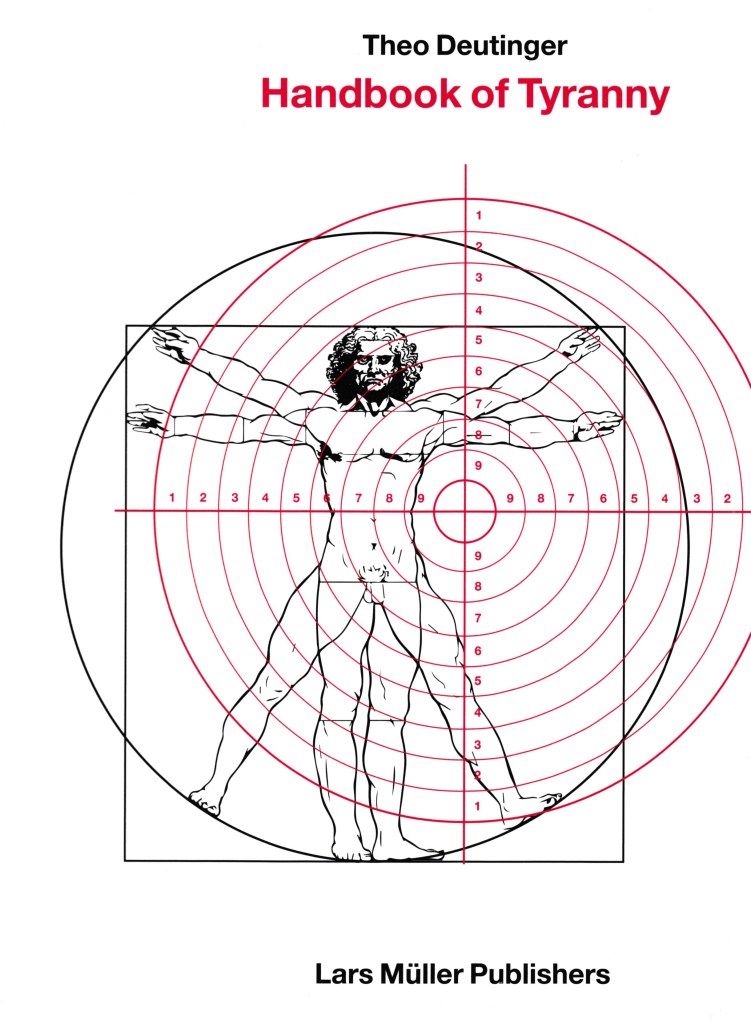
Tyranny exists everywhere. It is implemented in large and small doses by populist, autocratic and democratic leaders alike. The invocation of power is imbued in every system, state and nation that is concerned with keeping order regardless of what the intention of order may be. “For every obstacle to organizing and controlling society, there seems to be a technical solution at hand. The illustrated details—the sheer number and bluntness of these technologies—profoundly reinforce their cruelty,” writes Theo Deutinger, in the introduction to Handbook of Tyranny (Lars Müller, fourth edition).
I am embarrassed to admit that this book, which richly lays out the infrastructure necessary to maintain tyrannical power—as defined by such characteristics as crowd control, brutal architecture, demolition, refugee camps, walls, fences and impediments to free access and egress, prisons, etc.—has been sitting unopened on my pile for years since it was revised in 2023. It is one of the most important books of our current era, as it tracks with unerring exactitude all the tools required to enforce tyranny from top to bottom.
Fortress Tyranny exists today in Russia, Middle East, Africa, India and the United States. It is defined by the statutes, decrees, legal and extra-legal prohibitions that determine and enforce oppressive behaviors. Deutinger, an architect and developer of sociocultural concepts, and Brendan McGetrick, a writer, curator and designer of the book, have brought together the modern ideas of popular autocracy through visual data that digs deep into the gut of the Big Brother state.
Of the many insights related to establishing a concentrated perimeter to control people’s actions is the chapter “Green Fortress”—how nature is employed as offensive and defensive tools of tyrannical subjection. The section on “Vegetation” is particularly enlightening in illustrating the kinds of trees and bushes used for containment. For instance, “Prickly trees” are used to deter intruders from climbing and entering secure positions, while “Dense trees” are used to block access and hide property. When creating a fortress, as is common in tyrannical space, these details are important.
Crowd control is also of utmost importance. Where to deploy police, militia and military, and with what kinds of weaponry, is a design decision of great lethal consequence.
Walls, fences and gates are equally important for keeping potential enemies out of sensitive areas, as well as in. “Swarm intelligence, crowdfunding, crowdsourcing and crowd innovation are some of the keywords that promise economic and social progress, thanks to the bundling of the power of individuals,” writes Deutinger, about the alternative potential danger of massing groups. “Six people per square meter is the threshold at which bodies are jammed so tightly they begin to behave like fluid. Pressure waves can travel through them and they can lose control.” Yet, he continues, crowd control is often not as about preventing disasters as it is avoiding negative media coverage.
Deutinger does not spend all his attention on crowd control—although his diagrams of the various methods are among the most quietly powerful in the book. He devotes a chapter to prison cells and the design thereof to make incarceration useful for repressing dissent. He further points to a less overt symbolism: “The prison cell is a mirror of society,” he says. “From a cell’s size, amenities and maintenance, one can draw a direct conclusion about a country’s level of prosperity, democracy and humanity.”
Fences and walls are something Americans have debated and politicized for a long time. They are protective, exclusionary and philosophical. “The construction of a wall or fence between two countries is mostly based on fundamental economic and/or political differences,” Deutinger explains. He suggests unintended consequences: “The world’s most heavily guarded boarder is the demilitarized zone (DMZ) between North and South Korea. … The non-interference of humans has resulted in an inadvertent park which is not recognized as one of the world’s best-preserved natural habitats in the temperate zone.”
Handbook of Tyranny is instructive for what is taken for granted as obvious distinctions between dictatorship and democracy. What characteristics define each is clear but ambiguous, too. All nations use the same tools and materials to instill normalcy or foster disruption. So, in reading this book, the same designs in a police state may resemble designs in a free state. What is clear form Deutinger’s research is the natural similarity between all governments when it comes down to how to apply architecture and design to maintain control of a populace. Some are more repressive than others, and more violent toward their own or unwelcome visitors, but all have the same security toolkits. How they are used, whether or not they exist covertly or overtly, is the important thing. We are always on the edge of tyranny, and this book reveals how close to that edge we continue to be.
The post The Daily Heller: The One-Stop-Shop for Tyranny appeared first on PRINT Magazine.